Listening 2025-08 Test 3

شهر الامتحان: 2025-08

أُعيد بناؤه من ذكريات المتقدمين للاختبار — ليس مادة IELTS رسمية. الصوت والنصوص أُعيد إنشاؤها للتدريب.

الصوت المُعاد إنشاؤه

Section 1: Homestay Application

The housing officer takes some details from the girl. Complete the following form with NO MORE THAN THREE WORDS AND/OR A NUMBER for each answer.

PERSONAL DETAILS FOR HOMESTAY APPLICATION First name 1. _______ Family name Yuichini Gender Female Age 28 Passport number 2. _______ Nationality Japanese Course enrolled 3. _______ Length of the course 4. _______ Homestay time 5. _______
  1. 1

    First name 1. _______

  2. 2

    Passport number 2. _______

  3. 3

    Course enrolled 3. _______

  4. 4

    Length of the course 4. _______

  5. 5

    Homestay time 5. _______

Section 1: Family Preference

Mark TWO letters that represent the correct answer.

  1. 6

    Which kind of family does the girl prefer?

    • A. A big family with many young children
    • B. A family without smoker or drinkers
    • C. A family without any pets
    • D. A family with many animals or pets

Section 1: Personal Preferences

Fill in the blanks with NO MORE THAN THREE WORDS for each answer.

  1. 7

    Although the girl is not a vegetarian, she doesn't eat a lot of meat. Her favourite food is __________.

  2. 8

    The girl has given up playing handball. Now, she just plays __________ with her friends at weekends.

  3. 9

    The girl does not like the bus because they are always late. She would rather __________.

  4. 10

    The girl can get the information about the homestay family that she wants __________.

Section 2: Travel to Enzia

Complete the notes by filling in the blanks with NO MORE THAN THREE WORDS AND/OR NUMBER for each answer.

VISAS Now Eznina visas are needed by almost all nationalities. Normal visas last 11. __________ You need to pay 12. __________ for the visa. Price may change from time to time Some Enzian consulates in neighbouring countries require you to provide a letter to 13. __________ You can get information of major embassies on 14. __________ of the student handbook. If you want to re-enter Eznia, you must get a multi-entry visa. SOME MISCELLANEOUS GENERAL ADVICE If you carry a lot of money, you need to complete a 15. __________ Remember to declare all your items, especially expensive items, on a 16. __________ You are advised to carry a health certificate. The one you need is the 17. __________ NOTES FOR STUDENTS If you wish to get a youth fare card, you should show your 18. __________ Due to the bureaucracy in Eznia, you are advised to take at least 19. __________ passport photos with you. CURRENCY Pounds and US dollars are not very useful now in Eznia, so you should take 20. __________ or with you. Credit cards are not acceptable because of fraud scandals.
  1. 11

    Normal visas last 11. __________

  2. 12

    You need to pay 12. __________ for the visa.

  3. 13

    Some Enzian consulates in neighbouring countries require you to provide a letter to 13. __________

  4. 14

    You can get information of major embassies on 14. __________ of the student handbook.

  5. 15

    If you carry a lot of money, you need to complete a 15. __________

  6. 16

    Remember to declare all your items, especially expensive items, on a 16. __________

  7. 17

    You are advised to carry a health certificate. The one you need is the 17. __________

  8. 18

    If you wish to get a youth fare card, you should show your 18. __________

  9. 19

    Due to the bureaucracy in Eznia, you are advised to take at least 19. __________ passport photos with you.

  10. 20

    Pounds and US dollars are not very useful now in Eznia, so you should take 20. __________ or with you.

Section 3: Shopping Habits

Complete the sentences below. Write NO MORE THAN THREE WORDS AND/OR A NUMBER for each answer.

  1. 21

    The woman being interviewed is now working in the bank. Her occupation is __________.

  2. 22

    The woman usually spends about __________ when she goes shopping.

  3. 23

    The woman often goes to __________ because she finds them convenient.

  4. 24

    According to the woman, __________ is/are her most difficult thing(s) to buy.

Section 3: Shopping Amounts

Fill in the blanks with ONE WORD AND/OR A NUMBER for each answer.
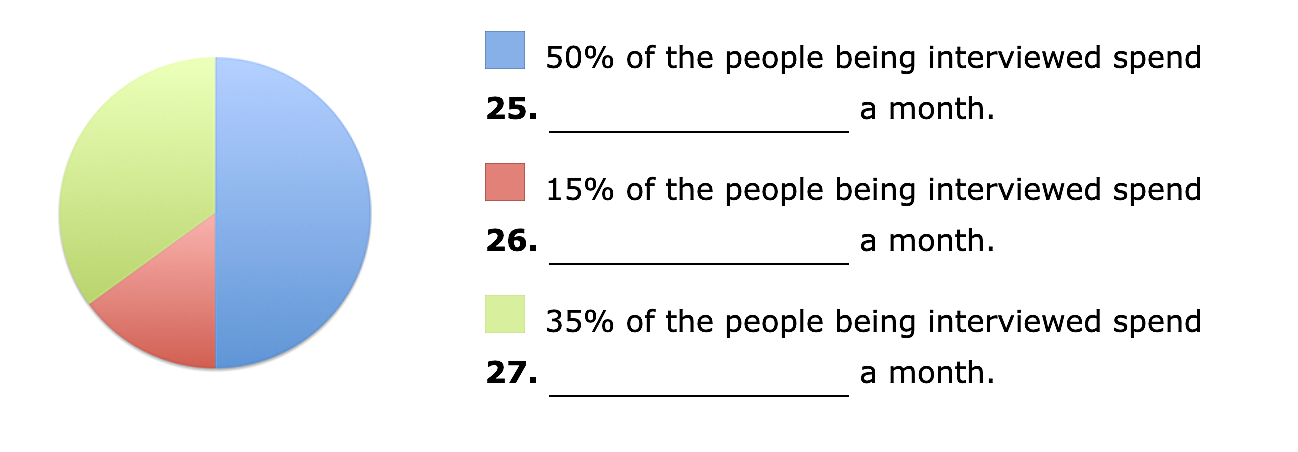
25. __________ 26. __________ 27. __________
Recreated diagram for questions 25, 26, 27
  1. 25

    25. __________

  2. 26

    26. __________

  3. 27

    27. __________

Section 3: Difficult Items to Buy

Mark THREE letters that represent the correct answer. Most of the people being interviewed think that _________ is/are most difficult to buy.

  1. 28

    Most of the people being interviewed think that _________ is/are most difficult to buy.

    • A. Books
    • B. Study materials
    • C. Foods
    • D. Trousers
    • E. Shoes
    • F. Sportswear
  2. 29

    Most of the people being interviewed think that _________ is/are most difficult to buy.

    • A. Books
    • B. Study materials
    • C. Foods
    • D. Trousers
    • E. Shoes
    • F. Sportswear
  3. 30

    Most of the people being interviewed think that _________ is/are most difficult to buy.

    • A. Books
    • B. Study materials
    • C. Foods
    • D. Trousers
    • E. Shoes
    • F. Sportswear

Section 4: Time Management Lecture

Choose the correct letter, A, B, C or D.

  1. 31

    What does the lecturer provide for those who are interested in doing extra reading?

    • A. Personal consultation sessions.
    • B. Extra materials, such as a booklist.
    • C. Mid-term examination.
    • D. Free glasses.
  2. 32

    In the past, time management meant you needed to

    • A. reduce your stress.
    • B. plan for every hour of the week.
    • C. own a good watch.
    • D. set goals and try to achieve these goals.
  3. 33

    Today, wise time management means you need to

    • A. set goals and work in a systematic way.
    • B. work faster.
    • C. set an overview of your assignment.
    • D. make a list, plan for everything and try to stick to this plan.
  4. 34

    In this college, students are assigned ____________ at the end of each semester.

    • A. team projects.
    • B. final term examinations.
    • C. essays.
    • D. time management courses.
  5. 35

    One sign the lecturer mentions that students feel under pressure is

    • A. library books go missing.
    • B. students get angry for no reason.
    • C. lower class attendance rates.
    • D. trouble at the library.
  6. 36

    What kind of suggestion does the lecturer give to the students?

    • A. Making a very detailed plan of their daily activities.
    • B. Not being so stressed just because there is an assignment.
    • C. A regular one-hour session in their personal timetables.
    • D. Wearing comfortable shoes.
  7. 37

    According to the lecturer, there are three kinds of planners. They are:

    • A. one weekly planner, one daily planner and one hour planner.
    • B. one yearly planner, one weekly planner and one daily planner.
    • C. one term planner, one monthly planner and one weekly planner.
    • D. one term planner, one weekly and one daily planner.
  8. 38

    If you want to set an overview of your time, you should need at least

    • A. one week.
    • B. half a week.
    • C. one month.
    • D. one term.
  9. 39

    The daily planner of time is mainly concerned with

    • A. the detailed planning.
    • B. how to plan all available time.
    • C. TV schedules.
    • D. an overview of everything you need to do for several days.
  10. 40

    According to the lecturer, wise time management may have the following benefit:

    • A. having more time to spend on relaxation and other activities.
    • B. improving your performance in the final term assignment.
    • C. helping you write better essays.
    • D. improving your memory.

ورقة الإجابة

املأ أثناء الحل — التصحيح فوري ومحلي، وكل خطأ يُسجل في سجل أخطائك مع الدرس الذي يصححه.

  1. 1.
  2. 2.
  3. 3.
  4. 4.
  5. 5.
  6. 6.
  7. 7.
  8. 8.
  9. 9.
  10. 10.
  11. 11.
  12. 12.
  13. 13.
  14. 14.
  15. 15.
  16. 16.
  17. 17.
  18. 18.
  19. 19.
  20. 20.
  21. 21.
  22. 22.
  23. 23.
  24. 24.
  25. 25.
  26. 26.
  27. 27.
  28. 28.
  29. 29.
  30. 30.
  31. 31.
  32. 32.
  33. 33.
  34. 34.
  35. 35.
  36. 36.
  37. 37.
  38. 38.
  39. 39.
  40. 40.
محفوظ على هذا الجهاز — لا حاجة لحساب. سجّل الدخول من صفحة تقدمك إذا أردت مزامنتها في مكان آخر.
عرض النص المكتوب
Listening practice test. Please turn to section 1 of listening practice test. Section 1. Listen to the conversation between a Japanese student and a housing officer and complete the form. First, you have some time to look at questions 1 to 5. You will see that there is an example which has been done for you. The conversation relating to this will be played first. Yes. What can I do for you? My friend is in a homestay and she really enjoys it, so I'd like to join a family as well. OK. Let me get some details. What's your name? My name is Keiko Yuichini. Could you spell your family name for me, please? Yes, it's Yuichini. That's Y-U-I-C-H-I-N-I. The student's family name is Yuichini, so that has been written on the form. Now we shall begin. You should answer the questions as you listen because you will not hear the recording a second time. Now listen carefully and answer questions 1 to 5. Yes. What can I do for you? My friend is in a homestay and she really enjoys it, so I'd like to join a family as well. OK. Let me get some details. What's your name? My name is Keiko Yuichini. Could you spell your family name for me, please? Yes, it's Yuichini. That's Y-U-I-C-H-I-N-I. And your first name? It's Keiko. K-E-I-K-O. That's Keiko Yuichini. OK. And your female and your nationality? I'm Japanese. Right. And could I see your passport, please? Here it is. OK. Your passport number is J-O-6-3-3-7. And you are how old? I'm 28 years old. Now you are living in one of the colleges. Which one? Willow College, Rome 21C. Right. 21C, Willow College. And how long are you planning to stay with homestay? About four months, longer if I like it. And what course are you enrolled in? Well, I've enrolled for 20 weeks in the Advanced English Studies because I need help with my writing. And I'm nearly at the end of my first five-week course. Right. So you've completed five weeks and you have enrolled for another 15 weeks. That's about four months altogether. That's right. About four months. Before they continue their conversation, look at questions 6 to 10. As you listen to the rest of the conversation, complete the form by filling in the numbered spaces 6 to 10. OK. Do you have a preference for a family with children or without children? I prefer... I mean, I like young children, but I like to be with older people. You know, I like someone of my own age. OK. And do you smoke or drink? No and no. Would you mind being with a family of smokers? Yes, I would. I don't like smoking. I'd rather be with a family of people who do not smoke or drink. OK. And what about pets? Oh, I love animals. I'm a veterinarian, so that's fine. The more the better. All right. Now what about you? Are you a vegetarian or do you have any special food requirements? No, I'm not a vegetarian, but I don't eat a lot of meat. I really like seafood. And what about your hobbies? I like reading and going to the movies. Do you play any sports? Yes, I joined the handball team, but I didn't like that, so I stopped playing. You know, I play tennis on the weekend with my friends. All right. Let's see. Name, age, transport. Are you familiar with the public transport system? No, I'm not really, because I've been living on campus. I've been to the city a few times on the bus, but they're always late. What about the trains? I like catching trains. They're much faster. Well, let's go and check on the computer to see what I've got. Um, listen, would it be OK to leave this with me? Could you come back after class this afternoon? Yes, of course. I'll check my records and I will give you details this afternoon. Thank you for your help. It's a pleasure. I'll see you this afternoon. Bye. Bye. That is the end of section one. You now have half a minute to check your answers. Thank you. Thank you. Thank you. Section two. You are going to hear a talk given by a tour guide about travel to Esnia. First look at questions eleven to fourteen. As you listen to the first part of the talk, answer questions eleven to fourteen. Hello, everyone. As you know, this agency has specialised in tours and independent travel to Esnia for over twenty years. It's a magnificent place to visit, but it's not always as easy or as comfortable as it might be. So this tour is designed to help you handle the bureaucratic hassles and give you time and energy to enjoy the beauty of this breathtaking country. The first hassle is visas. Nowadays, Esnian visas are needed by almost all nationalities. The normal visa lasts for just ninety days, but a renewal is possible. It is worth leaving yourself plenty of time when applying, or I suggest, from experience, two months. That should do it. The latest confirmed price is £30, but it should be noted, and a lot of our regular travellers tell us that the price may change without notice and hold up visa processing. So ring up the Esnian embassy and check the price before sending out forms. Now, for those of you who are intending to take Esnia as part of a longer tour and want to wait till you get to another country, do remember that some Esnian consulates in neighbouring countries require you to provide a letter from your own embassy, just to confirm your nationality. You can find a list of major embassies throughout the world in the student handbook on page 13. Oh, and one more thing. Check whether you need a multiple-entry visa if you are leaving and re-entering Esnia on your tour. Before the talk continues, you will have a chance to look at questions 15 to 20. As you listen, complete the summary and answer questions 15 to 20. Now, some miscellaneous general advice. Firstly, if you are rich enough to bring in over $1,000 in cash or travellers' cheques to Esnia, you need to fill in the currency form. Don't forget this. You could get into trouble if you do. You must declare all of your items and more expensive items, such as video cameras, on a tourist export form, which you can arrange to carry in advance. Regarding health regulations, although Esnia is becoming a generally healthier country with every passing year, neighbouring countries remain cautious with regards to health standards there, and therefore it is worthwhile carrying a health certificate. The one you need is the BM276. Now, all of you here are students, and there will be plenty of concessions for young people travelling in Esnia. The Esnian Transport Authority, for example, issues a special youth fare card which you can get in any railway station. Just show your international student card. Information about getting this is in the handbook. And give two passport photos. And by the way, because there is so much bureaucracy in Esnia, we advise you to take at least 12 passport photos with you. They are not always easy to get done there. Finally, a bit more about currency. Pounds won't get you very far in Esnia these days, so they are no good. We advise people to carry either Yen or Australian dollars. US dollars are starting to cause difficulties because of political disputes. Another surprise is that credit cards are virtually useless because of fraud scandals. Do carry traveller's cheques, but we advise medium denominations. Large denominations increase the likelihood of theft, and small ones increase commission charges. Now, as I mentioned earlier, this student handbook has a wealth of information. That is the end of section 2. You will now have half a minute to check your answers. Thank you. Section 3. In this section, you will hear a discussion about shopping habits. First look at questions 21 to 24. As you listen to the first part of the discussion, answer questions 21 to 24. Oh, that's OK. So how often do you go shopping? Oh, I buy a lot of books. Should I exclude books? Oh, if you leave books aside, what about shopping for all of your personal items, study things and that sort of thing? OK, because I go to the supermarket almost every day, it seems the other things, I'd say, I tend to do it every other week. And do you spend the same amount each time? I guess so. I only have about £100 a month spare, so I'd probably spend about £50 each time. What sort of shops do you like best, the department store or the small retail outlets? Oh, I like big department stores, so everything's in one place. The weather's so bad, so it's a bit miserable trudging from one little shop to another. Great. What do you find most difficult to buy? What do you mean? Well, what do you have to really search for? What takes you a long time to find? Oh, jeans, definitely. You can get hold of a sweater or a CD in a moment, but with jeans I can spend all afternoon and still not find a pair that fits. OK, one last question. Who do you usually shop with? Now, I usually go shopping on my own, but if I want to make it more of a social occasion, with friends, to have a coffee and things, I often go with colleagues from work, you know, in our lunch hour. Well, thank you very much. You've been very helpful. No problem. Before the next part begins, you will have a chance to look at questions 25 to 30. As you listen, answer questions 25 to 30. Hello, Dale. How did you get on with your shopping enquiries? Well, I got 50 people to answer questions and the results were quite interesting. OK, let's have a look. Well, those were handouts and here you can see that the majority of people I interviewed said they went shopping once a week. Most often, that was the weekend. Right. For those people who spend enormous amounts of money, if you see this chart, you can see that half the people spend £45 a month and while 15% of people spend more than that, an average of £75, the rest spend relatively small amounts. Even the regular shoppers spend no more than £20 a month. Window shoppers? Yes, I asked them what kinds of shops they prefer and the response was unanimous. Everyone went for department stores. I think that's what young people today want. That's understandable. And that's a useful statistic, I think. I also talked to them about the things they found most difficult to buy. I thought the answer was going to be something like books or study materials, but it's always clothes. They have problems with things related to hobbies. As far as sportswear was concerned, they complain about the lack of shops they go to. Not many had trouble buying sweaters and things like that. But shoes and trousers were really problematic. Was that, again, because there just isn't enough variety? Yes, they say everywhere they just come across the same styles, so they just give up after a while. I know what they mean. Lastly, I asked them whom they want to shop with. They said they want to shop with someone who has the same interests as them. Lastly, I asked them whom they want to shop with. That is the end of section 3. You will now have half a minute to check your answers. Thank you for watching! Please subscribe to my channel! Thank you for watching! You will hear a lecture about study and answer questions 31-40. First look at questions 31-40. As you listen to the lecture, answer questions 31-40. Is this microphone working? Good. Now, welcome everybody to the second of these lectures on successful study at college. Yesterday we looked at housekeeping issues, where to find information, how to use the library computer system and so on. Today we're going to cover an issue that will be vitally important to you all throughout your time here at college. And that is time management. Hundreds of books have been written about time management, and those of you who are interested in doing some extra reading on the subject are very welcome to see me after the lecture, as I have a book list here and some other useful materials. Now, time management. In the past, this used to mean making a list to plan for every hour of the week and then try to stick to this plan. These days, however, the whole idea of managing time has changed. In fact, if you think about it, you'll find that it's impossible to manage time. It just goes. So, what you really need to manage is yourself. To manage yourself effectively, you need to have a clear idea both of what you want to achieve and how to achieve it. In other words, you need to set goals and you need to move towards achieving these goals in an efficient and systematic way. Most coursework at the college is set by mid-semester, and at the end of the semester usually involves two written assignments of between 1,500 and 3,000 words in length. If you look around you at college, you will see that during the first weeks of the term, everyone looks cheerful and focused, followed by a change around week six, assignment time, when people start to look a bit stressed. The library reports that an increasing number of students become angry when books are not available. So, what's happened? Has everybody become suddenly irritable and angry for no reason? Not quite. The reason is that people have not managed their resources well. They have not set priorities for reaching their goals and, as a result, some of them realise they are going to do badly with their assignments. This will not be because they lack intelligence or love of the subject. They will fail because they did not have a clear idea of what they have to do and how long it should take them. Let's step back a minute. What do we mean by establishing goals? Well, basically, it means deciding what you want to achieve. In other words, deciding on the results that you want to achieve. The students that I have mentioned found themselves very stressed mainly because they have an assignment to do. But they did not fully think through the effect that this would have on their day-to-day life. There's an awful lot of spare time in a day. For example, if you manage to spend some of that time, even just one hour, on an activity that helps you with your study, that one hour could have a major impact in your course, particularly if you make it a regular habit. I'd like to ask you now to have a look at the planners in your information kits. You will see that there are three – one term planner, one weekly planner and one daily planner. The term planner is to help you get an overview of everything that you will need to do for the term. The weekly planner is to help you week by week. And the daily planner will help you with the really detailed planning. Before we go any further, I would like you to make a note in your daily planner right now. I want you to picture how you could make a major difference in your life by spending just one hour a day on some activities for the next term. Background reading, for example, or preparing a bibliography. Now imagine the benefit at the end of the term. The term diary and the weekly diary are the most important ones. However, a week is really the shortest time you have to establish an overview of your time for planning purposes. Now you need to set priorities for the term. Work out how you could achieve those priorities and the results that you desire. If you can get into the habit of planning like this, you'll soon find that you've actually had more time than before to spend on relaxation and other activities that you enjoy. Now let's share some of the ideas that you've come up with. I'll divide you up into groups to share your ideas. OK. That is the end of section four. You will now have half a minute to check your answers. Thank you.
عرض مفتاح الإجابة

مفتاح الإجابة

  1. 1. Keiko

    The answer is 'Keiko' because the question asks for the first name, and 'Keiko' is a common first name, likely given by the speaker.

  2. 2. JO6337

    The answer is 'JO6337' because the question asks for the passport number, and this is the number provided.

  3. 3. Advanced English studies

    The answer is 'Advanced English studies' because the question asks for the course enrolled, and this is the course named.

  4. 4. 5 months

    The answer is '5 months' because the question asks for the length of the course, and this is the time given.

  5. 5. About 4 months

    The answer is 'About 4 months' because the question asks for the homestay time, and this is the period mentioned.

  6. 6. B / D

    The answer is 'B / D' because the girl prefers a family without smokers or drinkers and also likes a family with many animals or pets. Option A fails because she does not prefer a big family with many young children, and C fails because she does not want a family without pets.

  7. 7. Seafood

    The answer is 'Seafood' because the girl does not eat a lot of meat and says her favourite food is seafood.

  8. 8. Tennis

    The answer is 'Tennis' because the girl has stopped playing handball and now plays tennis with her friends at weekends.

  9. 9. Take the train

    The answer is 'Take the train' because the girl does not like the bus as they are always late, so she prefers to take the train.

  10. 10. This afternoon

    The answer is 'This afternoon' because the girl can get the information about the homestay family she wants this afternoon.

  11. 11. 90 days

    The answer is '90 days' because normal visas last for 90 days.

  12. 12. 30 pounds

    The answer is '30 pounds' because you need to pay 30 pounds for the visa.

  13. 13. Confirm your nationality

    The answer is 'Confirm your nationality' because some consulates require a letter to confirm your nationality.

  14. 14. Page 13

    The answer is 'Page 13' because information about major embassies is on page 13 of the student handbook.

  15. 15. Currency form

    The answer is 'Currency form' because if you carry a lot of money, you need to complete a currency form.

  16. 16. Tourist export form

    The answer is 'Tourist export form' because you must declare expensive items on a tourist export form.

  17. 17. BM276

    The answer is 'BM276' because the health certificate you need is called BM276.

  18. 18. International student card

    The answer is 'International student card' because you need to show your international student card to get a youth fare card.

  19. 19. 12

    The answer is '12' because you are advised to take at least 12 passport photos with you.

  20. 20. Yen / Australian dollar

    The answer is 'Yen / Australian dollar' because pounds and US dollars are not useful now, so you should take yen or Australian dollars.

  21. 21. Cashier

    The answer is 'Cashier' because the woman being interviewed now works as a cashier in the bank.

  22. 22. 50 pounds

    The answer is '50 pounds' because the woman usually spends about 50 pounds when she goes shopping.

  23. 23. Big department stores

    The answer is 'Big department stores' because the woman often goes to big department stores as she finds them convenient.

  24. 24. Jeans

    The answer is 'Jeans' because the woman says jeans are the most difficult thing for her to buy.

  25. 25. 45 pounds

    The answer is '45 pounds' because this is the amount relevant to the question, likely about spending or cost.

  26. 26. 75 pounds

    The answer is '75 pounds' because this is the amount relevant to the question, likely about spending or cost.

  27. 27. 20 pounds

    The answer is '20 pounds' because this is the amount relevant to the question, likely about spending or cost.

  28. 28. D

    The answer is 'D' (Trousers) because most people interviewed think trousers are the most difficult to buy. Option E (Shoes) is tempting but is not the most chosen.

  29. 29. E

    The answer is 'E' (Shoes) because most people interviewed think shoes are the most difficult to buy. Option D (Trousers) is tempting but is not the most chosen for this question.

  30. 30. F

    The answer is 'F' (Sportswear) because most people interviewed think sportswear is the most difficult to buy. Other options are not mentioned as the most difficult.

  31. 31. B

    The answer is 'B' (Extra materials, such as a booklist) because the lecturer provides extra materials for those interested in extra reading. Option A is tempting but not mentioned as provided.

  32. 32. B

    The answer is 'B' (plan for every hour of the week) because in the past, time management meant planning for every hour. Option D fails because it is about setting goals, not detailed planning.

  33. 33. A

    The answer is 'A' (set goals and work in a systematic way) because today, wise time management means setting goals and working systematically. Option D fails because it is about making a list and planning for everything, which is the old way.

  34. 34. C

    The answer is 'C' (essays) because students are assigned essays at the end of each semester.

  35. 35. D

    The answer is 'D' (trouble at the library) because one sign of students feeling under pressure is trouble at the library. Option A is tempting but not the main sign mentioned.

  36. 36. C

    The answer is 'C' (a regular one-hour session in their personal timetables) because the lecturer suggests students have a regular one-hour session in their timetables. Option A fails because it is about making a very detailed plan, which is not the suggestion.

  37. 37. D

    The answer is 'D' (one term planner, one weekly and one daily planner) because the lecturer says there are three kinds of planners: term, weekly, and daily.

  38. 38. A

    The answer is 'A' (one week) because to set an overview of your time, you need at least one week.

  39. 39. A

    The answer is 'A' (the detailed planning) because the daily planner is mainly concerned with detailed planning.

  40. 40. A

    The answer is 'A' (having more time to spend on relaxation and other activities) because wise time management may give you more time for relaxation and other activities.

Listening 2025-08 Test 3 — IELTS Listening Actual Test with Answers | IELTS Actual Tests