สร้างขึ้นใหม่จากความทรงจำของผู้เข้าสอบ — ไม่ใช่ข้อสอบ IELTS อย่างเป็นทางการ ไฟล์เสียงและบทความเป็นการจำลองเพื่อฝึกฝน
ดูสคริปต์เสียง
====================
IELTS Listening Transcript
====================
PART 1
Speaker 0: Part one.
Speaker 0: You will hear a man who runs a volunteer agency interviewing a woman called Grace who is applying to do volunteer work.
Speaker 0: First, you have some time to look at questions one to five.
Speaker 0: Now listen carefully and answer questions one to five.
Speaker 1: Hello, Grace. I'm William. Thanks for coming in for this interview. It's very important for us to meet our volunteers in person. I understand.
Speaker 2: It's no problem at all.
Speaker 1: Okay. Let's get started. What's the best phone number to contact you on?
Speaker 2: My mobile phone's probably best. The number's 0216367189. But I can't always answer it during the day. I'll give you my email address as well. I check it frequently.
Speaker 1: Okay. I'll make a note that email's a good way to contact you. What's the address?
Speaker 2: It's graceb@travel.co.nz. I chose it when I was younger, and I just haven't changed it since. It's easy to remember.
Speaker 1: Now do you have any particular qualifications, Grace?
Speaker 2: I'm a housewife now, but I used to be in teaching. I trained for that and got my diploma, although I haven't done it for years. Before having children, I worked as a bank teller.
Speaker 1: Alright. I need to find out when you'll be available during the week. You said you have children. Are they at school?
Speaker 2: Yes. Both of them are. So I can't start work before 08:15 in the morning or work past 03:00 in the afternoon.
Speaker 1: So you'd be looking for about four or five hours a day, say 09:15 AM to 2 PM? That gives you time to get to and from school to work.
Speaker 2: That's perfect. It's important for me to be there for my children.
Speaker 1: Of course. And are you looking to work Monday to Friday?
Speaker 2: Yes. If it gets to be too much, I can rethink it later.
Speaker 1: Now, Grace, you obviously have a lot of work experience, but have you done any volunteer work before?
Speaker 2: During the Rugby World Cup, there were many visitors who didn't know their way around or what they should see and do in Auckland City. So I worked as a guide to help introduce the city to tourists. I really enjoyed it.
Speaker 1: Okay. Good. Have you done anything else? Perhaps when you were at school or university? Did you do any volunteer work there?
Speaker 2: When I was at university, the manager of a netball team asked me to be the coach, and I did that.
Speaker 1: Great. It sounds like you like your sports.
Speaker 2: I used to, but not so much nowadays.
Speaker 1: Okay.
Speaker 0: Before you hear the rest of the conversation, you have some time to look at questions six to 10.
Speaker 0: Now listen and answer questions six to 10.
Speaker 1: If not sports, do you have any other interests?
Speaker 2: Oh, yes. I love to get out in my garden, and I grow most of my own vegetables. I love flowers and flower arranging, but I don't suppose there's much volunteer work associated with those kinds of things.
Speaker 1: You'd be surprised. Any other hobbies?
Speaker 2: Like most people, I guess, I like music. Actually, I can play the guitar, but I haven't done much for a while, so I'm a bit rusty. One day I'd like to have a go at the flute.
Speaker 1: Okay. That gives me a good idea of the type of work you might be interested in. Ideally, it'd be something that combines your experience and your hobbies. If you're interested in something outdoors, I have a position helping out on a farm. That's just for a month. It's not too physically demanding, though it does require you to be on your feet all day. And it'd be nice as long as the weather is fine, but I imagine it could be uncomfortable in the rain or the heat. In the past we've had many positions working in community centres. They've been working with the disabled or teens. The position we have available now is with elderly men and women. They have activities like flower arranging, music lessons, sing alongs, things like that.
Speaker 2: Both of those sound great. I'm really open to anything.
Speaker 1: That's nice to know. Just a couple more questions. Why do you want to do volunteer work?
Speaker 2: Well, now that both my children are in school, I'd like to make some friends as I've got the time on my hands. Also, I like the idea of helping others.
Speaker 1: And last question. How did you find our agency? We aren't in the phone book. Did a friend tell you about us?
Speaker 2: No. I was on my way to school the other day, and I saw your advertisement at the supermarket.
Speaker 1: It's good to know someone sees those ads. Thank you again for coming.
Speaker 0: That is the end of part one. You now have one minute to check your answers to part one.
PART 2
Speaker 3: Part two.
Speaker 4: You will hear a real estate agent giving information to a couple who want to buy a house.
Speaker 4: First, you have some time to look at questions.
Speaker 4: Now listen carefully and answer questions 11 to 13.
Speaker 4: Hello, Mister and Missus Clark. I believe you are doing well. I am Tom, the sales manager of Houzzed Inc, and I got your mail requesting for a house that would suit your specifications. I have been able to do some work and have come up with two options that I think should fit what you are looking for. The first house is situated on Allen Street, and the owner told me that he bought the house largely because of where it is located. The house was decorated a few years ago, but I think it still looks new to a large extent. Anyways, you might dislike the old fashioned design of the house, which was modeled to the original owner's taste. Of course, you can arrange decorations of your own. I just have to inform you beforehand. I looked through your profile, and it said that you have a large family of six. I felt this house could be more appropriate for you with children than just young couples as it has eight rooms, including four bedrooms. According to your budget, although the house is a bit pricey, the price hasn't exceeded your limit yet. It is very reasonable, though, for a house on Allen Street. The owner had initially fixed every afternoon for potential buyers to visit. Then he shifted it to all weekends. But by yesterday, he informed me that he would be allowing only Wednesdays during lunchtime for visits, so it means we have to go either tomorrow or next week.
Speaker 4: Before you hear the rest of the talk, you have some time to look at questions 14 to 20.
Speaker 4: Now listen and answer questions 14 to 20.
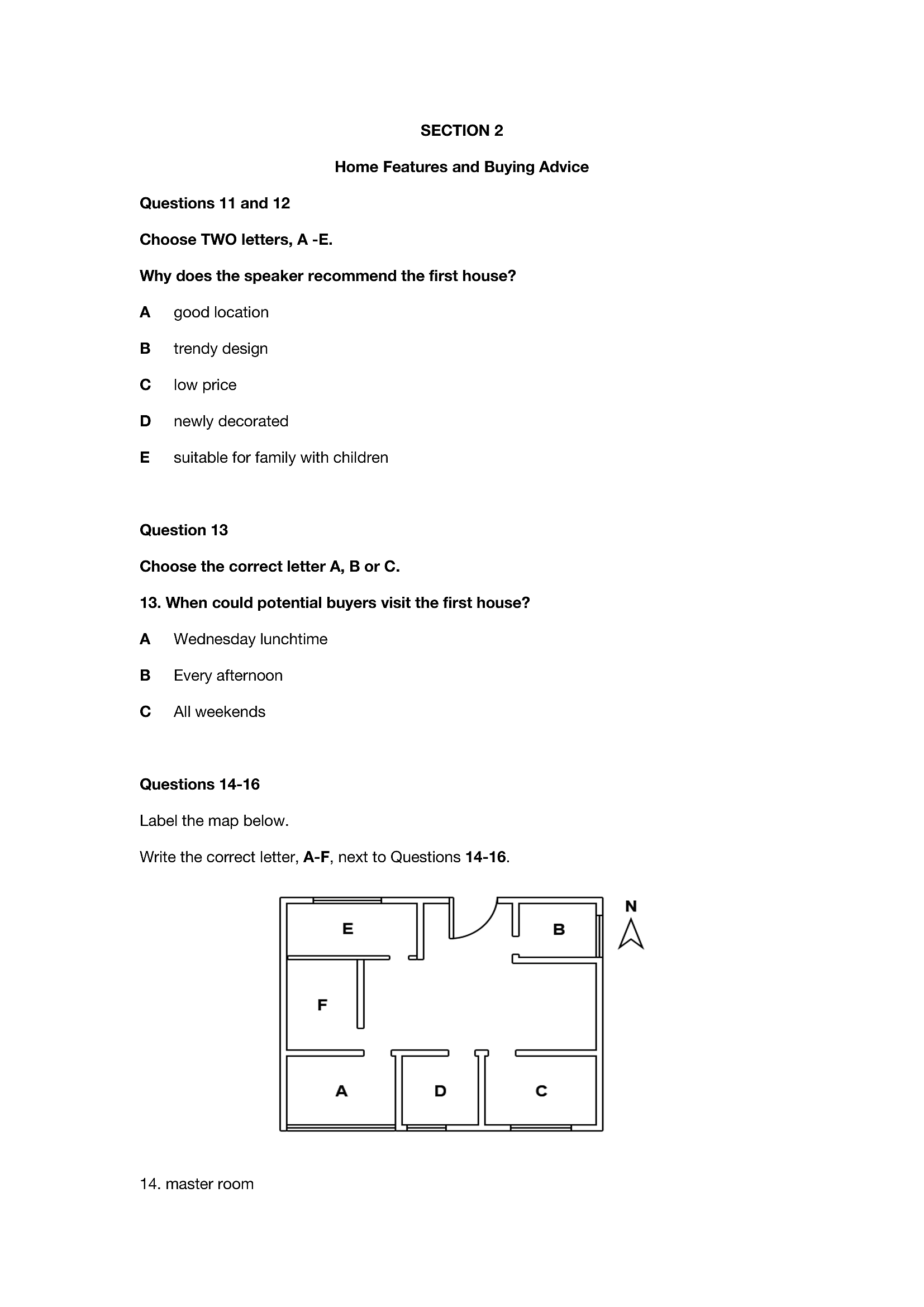
Speaker 4: Okay. On to the next house. I was able to get the layout of this building to help you understand it better. The house is situated on Pearl Street, just around the corner. It is a well planned and designed house. In the Southeast of the house, you can see the master room, whereas the dining room is in the northwestern corner. There is a bathroom in the southwestern corner of the house that is modern and well equipped. It provides adequate storage for the whole family. As for the bedroom, which is kept especially for visitors, it is in the direct south of the house, just between the bathroom and the master room. You will see the kitchen to your left when you just step in the house. Of course, I should give as much information as I can so as to help you in the decision making process. The second house has both advantages and disadvantages, and you should know well about them. First, the premises are quite lovely, and there is a small garden just behind the main building. Also, you do not have to manage space with other neighbors since there is a big parking lot, unlike the first house. As you can see, north of the house, you have a lot of banks, and to the east and west, there are a good number of companies and malls. It is very compact and easily accessible due to its central location. Again, in contrast to the first house, there are only two bedrooms, and this would have been good for a young couple with a small family size. However, for a family size like yours, I really am not sure. But if necessary, perhaps you could turn the storeroom into a bedroom, then there will be three bedrooms. The last problem is that it lacks a garage, which is a very important feature for residents here as every household has at least one car, and there are few public car parks in this area. This is all I have for now.
Speaker 3: That is the end of part two. You now have half a minute to check your answers to part two.
PART 3
Speaker 6: Section three.
Speaker 6: First, you have some time to look at questions 21 to 25.
Speaker 0: Now listen carefully and answer questions 21 to 25.
Speaker 7: Hi, Francis. Sam. So how did you go with applying the different theoretical business tools for the report I asked you to write?
Speaker 5: It was interesting and made us really focus on which tool was best to use when analysing a business.
Speaker 7: Good.
Speaker 8: So tell me what you found out.
Speaker 5: We liked the theory behind pest analysis. That's political, economic, social and technological, although we're not sure if it was very applicable to our case. Some of the other groups had studies for which it worked really well, and they said it was easy to use. But I felt it focused too much on the big picture and was unsuitable for our company.
Speaker 8: I agree. On the other hand, I enjoyed using the drill down method. It was painstaking to do, and we seemed to be working on it for ages. But the results were worth waiting for.
Speaker 5: Yes. I liked the way it eventually broke down complex problems.
Speaker 8: Yes. I much prefer doing the PMI analysis. It was so straightforward to break down into its three components, plus, minus, and interesting implications. You just needed to brainstorm these components and then write them up, fast and effective.
Speaker 5: And it didn't make your brain hurt doing it.
Speaker 8: I agree. And you don't need any special training at all. Anyone can use it.
Speaker 7: So was there any tool that you thought was superior to the others?
Speaker 8: In my opinion, the one tool that is critical to business, especially for larger companies, is Pareto analysis. If they applied Pareto analysis, they would see that by focusing on the critical 20% of their problems, they could generate 80% of the benefits. This would allow them to work faster, and it also reduces their workload. It's all about finding out what their basic problems are.
Speaker 5: I agree with Francis about Pareto, but my favourite was the SWOT analysis. You know, looking at the company's strengths, weaknesses, opportunities, and threats, as it can be used in so many different situations. It works in large and small companies, and even down to departmental level. It was great for our case study.
Speaker 8: Yes. That's true.
Speaker 0: Before you hear the rest of the discussion, you have some time to look at questions 26 to 30 on page six.
Speaker 0: Now listen and answer questions 26 to 30.
Speaker 7: Okay. I've read your draft report, but can you tell me a bit more about that company you focused on?
Speaker 8: Well, the company we used in our study was a manufacturing company who have relied on distributors to take their product to the end user. We did some analysis examining the possibility of them distributing their own products. We initially looked at their strengths.
Speaker 5: The company, although it is small, is well known and has a very good reputation. The management are very committed to increasing the company profits, and they are confident this move would be successful.
Speaker 8: Right. And the company has quite a lot of staff who have previously worked for distribution companies, so the knowledge is already there. That was something we didn't expect to find and is probably going to help them the most to achieve their goals.
Speaker 7: I was quite impressed by some of the opportunities you detailed. I did think you missed something quite pertinent to their future growth, however.
Speaker 5: What was that?
Speaker 7: You didn't consider the potential for establishing an offshore division. You talked about the company negotiating better terms with its suppliers. Most of these are based abroad. And so if the company had a way of actually distributing the product there, this could be a tremendous opportunity and give them an edge over their competitors.
Speaker 8: That's a good point. So what did you think about the threats we identified?
Speaker 7: I thought you did a good job. I was really pleased to see that you considered how the government's planned environmental policy could really affect the viability of this venture. With this law being introduced next year, they might need to find new ways of using their existing technology. It's easy to identify what your competitors are doing, but it's the bigger picture that often gets ignored.
Speaker 7: So, Sam, what did you learn from this assignment?
Speaker 5: Heaps. I guess I hadn't realized how much time it takes to ensure your company survives and profits. It was great to study the different tools in books, but applying them in the real world was much harder than I thought. It was a great learning experience.
Speaker 7: I'm glad I could make your assignment relevant. I'm basically happy with your report. You've got the format correct, with the necessary headings, etcetera. And you've got sufficient details under the different headings. Just remember to state whether or not you think the company should go ahead with a new venture. But you've done a good job so far.
Speaker 6: That is the end of section three. You now have half a minute to check your answers. Now turn to section four.
PART 4
Speaker 9: Section four.
Speaker 9: You will hear part of a lecture about time measurement.
Speaker 9: First, you have some time to look at questions 31 to 40.
Speaker 9: Now listen carefully and answer questions 31 to 40.
Speaker 9: Good morning, everyone. Today I'm going to talk about the research project I've been involved in on time measurement. Do you know how time is measured? Consider how we measure length and how, with time, we encounter a difficulty. Before we could grasp it, it would slip through our fingers. In fact, as we can see, we are forced to have the resource to measure something else: the movement of something in space or a set of movements in space. All the methods that have been employed so far really measure time by a motion in space. The measurement of time is no easy matter, a scientific unit only arrived at after much thought and reflection.
Speaker 9: As the most primitive form of measurement, the sun seems to be natural. Ever since man first noticed the regular movements of the sun and stars, we have wondered about the passage of time. Prehistoric people first recorded time according to the sun's position. To start off, let us take noon, which is when the sun is on the meridian at the highest point of its course across the heavens, and when it casts the shortest shadow. But this measurement, which was regarded as a major one in ancient times, was less important than the natural events that occurred. The earliest natural events that had been recognized were in the heavens, but during the course of the year there were many other events that indicated significant changes in the environment. Seasonal winds and rains, the flooding of rivers, the flowering of trees and plants, and the breeding cycles or migration of animals all led to natural divisions of the year, and the further observation and local customs led to the recognition of the season.
Speaker 9: Years later, precise measurements were invented because the passage of time was extremely important for astronomers and priests who were responsible for determining the exact hour for daily rituals and for important religious festivals. Apart from the connection with religion, accurate time measurement was also related to the government, since they divided the day or the night into different periods in order to regulate work and various events.
Speaker 9: For thousands of years, devices had been used to measure and keep track of time. The current sexagesimal system of time measurement dates back to approximately 2,000 BCE from the Sumerians. It was found that the earliest ancient timekeepers were mainly invented and used in Mesopotamia, where the water clock was introduced from, as well as in North Africa, especially in the area of ancient Egypt.
Speaker 9: So now I'd like to introduce you to some of the most well known ancient timekeepers as well as disadvantages of them for which they were replaced by various new forms of clocks that were used afterwards. A sundial is a device that tells the time of day by the apparent positioning of the sun in the sky. In the narrowest sense of the word, it consists of a flat plate and a nomen, which casts a shadow onto the dial. As the sun appears to move across the sky, the shadow aligns with different hour lines, which are marked on the dial to indicate the time of day. However, it was quickly noted that the length of the day varied at different times of the year. Therefore, there could have been a difference between clock time and sundial time. In addition, the sundial was of no use at night, so a water clock was invented.
Speaker 9: The water clock, or klepsydra, appeared to have been invented around 1500 BCE and was a device which relied on the steady flow of water from or into a container. Measurements could be marked on the container or on a receptacle for the water. It was reliable, but the water flow still depended on the variation of pressure and temperature from the top of water in the container.
Speaker 9: As the technology of glassblowing developed, from sometime in the fourteenth century, it became possible to make sand glasses. Originally, they were used as a measurement for periods of time like lamps or candles. But as clocks became more accurate, they were calibrated to measure specific periods of time. The drawback, however, as you can imagine, was the limited length of time they could measure.
Speaker 9: The last timekeeper to be introduced is the fire candle clock. Candle clocks took advantage of a simple concept: the slow and consistent nature of a burning wax candle. By utilizing this process, our ancestors were able to keep steady track of the time. The clocks were created by engraving the length of the candle with evenly spaced markings. Each marking represented a single unit of time, and as the wax burned down, each hour would disappear. However, the drafts and the variable quality of the wax mainly influenced the time of burning. Like oil lamps, candles were used to mark the passage of time from one event to another rather than tell the time of day.
Speaker 9: That is the end of section four. You now have half a minute to check your answers.