Listening 2026-01 Test 2

เดือนที่สอบ: 2026-01

สร้างจากความทรงจำของผู้เข้าสอบ — ไม่ใช่ข้อสอบ IELTS อย่างเป็นทางการ เสียงและบทอ่านเป็นการจำลองเพื่อฝึกฝน

เสียงที่สร้างขึ้นใหม่

Section 1: Tour to Japan — Whale-watching tour

Complete the notes below. Write ONE WORD AND/OR A NUMBER for each answer.

Tour to Japan Whale-watching tour Led by a 1. _________ during the tour Group size: 12 or 13 people Fees per person: $ 2. _________ Enjoy sea views on a 3. _________ Other activities Bushwalk: good choice for people who want to do more 4. _________ Fishing trip: No 5. _________ activities in the trip Additional information A free 6. _________ is offered during the trip No extra charge for 7. _________ in the theatre Evening activity: watching 8. _________ Souvenirs: products made by local 9. _________ Every room in the hotel is equipped with a 10. _________
  1. 1

    Led by a 1. _________ during the tour

  2. 2

    Fees per person: $ 2. _________

  3. 3

    Enjoy sea views on a 3. _________

  4. 4

    Bushwalk: good choice for people who want to do more 4. _________

  5. 5

    Fishing trip: No 5. _________ activities in the trip

  6. 6

    A free 6. _________ is offered during the trip

  7. 7

    No extra charge for 7. _________ in the theatre

  8. 8

    Evening activity: watching 8. _________

  9. 9

    Souvenirs: products made by local 9. _________

  10. 10

    Every room in the hotel is equipped with a 10. _________

Section 2: Grampic Arts Campus — Plan Labelling

Label the plan below.
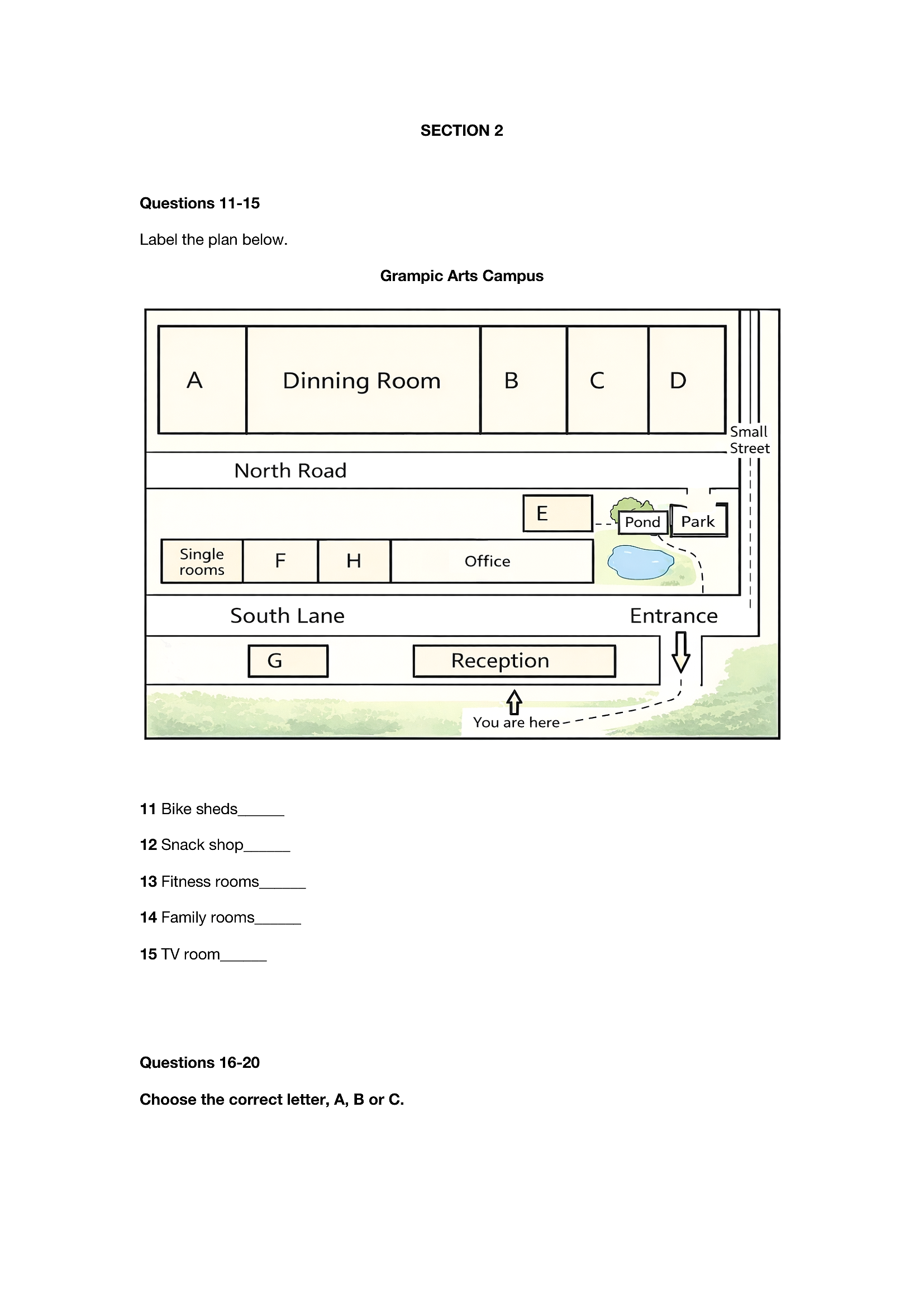
  1. 11

    Bike sheds _______

  2. 12

    Snack shop _______

  3. 13

    Fitness rooms _______

  4. 14

    Family rooms _______

  5. 15

    TV room _______

Section 2: Grampic Arts Campus — Multiple Choice

Choose the correct letter, A, B or C.
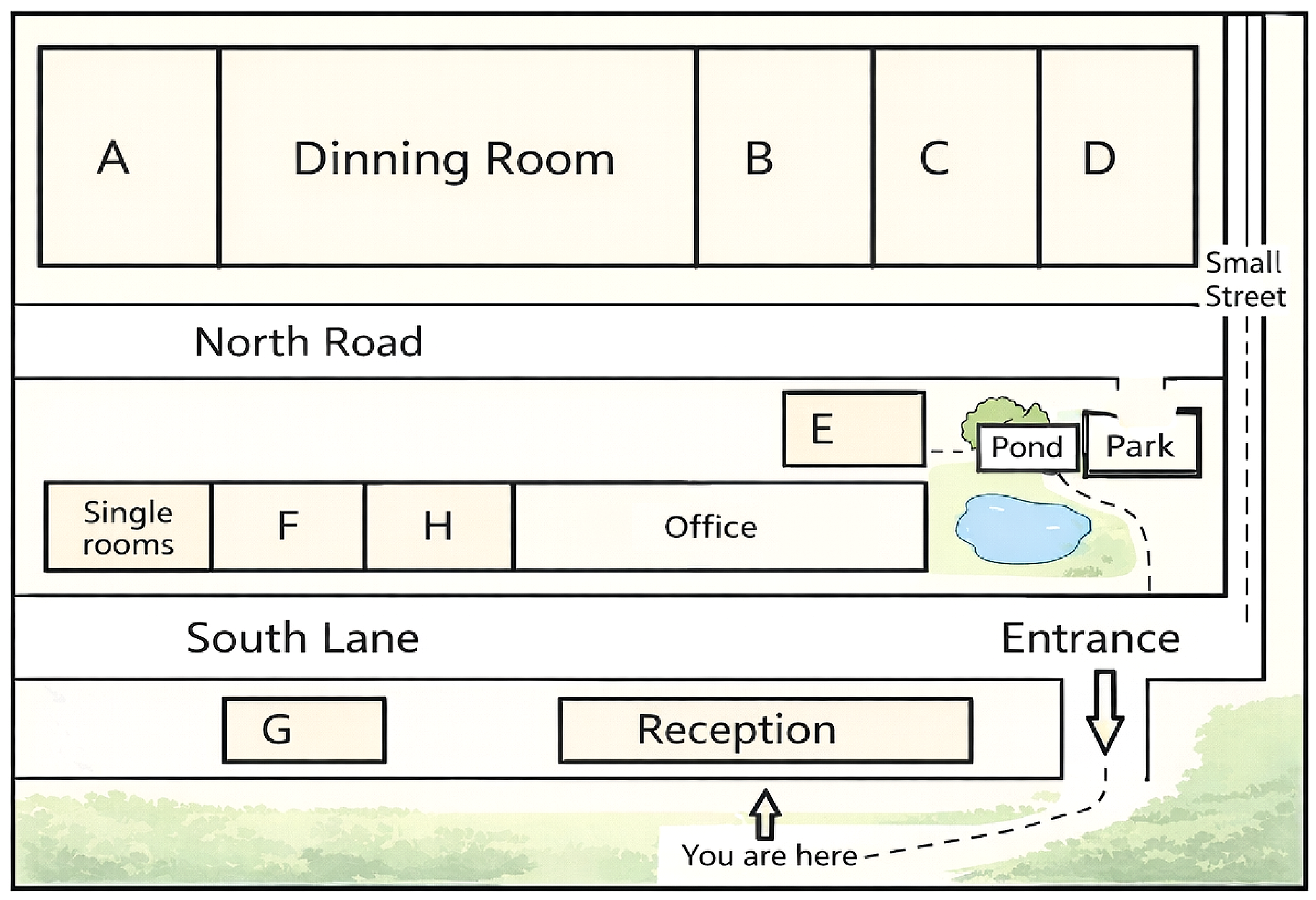
Recreated diagram for questions 16, 17, 18, 19, 20
  1. 16

    The drama option takes place

    • A. in the theatre
    • B. in the sports hall
    • C. in the lecture rooms
  2. 17

    The photography option is reserved for

    • A. people new to photography
    • B. people with special equipment.
    • C. parents and children.
  3. 18

    The writing option will focus on

    • A. poetry techniques.
    • B. short stories.
    • C. starting a novel.
  4. 19

    The music option involves

    • A. singing classes.
    • B. going to a concert.
    • C. giving a performance.
  5. 20

    What information is given about the creche?

    • A. the costs the same as last year
    • B. lunch costs extra.
    • C. parents must pay in advance.

Section 3: Presentation Suggestions — Multiple Choice

Choose the correct letter, A, B or C.

  1. 21

    What suggestions did Sara get from her tutor about her presentation?

    • A. write main ideas on index cards
    • B. practice in front of classmates
    • C. have a good conclusion
  2. 22

    What does Charlie think they should make first to publicize their presentation?

    • A. some photos
    • B. a poster
    • C. a flyer
  3. 23

    Why does Sara want to add some slides?

    • A. to display some necessary illustrations
    • B. to attract the audience’s attention
    • C. to deliver the content more easily
  4. 24

    What does Sara think is the best advice from her tutor?

    • A. leave the best part at the end of the presentation
    • B. add an impressive introduction
    • C. have inflection in her voice
  5. 25

    Who will be the audience when Sara does her presentation?

    • A. her parents
    • B. an art critic
    • C. an artist

Section 3: Presentation Features — Matching

What feature should each of the following part of the presentation have? Choose FIVE answers from the box and write the correct letter, A-G, next to Questions 26-30.

Features A. concise with a question B. combine different materials C. high quality D. use lettering E. originality F. use all sources of media G. ask the audience many questions
  1. 26

    introduction ______

  2. 27

    the jewelry displayed ______

  3. 28

    a wood carving ______

  4. 29

    forest paintings ______

  5. 30

    conclusion ______

Section 4: Penguins in Africa — Note Completion

Complete the notes below. Write ONE WORD ONLY for each answer.

Penguins in Africa Appearance and lifestyle They are also called Jackass Penguins for the sound they make. The 31 _________ of their body remains constant. They restrict their 32 _________ on land from dusk till dawn. They cannot fly because they have heavy 33 _________ They nest under the tree 34 _________ They eat tree 35 _________ Predators • seals 36 _________ • seagulls (eat the penguin 37 _________) Threats They lose 38 _________ in winter. They are fighting for nesting 39 _________ and food because of human activities. In order to improve survivorship, it is helpful to increase the 40 _________ of their genes.
  1. 31

    The 31 _________ of their body remains constant.

  2. 32

    They restrict their 32 _________ on land from dusk till dawn.

  3. 33

    They cannot fly because they have heavy 33 _________

  4. 34

    They nest under the tree 34 _________

  5. 35

    They eat tree 35 _________

  6. 36

    Predators: 36 _________

  7. 37

    seagulls (eat the penguin 37 _________)

  8. 38

    They lose 38 _________ in winter.

  9. 39

    They are fighting for nesting 39 _________ and food because of human activities.

  10. 40

    In order to improve survivorship, it is helpful to increase the 40 _________ of their genes.

แสดงสคริปต์เสียง
==================== IELTS Listening Transcript ==================== PART 1 Speaker 0: Part one. Speaker 0: You will hear a customer asking about a tour to Japan. Speaker 0: First, you have some time to look at questions one to five. Speaker 0: Now listen carefully and answer questions one to five. Speaker 1: Good afternoon. Speaker 2: Dreamtime Travel. How can I help you? Speaker 1: Hi. My name is Taylor, and I'm interested in the tours you offer to Japan. Could you give me some details about that? Speaker 2: Sure. We operate several Japanese tours. Which one in particular do you want to know? Speaker 1: Well, I like the one that mentioned whales. It's the tour of whale watching, I think. Speaker 2: Ah, yes. That's our whale watch experience. It's very popular, and it's based in a lovely little town with nice beaches not far from here. Speaker 1: Good. So is there someone guiding us on the tour? Speaker 2: Yes. Each tour has one guide during the journey, and you will go there by minibus. We like to keep our tours small and personal, so we don't take a large number of people, just 12 or 13 people usually. Speaker 1: Well, that sounds good. How much is it? Speaker 2: At this time of year, it's usually around $150 for each person, but let me check. Oh, it's actually $25 cheaper at the moment, so that's $125. You will have the opportunity to watch a group of whales performing an aqua show, which is the most eye-catching part of the whole trip. And also, you will have a tour on the boat and you can enjoy the magnificent sea views. Speaker 1: Oh, right. And how long does the tour last? Speaker 2: It's two days. That includes four hours travel time. Speaker 1: And what about the other things, you know, that are included in the price? Speaker 2: Oh, there are lots of things. If you don't wanna do the cruise, you can join a free bushwalk we offer. You will get more exercise with the walk option, and that would be attractive for those who try to keep fit. Another option is a fishing trip, which is $12. Some customers might worry about the safety of the trip, but it's unnecessary since all activities that might be dangerous will be excluded. Speaker 1: Good. Speaker 0: Before you hear the rest of the talk, you have some time to look at questions six to 10. Speaker 0: Now listen and answer questions six to 10. Speaker 1: And what about the breakfast? Do I have to pay extra money for it? Speaker 2: I'm afraid so. Breakfast is served in the hotel at a reasonable price. During the trip, tourists will have lunch together, which is free of charge. Speaker 1: And the insurance? Speaker 2: Oh, the fees you pay will cover it. Speaker 1: Okay, I see. Speaker 2: So what about the evening activities? Are we free at night? Speaker 1: Yeah, if you just want to relax, you are free to sit by the hotel pool or walk along the beach. But there is also an alternative if you are not interested in these activities. Theatre is also a great place for you to unwind. There used to be some musicals in the theatre at night, but they got cancelled as the audience found them unattractive. Now comedies are available to the public in the theater every evening, and if you want to watch them, please contact the travel agents. Speaker 2: Well, sounds good. And is dinner available at the hotel? Speaker 1: Yes. But that will cost an extra $25 more or less. I would recommend that you try the local shrimps, miso soup, and pickles. Those are delicious. Speaker 2: Wow. Sounds good. Can we purchase souvenirs from the town where we stay? Someone told me that there's a small exhibition of Japanese products near the hotel at night. Speaker 1: Oh, right. I forgot to mention that. There are a variety of products produced by factories here on display, and you can choose any object that catches your eye. Small toys are very popular among tourists. Speaker 2: Fantastic. One more question. What is the hotel room like? Speaker 1: Well, each room has a balcony. The view from there is quite beautiful as the hotel is located near a national park. Is there anything else you want to know? Speaker 2: No, thank you. That's all for now. Bye. Speaker 1: Goodbye. Speaker 3: That is the end of part one. You now have half a minute to check your answers to part one. PART 2 Speaker 4: Now listen carefully and answer questions 11 to 15. Speaker 5: Welcome to Grampic Arts Campus for our annual residential arts weekend. I'm Bob Grain, director of the program. It's a large campus. It's quite easy to get lost, so I'm going to give you a quick overview of the most important places here. Right. I'm glad you all found your way here to reception. First, a word about parking. We do have a free temporary car park here. And for those of you coming by bike, the bike sheds aren't far from reception. You'll see them on your left as you walk down South Lane towards the residential rooms. Now dinner is in the dining room at 07:30. If you need something to eat now, the snack shop is still open. The quickest way to get there is to leave here, go straight through the office, they won't mind, the ornamental ponds in front of you, and the snack shop is the building on your left. The fitness facilities are even better this year. We've outgrown the old fitness rooms, which were next to the office. To find the new fitness rooms from here, walk up to North Road. They're at the end in the last block next to the dining room. Now your bedrooms are quite near. You can see the single rooms in the tall block to the far left of us across South Lane. Couples and families are in our family rooms, right next door to them. I'm afraid there aren't any TVs in the rooms. We ask you to keep the noise down, please. We have a TV room. You can probably see it from here. It's right opposite us in the big red building. Speaker 4: Before you hear the rest of the information, you have some time to look at questions 16 to 20 on page four. Speaker 4: Now listen and answer questions 16 to 20. Speaker 5: Now about the program itself, which is the reason you're here. As you know, you've chosen your main options, but there are gaps in our timetables for some extra options. You may have this information in your brochure, but there've been some changes. Firstly, the drama option. I'm afraid our theatre and practice rooms here are being refurbished and are out of use. We decided against using our sports hall, and instead, we're going to use our lecture rooms, which we've converted into a theatre for the weekend. There are also changes to the photography option. This year, this option isn't open to everyone. We decided for practical reasons to reserve it for beginners with no previous experience. Let me remind you that you don't need any special equipment. That's provided. The tutors have said that, unfortunately, they can't accept parents with children because that proved too disruptive last time. But if you're over 18, that's fine. On to the writing option. Previous courses looked at starting your novel. This year, we wondered about focusing on the techniques of writing different types of poetry. However, as a result of many requests, we've decided the workshop will concentrate on helping each participant write one or more short stories. Poetry, maybe some future time. Now music. The brochure says you'll go to a concert. That's a misprint. Instead, you'll be writing and putting on your own performance, a concert for yourselves. Unfortunately, the singing tutor is ill. It's too late to replace her, so we've had to cancel singing lessons. Apologies for that. Finally, the creche. This is available for all families on the program, and there are still some places left. I'm sure you'll be pleased to know that the charge for this hasn't increased since last year. Lunch is included, but, of course, parents are welcome to collect their children and spend the lunch break with them. May I remind you that any fees for this service must be settled in full at the end of the last day. So has anybody got any questions? Speaker 4: That is the end of section two. You now have half a minute to check your answers. PART 3 Speaker 6: Part three. You will hear two students, Sarah and Charlie, talking about their presentation of artworks. First, you have some time to look at questions 21 to 25. Now listen carefully and answer questions 21 to 25. Speaker 7: Sara, I can't believe our presentations for art class are next week. I still have so much to do. Speaker 8: Me too. This project has been more challenging than I originally thought. What can we do to ensure we're really prepared? Speaker 7: I've always thought that having a solid conclusion is necessary for any presentation. I talked to my tutor about perhaps practicing our presentations in front of the class. This would cause us to be less nervous when it comes time for the actual presentation. But the tutor made the point that we may not have the opportunity to do this. Speaker 8: Did he have anything useful to suggest? Speaker 7: He mentioned something that helps him. When he gives a presentation, he always writes down the central points on cards, so he can glance down at them throughout his talk and know what he intends to say next. Speaker 8: I think it's an excellent idea. Speaker 7: Yeah, that sounds helpful. I was considering what to do to publicize our presentations. They comprise an exhibition of our own artworks as well as a discourse on art through history. Showing other students some photos, as the teacher suggested, isn't enough. So first, we should create some posters to pin on the notice board before producing some flyers to advertise it. Speaker 8: Great idea. Most students look at it every day. So they would be well informed. I suggest we also add some slides to our presentations. Speaker 7: Why? The speeches we have prepared can convey the content more conveniently without having to use complicated technology. When I attempt to incorporate technology in any project, I always fumble and make a mess of it. Speaker 8: True. But we mention various examples of styles of art throughout our speech. And I think it's necessary to show the audience exactly what we're referring to. This will also hold the audience's attention. And if we both have fantastic conclusions, people will be impressed. Speaker 7: We should leave the best until last. Are you aware? If you use inflection in your voice, you can better convey enthusiasm to the audience? Speaker 8: Yes. I have heard that. My tutor suggested that our introductions should pique the listener's interest. We should make them as thought-provoking as possible. I really think it's the best suggestion he's given. Speaker 7: Oh, right. Who will attend your presentation? Speaker 8: My parents are attending mine, and they've invited an art critic to come along. Speaker 7: That makes me nervous. My parents aren't sure if they will be able to attend or not, but they've invited a sculptor that they know well to be present. I hope if I can impress her, she may offer to train me in sculpting. I'm very interested in this form of art. Speaker 6: Before you hear the rest of the discussion, you have some time to look at questions 26 to 30. Now listen and answer questions 26 to 30. Speaker 7: I hope you are well prepared. The teacher mentioned each aspect of the presentation should have its own feature. If I get my introduction off to a good start, I will be more comfortable. Speaker 8: I want it to be ordinary and out of the ordinary at the same time. If I can do this, I should be able to hold the audience's attention throughout the entire presentation. Speaker 7: Smart. You shouldn't exclude originality completely. I couldn't find any examples of jewelry that were of high enough quality to display. I could only find cheap, inaccurate examples. Speaker 8: That's why I've chosen to show slides. There are always pictures of high quality jewelry items on the internet. I'm having trouble with my wood carvings though. I've attempted to produce some myself. But I'm unsure about the techniques I've used. Speaker 7: I don't think your technique will be critiqued so much as the variety of materials you combine to come up with something impressive. Speaker 8: Teacher mention we must use mixed media samples in our forest paintings? I have several different media styles, but I'm not sure it's enough. I still need to finish it off. Speaker 7: Actually, he made the point we must incorporate lettering into our artworks. I believe my painting portrays this quite well. I've managed to subtly hide adjectives describing the beautiful forest scene throughout the painting. Speaker 8: That's nice. I'm concerned about your conclusion. You mentioned you want it to be solid, but I notice you've included many questions for the audience. I think this may lessen the impact. The conclusion should be concise, perhaps leaving one open-ended question with the audience at the end to keep them thinking. Speaker 7: I guess you're right. I may have to rework it. In the meantime, I also need to complete several paintings for the exhibition part. I'd better get to work. Speaker 6: That is the end of part three. You now have thirty seconds to check your answers. PART 4 Speaker 9: Section four. You will hear part of a lecture about African penguins. First, you have some time to look at questions 31 to 40. Now listen carefully and answer questions 31 to 40. Speaker 9: Good morning, everyone. Today's lecture is about a type of adorable animal, the penguin. When you think of penguins, you may picture them surrounded by snow and ice. But not all penguins live where it's cold. African penguins live in the Southern tip of Africa. They are usually found within 40 kilometres of the shore and on a number of its surrounding islands. African penguins are also known as jackass penguins because they make donkey-like braying sounds to communicate. African penguins can keep their body temperature at a stable level, but their land habitat can get quite warm, so there are a number of ways for them to stay cool. They limit their daylight movements on breeding sites on land to early mornings and early evenings to avoid too much sun. The pink glands above their eyes can help them cope with the temperate climates. Like other penguins, African penguins spend most of the day feeding in the ocean, which also helps keep them cool. Being a type of small to medium sized penguin species, African penguins average about sixty centimetres tall and weigh up to three point six kilograms. They have a black stripe and a pattern of unique black spots on their chest. Males are larger than females and have larger beaks. Even though they are categorised as birds, African penguins aren't able to fly because of their heavy bones. Their wings are more like flippers that make them particularly suited for life in the water. When they're on land, their flippers and their tails help them keep their balance and walk upright. African penguins begin to breed at the average age of four. When a male and female pair up, they tend to breed together for the rest of their lives. Most other penguins nest and lay their eggs out in the open, but African penguins have a different approach. They dig holes under bushes out of their own excrement, called guano, so they are sheltered from the sun and predators. The African penguins survive on a diet that is comprised mainly of marine organisms. They feed primarily on fish like sardines, along with the occasional squid and shellfish. But when normal food is in short supply, they eat tree roots as well. The streamlined body of the African penguin allows it to move through the water like a rocket, capable of reaching a speed of around 20 kilometres per hour when hunting for food. The African penguin's smaller size means that it has many predators both in the water and also on dry land. Their natural predators at sea include seals and sharks. The biggest threat to them on land is not just towards the adult penguins. The penguin chicks are sometimes taken by seagulls into the air and dropped from above. The seagulls could thus feed on them. At risk from predators, young penguins are protected for about forty days after hatching by both parents. They will leave the colony when they are between three to five months old and will return a few years later. The entire surface of their body is densely covered with feathers, which fall off during the winter. This process is called molting and takes about three weeks to complete. During that time, they are unable to forage. Therefore, prior to this, African penguins spend about five weeks laying down fat deposits. They generally live between ten to fifteen years. However, many do not reach their full lifespan. Their population has drastically declined. Approximately 120,000 African penguins remain in the wild, and their population has decreased by 90% in the past sixty years. They are considered to be vulnerable and have been listed as being endangered. Two major factors have contributed to their decline: they are struggling for nesting space due to human disruption and competing for food due to overfishing and pollution. With the limited number of breeding pairs, survivorship becomes difficult for African penguins. This makes them especially vulnerable as environmental conditions change or an outbreak of a disease occurs. For instance, avian malaria has caused twenty seven percent of the captive breeding penguins' deaths annually. The more genetic diversity there is within a species, the higher the likelihood that at least some of the individuals will adapt and survive. ==================== Chinese Translation ==================== 第一部分 Speaker 0:第一部分。你将听到一位顾客询问关于日本旅行团的信息。首先,你有时间看一下第一到第五题。现在请仔细听,并回答第一到第五题。 Speaker 1:下午好。 Speaker 2:梦幻时光旅行社。有什么可以帮您的吗? Speaker 1:嗨,我叫泰勒,我对你们提供的日本旅行团感兴趣。能给我一些详细信息吗? Speaker 2:当然。我们运营几个日本旅行团。您特别想了解哪一个? Speaker 1:嗯,我喜欢那个提到鲸鱼的团。我想是观鲸团。 Speaker 2:啊,是的。那是我们的观鲸体验团。这个团很受欢迎,地点在一个离这里不远、有美丽海滩的可爱小镇。 Speaker 1:好的。那么旅行中有导游带领我们吗? Speaker 2:有的。每次旅行都有一名导游全程陪同,你们会乘坐小巴前往。我们喜欢保持小团和个人化的服务,所以不会带很多人,通常只有12到13人。 Speaker 1:嗯,听起来不错。多少钱? Speaker 2:每年这个时候,通常是每人150美元左右,让我查一下。哦,实际上现在便宜了25美元,所以是125美元。您将有机会观看一群鲸鱼进行水上表演,这是整个行程中最引人注目的部分。此外,您还会乘船游览,欣赏壮丽的海景。 Speaker 1:哦,好的。旅行持续多长时间? Speaker 2:两天。其中包括四个小时的车程。 Speaker 1:那么其他方面呢,比如价格里包含什么? Speaker 2:哦,有很多项目。如果您不想参加游船活动,可以参加我们提供的免费丛林徒步。选择徒步可以锻炼更多,这对那些想保持健康的人很有吸引力。另一个选择是钓鱼之旅,费用是12美元。有些顾客可能会担心旅行的安全问题,但这是不必要的,因为所有可能有危险的活动都会被排除。 Speaker 1:好的。 Speaker 0:在听到谈话的其余部分之前,你有时间看一下第六到第十题。现在请听并回答第六到第十题。 Speaker 1:那早餐呢?我需要额外付钱吗? Speaker 2:恐怕是的。早餐在酒店供应,价格合理。旅行期间,游客们会一起吃午餐,这是免费的。 Speaker 1:那保险呢? Speaker 2:哦,你支付的费用已经包含了。 Speaker 1:好的,我明白了。 Speaker 2:那么晚上的活动呢?我们晚上自由吗? Speaker 1:是的,如果你想放松,可以自由地坐在酒店泳池边或在海滩上散步。但如果你对这些活动不感兴趣,也有其他选择。剧院也是一个放松的好地方。以前剧院晚上会上演音乐剧,但因为观众觉得不吸引人而被取消了。现在剧院每晚都有喜剧向公众开放,如果你想看,请联系旅行社。 Speaker 2:嗯,听起来不错。酒店提供晚餐吗? Speaker 1:是的。但需要额外花费大约25美元。我建议你尝尝当地的虾、味噌汤和泡菜。那些都很美味。 Speaker 2:哇,听起来不错。我们可以在住宿的小镇买纪念品吗?有人告诉我酒店附近晚上有一个日本产品的小型展览。 Speaker 1:哦,对了。我忘了提。这里展示着当地工厂生产的各种产品,你可以挑选任何吸引你的物品。小玩具在游客中很受欢迎。 Speaker 2:太棒了。还有一个问题。酒店房间怎么样? Speaker 1:嗯,每个房间都有阳台。因为酒店靠近一个国家公园,从那里看到的景色非常美丽。还有其他想了解的吗? Speaker 2:没有了,谢谢。暂时就这些。再见。 Speaker 1:再见。 Speaker 3:第一部分到此结束。你现在有半分钟时间检查第一部分的答案。 第二部分 Speaker 4:现在请仔细听,并回答第11到第15题。 Speaker 5:欢迎来到格兰匹克艺术校区参加我们的年度住宿艺术周末。我是项目总监鲍勃·格雷恩。校园很大,很容易迷路,所以我将快速介绍一下这里最重要的地方。好的,很高兴你们都找到了接待处。首先,说一下停车问题。我们这里有一个免费的临时停车场。对于那些骑自行车来的人,自行车棚离接待处不远。当你沿着南巷走向住宿区时,它们就在你的左边。现在,晚餐在餐厅,时间是晚上7点30分。如果你现在想吃点东西,小吃店还开着。去那里最快的路线是离开这里,径直穿过办公室(他们不会介意的),经过你面前的观赏池塘,小吃店就是你左手边的建筑。今年的健身设施更好了。旧的健身房(在办公室旁边)已经不够用了。要找到新的健身房,从这里走到北路。它们在尽头,餐厅旁边的最后一个街区。你们的卧室很近。你可以看到南巷对面最左边那栋高楼里的单人房。夫妻和家庭住在我们旁边的家庭房里。恐怕房间里没有电视。请你们保持安静。我们有一个电视房。你大概可以从这里看到它。就在我们对面的红色大建筑里。 Speaker 4:在听到其余信息之前,你有时间看一下第四页的第16到第20题。现在请听并回答第16到第20题。 Speaker 5:现在谈谈项目本身,这也是你们来这里的原因。如你们所知,你们已经选择了主要选项,但我们的时间表里还有一些空档可以安排额外选项。你们可能在手册里看到了这些信息,但有一些变化。首先,戏剧选项。恐怕我们这里的剧院和练习室正在翻新,无法使用。我们决定不使用体育馆,而是使用我们的演讲室,我们已经把它们改造成了周末用的剧院。摄影选项也有变化。今年,这个选项不对所有人开放。出于实际原因,我们决定只留给没有经验的新手。提醒一下,你们不需要任何特殊设备。设备由我们提供。导师们说,不幸的是,他们不能接受带孩子的家长,因为上次这样做的干扰太大了。但如果你年满18岁,就没问题。接下来是写作选项。以前的课程关注如何开始写小说。今年,我们曾考虑专注于不同类型诗歌的写作技巧。然而,由于许多人的要求,我们决定工作坊将集中帮助每位参与者写一篇或多篇短篇小说。诗歌,也许以后再说。现在说音乐。手册上说你们会去听一场音乐会。那是印刷错误。相反,你们将创作并上演自己的表演,一场为你们自己举办的音乐会。不幸的是,声乐导师生病了。现在换人已经太晚了,所以我们不得不取消声乐课。对此表示歉意。最后,托儿所。这为项目中的所有家庭开放,并且还有一些名额。我相信你们会很高兴知道这项服务的费用自去年以来没有增加。午餐包含在内,当然,也欢迎家长来接孩子,和他们一起度过午休时间。提醒一下,这项服务的任何费用必须在最后一天结束时全额付清。那么,有人有问题吗? Speaker 4:第二部分到此结束。你现在有半分钟时间检查你的答案。 第三部分 Speaker 6:第三部分。你将听到两名学生,莎拉和查理,谈论他们的艺术作品展示。首先,你有时间看一下第21到第25题。现在请仔细听,并回答第21到第25题。 Speaker 7:莎拉,我真不敢相信我们的艺术课展示就在下周了。我还有好多事要做。 Speaker 8:我也是。这个项目比我最初想象的要更具挑战性。我们能做些什么来确保我们真的准备好了? Speaker 7:我一直认为,任何展示都需要有一个扎实的结论。我和我的导师谈过,也许可以在全班面前练习我们的展示。这样在真正展示的时候,我们就不会那么紧张了。但导师指出我们可能没有这个机会。 Speaker 8:他有什么有用的建议吗? Speaker 7:他提到了一些对他有帮助的方法。当他做展示时,他总是把要点写在卡片上,这样他可以在整个演讲过程中低头看一眼,就知道接下来要说什么。 Speaker 8:我觉得这是个好主意。 Speaker 7:是的,听起来很有帮助。我在考虑如何宣传我们的展示。展示包括我们自己艺术作品的展览,以及关于艺术史的论述。像老师建议的那样,给其他学生看一些照片是不够的。所以首先,我们应该制作一些海报贴在布告栏上,然后再制作一些传单来宣传。 Speaker 8:好主意。大多数学生每天都看布告栏。这样他们就能充分了解信息。我建议我们在展示中也加入一些幻灯片。 Speaker 7:为什么?我们准备好的演讲可以更方便地传达内容,而不需要使用复杂的技术。每当我试图在任何项目中加入技术时,我总是手忙脚乱,把事情搞砸。 Speaker 8:没错。但我们在演讲中提到了各种艺术风格的例子。我认为有必要向观众准确地展示我们指的是什么。这也能吸引观众的注意力。而且如果我们都有精彩的结论,人们会印象深刻的。 Speaker 7:我们应该把最好的留到最后。你知道吗?如果你在声音中使用抑扬顿挫,可以更好地向观众传达热情。 Speaker 8:是的。我听说过。我的导师建议我们的介绍应该激发听众的兴趣。我们应该让它们尽可能发人深省。我真的认为这是他给出的最好建议。 Speaker 7:哦,对了。谁会来参加你的展示? Speaker 8:我的父母会来参加,他们还邀请了一位艺术评论家一起来。 Speaker 7:这让我紧张。我的父母不确定他们是否能来参加,但他们邀请了一位他们很熟悉的雕塑家出席。我希望如果我能给她留下深刻印象,她可能会提出教我雕塑。我对这种艺术形式非常感兴趣。 Speaker 6:在听到讨论的其余部分之前,你有时间看一下第26到第30题。现在请听并回答第26到第30题。 Speaker 7:我希望你准备好了。老师提到展示的每个方面都应该有自己的特色。如果我的介绍能开个好头,我会更自在。 Speaker 8:我希望它既普通又不普通。如果我能做到这一点,我应该能够在整个展示过程中抓住观众的注意力。 Speaker 7:聪明。你不应该完全排除原创性。我找不到任何质量足够高的珠宝样品来展示。我只能找到廉价、不准确的样品。 Speaker 8:这就是我选择展示幻灯片的原因。网上总有高质量珠宝物品的图片。不过我的木雕遇到了麻烦。我尝试自己制作了一些。但我不确定我使用的技巧。 Speaker 7:我认为你的技巧不会受到太多批评,更重要的是你结合各种材料创造出令人印象深刻的作品。 Speaker 8:老师提到我们必须在森林画作中使用混合媒介样本?我有几种不同的媒介风格,但我不确定是否足够。我还需要完成它。 Speaker 7:实际上,他指出我们必须将文字融入我们的艺术作品中。我相信我的画很好地体现了这一点。我成功地在这幅画中巧妙地隐藏了描述美丽森林景色的形容词。 Speaker 8:那很好。我担心你的结论。你说过你想要它很扎实,但我注意到你为观众准备了很多问题。我认为这可能会削弱效果。结论应该简洁,也许最后给观众留一个开放式问题,让他们思考。 Speaker 7:我想你是对的。我可能需要重做。与此同时,我还需要完成几幅用于展览部分的画作。我最好开始工作了。 Speaker 6:第三部分到此结束。你现在有三十秒时间检查你的答案。 第四部分 Speaker 9:第四部分。你将听到一段关于非洲企鹅的讲座节选。首先,你有时间看一下第31到第40题。现在请仔细听,并回答第31到第40题。 Speaker 9:大家早上好。今天的讲座是关于一种可爱的动物——企鹅。当你想到企鹅时,你可能会想象它们被冰雪包围。但并非所有企鹅都生活在寒冷的地方。非洲企鹅生活在非洲南端。它们通常在距离海岸40公里以内以及周围的一些岛屿上被发现。非洲企鹅也被称为驴企鹅,因为它们会发出像驴叫一样的声音来交流。非洲企鹅可以将体温维持在稳定水平,但它们的陆地栖息地可能相当温暖,因此它们有多种方式来保持凉爽。它们在陆地上的繁殖地,白天的活动仅限于清晨和傍晚,以避免过多的阳光。它们眼睛上方的粉红色腺体可以帮助它们适应温带气候。像其他企鹅一样,非洲企鹅大部分时间都在海洋中觅食,这也有助于它们保持凉爽。作为一种中小型企鹅,非洲企鹅平均身高约60厘米,体重可达3.6公斤。它们的胸部有一条黑色条纹和独特的黑色斑点图案。雄性比雌性大,喙也更大。尽管被归类为鸟类,但非洲企鹅因为骨骼沉重而无法飞行。它们的翅膀更像是鳍状肢,使它们特别适合在水中生活。在陆地上时,它们的鳍状肢和尾巴帮助它们保持平衡并直立行走。非洲企鹅平均在四岁时开始繁殖。一旦雄性和雌性配对,它们通常会终生一起繁殖。大多数其他企鹅在露天筑巢和产卵,但非洲企鹅有不同的方式。它们在自己的排泄物(称为鸟粪)下的灌木丛中挖洞,这样它们就可以免受阳光和捕食者的侵害。非洲企鹅的饮食主要包括海洋生物。它们主要以沙丁鱼等鱼类为食,偶尔也吃鱿鱼和贝类。但当正常食物短缺时,它们也会吃树根。非洲企鹅流线型的身体使它们能够像火箭一样在水中移动,在捕食时速度可达每小时20公里左右。非洲企鹅体型较小,这意味着它们在水中和陆地上都有许多天敌。它们在海洋中的自然天敌包括海豹和鲨鱼。它们在陆地上最大的威胁不仅仅针对成年企鹅。企鹅幼崽有时会被海鸥抓到空中然后扔下来。海鸥就这样以它们为食。由于面临捕食者的威胁,幼企鹅在孵化后大约40天内受到双亲的保护。它们会在三到五个月大时离开群落,并在几年后返回。它们全身表面密布羽毛,这些羽毛在冬季脱落。这个过程称为换羽,大约需要三周完成。在此期间,它们无法觅食。因此,在此之前,非洲企鹅会花费大约五周时间储存脂肪。它们通常能活10到15年。然而,许多企鹅无法活到完整的寿命。它们的数量急剧下降。目前野外大约有12万只非洲企鹅,其数量在过去60年中减少了90%。它们被认为是脆弱的,并被列为濒危物种。导致其数量下降的两个主要因素是:由于人类干扰而争夺筑巢空间,以及由于过度捕捞和污染而争夺食物。由于繁殖对数量有限,非洲企鹅的生存变得困难。这使得它们在环境条件变化或疾病爆发时尤其脆弱。例如,禽疟疾每年导致圈养繁殖企鹅中27%的死亡。一个物种的遗传多样性越高,至少有一些个体能够适应和生存的可能性就越大。
แสดงคำตอบ

คำตอบ

  1. 1. guide

    The answer is 'guide' because the speaker says, 'Each tour has one guide during the journey.'

  2. 2. 125

    The answer is '125' because the speaker says, 'it's actually $25 cheaper at the moment, so that's $125.'

  3. 3. boat

    The answer is 'boat' because the speaker says, 'you will have a tour on the boat and you can enjoy the magnificent sea views.'

  4. 4. exercise

    The answer is 'exercise' because the speaker says, 'You will get more exercise with the walk option, and that would be attractive for those who try to keep fit.'

  5. 5. dangerous

    The answer is 'dangerous' because the speaker says, 'all activities that might be dangerous will be excluded.'

  6. 6. lunch

    The answer is 'lunch' because the speaker says, 'tourists will have lunch together, which is free of charge.'

  7. 7. insurance

    The answer is 'insurance' because the speaker says, 'the fees you pay will cover it,' referring to insurance.

  8. 8. comedies

    The answer is 'comedies' because the speaker says, 'Now comedies are available to the public in the theater every evening.'

  9. 9. factories

    The answer is 'factories' because the speaker says, 'There are a variety of products produced by factories here on display.'

  10. 10. balcony

    The answer is 'balcony' because the speaker says, 'each room has a balcony.'

  11. 11. G

    The answer is 'G' because the speaker says, 'the bike sheds aren't far from reception. You'll see them on your left as you walk down South Lane towards the residential rooms,' which matches location G on the map.

  12. 12. E

    The answer is 'E' because the speaker says, 'the snack shop is the building on your left' after going through the office and past the ornamental pond, which matches E.

  13. 13. A

    The answer is 'A' because the speaker says, 'To find the new fitness rooms from here, walk up to North Road. They're at the end in the last block next to the dining room,' which matches A.

  14. 14. F

    The answer is 'F' because the speaker says, 'Couples and families are in our family rooms, right next door to them,' referring to the single rooms in the tall block, which matches F.

  15. 15. H

    The answer is 'H' because the speaker says, 'We have a TV room... right opposite us in the big red building,' which matches H.

  16. 16. C

    The answer is 'C' (in the lecture rooms) because the speaker says, 'we're going to use our lecture rooms, which we've converted into a theatre for the weekend.' Option A is tempting, but the real theatre is being refurbished and not used.

  17. 17. A

    The answer is 'A' (people new to photography) because the speaker says, 'we decided for practical reasons to reserve it for beginners with no previous experience.' Option C is wrong because parents with children are not allowed.

  18. 18. B

    The answer is 'B' (short stories) because the speaker says, 'we've decided the workshop will concentrate on helping each participant write one or more short stories.' Option A is wrong because poetry is only considered for the future.

  19. 19. C

    The answer is 'C' (giving a performance) because the speaker says, 'you'll be writing and putting on your own performance, a concert for yourselves.' Option B is wrong because the brochure's mention of going to a concert is a misprint.

  20. 20. A

    The answer is 'A' (the cost is the same as last year) because the speaker says, 'the charge for this hasn't increased since last year.' Option C is wrong because fees are paid at the end, not in advance.

  21. 21. A

    The answer is 'A' (write main ideas on index cards) because Sara says, 'he always writes down the central points on cards, so he can glance down at them throughout his talk.' Option B is wrong because the tutor said they may not have the chance to practice in front of classmates.

  22. 22. B

    The answer is 'B' (a poster) because Charlie says, 'first, we should create some posters to pin on the notice board before producing some flyers.' Option C is tempting, but flyers come after posters.

  23. 23. A

    The answer is 'A' (to display some necessary illustrations) because Sara says, 'we mention various examples of styles of art throughout our speech. And I think it's necessary to show the audience exactly what we're referring to.' Option C is wrong because she says speeches can deliver the content more conveniently.

  24. 24. B

    The answer is 'B' (add an impressive introduction) because Sara says, 'My tutor suggested that our introductions should pique the listener's interest. We should make them as thought-provoking as possible. I really think it's the best suggestion he's given.'

  25. 25. C

    The answer is 'C' (an artist) because Sara says, 'they've invited a sculptor that they know well to be present.' Option A is wrong because her parents are not sure if they can attend.

  26. 26. E

    The answer is 'E' because Sara says, 'If I get my introduction off to a good start, I will be more comfortable,' showing E matches introduction.

  27. 27. C

    The answer is 'C' because Sara says, 'I couldn't find any examples of jewelry that were of high enough quality to display. I could only find cheap, inaccurate examples,' so C matches jewelry displayed.

  28. 28. B

    The answer is 'B' because Charlie says, 'I'm having trouble with my wood carvings though. I've attempted to produce some myself. But I'm unsure about the techniques I've used,' so B matches wood carving.

  29. 29. D

    The answer is 'D' because Charlie says, 'Teacher mention we must use mixed media samples in our forest paintings? I have several different media styles, but I'm not sure it's enough,' so D matches forest paintings.

  30. 30. A

    The answer is 'A' because Sara says, 'I'm concerned about your conclusion. You mentioned you want it to be solid, but I notice you've included many questions for the audience. I think this may lessen the impact. The conclusion should be concise, perhaps leaving one open-ended question with the audience at the end to keep them thinking,' so A matches conclusion.

  31. 31. temperature

    The answer is 'temperature' because the passage says, 'African penguins can keep their body temperature at a stable level.'

  32. 32. movements

    The answer is 'movements' because the passage says, 'They limit their daylight movements on breeding sites on land to early mornings and early evenings to avoid too much sun.'

  33. 33. bones

    The answer is 'bones' because the passage says, 'African penguins aren't able to fly because of their heavy bones.'

  34. 34. holes

    The answer is 'holes' because the passage says, 'They dig holes under bushes out of their own excrement, called guano, so they are sheltered from the sun and predators.'

  35. 35. roots

    The answer is 'roots' because the passage says, 'when normal food is in short supply, they eat tree roots as well.'

  36. 36. sharks

    The answer is 'sharks' because the passage says, 'Their natural predators at sea include seals and sharks.'

  37. 37. chicks

    The answer is 'chicks' because the passage says, 'The penguin chicks are sometimes taken by seagulls into the air and dropped from above. The seagulls could thus feed on them.'

  38. 38. feathers

    The answer is 'feathers' because the passage says, 'The entire surface of their body is densely covered with feathers, which fall off during the winter.'

  39. 39. space

    The answer is 'space' because the passage says, 'they are struggling for nesting space due to human disruption.'

  40. 40. diversity

    The answer is 'diversity' because the passage says, 'The more genetic diversity there is within a species, the higher the likelihood that at least some of the individuals will adapt and survive.'

Listening 2026-01 Test 2 — IELTS Listening Actual Test with Answers | IELTS Actual Tests