이 세트에 대하여: 수험생들이 회상한 실제 시험 자료를 모아 정리한 것입니다. IELTS는 전 세계 문제은행에서 출제하므로, 이 자료는 세계적으로 공유됩니다. 완전한 연습용 테스트를 제공하기 위해 비슷한 시기에 보고된 자료를 묶어 구성했으며, 한 번의 시험이 아닌 여러 날짜의 내용이 합쳐질 수 있습니다. 오디오는 연습용으로 재구성되었습니다. 학습 편의를 위해 정리된 자료입니다. 수험생 회상 기반 — 공식 IELTS 자료가 아닙니다.
스크립트 보기
Narrator: Section 1.
Olivia: Hi Zach! I heard you passed your driving test! Congratulations!
Zach: Thanks Olivia! I passed just last week. It feels great to be independent and driving on my own!
Olivia: I really want to take driving lessons, but I haven't been able to find a driving school that will give lessons during the weekends so that I don't have to miss any classes at college.
Zach: The driving school that I used was brilliant and really flexible with their teaching hours. It's really close to school. The address is 67 King's Road - that's 67-KING-apostrophe-S Road.
Olivia: Oh that's perfect! I don't like the idea of driving around busy streets. Did your teacher make you drive in urban areas or did he mainly teach you on roads in the countryside?
Zach: My teacher said that I had to learn on both in order to become a good and experienced driver. We would start in the city centre and then drive north above the city.
Olivia: He sounds like a good teacher. Would you mind giving me his contact details so I can ask him for lessons?
Zach: Of course! My mother's friend Daniel Smith referred me to him. His name is Allen Sutcliffe.
Olivia: Could you spell the surname please?
Zach: S-U-T-C-L-I-double-F-E.
Olivia: Thanks for helping me out, I'll give him a call tomorrow. I don't know if I should learn in a manual or automatic car, How do I decide?
Zach: I wasn't sure which type of car to learn in either. In the end I chose to learn in a manual car because once you've learnt how to drive manually you can drive automatic as well. Most cars on the road are automatic nowadays.
Olivia: OK, I think I'll learn with a manual car too then. Hopefully the teacher will be able to give me lessons in the evenings after school!
Zach: It would be much better if you take the lessons during the day. It will be far easier for you to learn when there is enough daylight to clearly see everything going on around you. But you need to be an experienced driver to drive safely at night.
Olivia: How frustrating! I was hoping I wouldn't have to take lessons during the weekends! You're right though, safety comes first!
Zach: Speaking of safety, you should wait until summer to start learning! It's really difficult and dangerous to drive in the wind and rain as a learner so you should definitely wait until the weather is sunny and dry.
Olivia: OK, that's perfect, actually! It will give me some time to save up some money to pay for the lessons.
Zach: Tell me about it! I had to work for months before I had enough money saved up! It was worth all the work when I finally got my driving license though!
Olivia: The whole process is so expensive! How much did it cost you in the end?
Zach: Well, each half hour lesson cost $30 and then the final test cost $50. In total it cost me about $300.
Olivia: Gosh, it's pretty expensive! How did you find the test? Was it really difficult?
Zach: No, it wasn't too bad, and the man was really calm and friendly. I knew that I would have to perform two parking maneuvers during the test, so I practiced them a lot beforehand and that really helped! The test used to last 40 minutes, but it changed a bit. For the first 20 minutes of the test he gave me directions and I had to just drive around and then the last 10 minutes was for demonstrating the maneuvers, so the test is 30 minutes in total.
Olivia: OK, great, I'll remember that! Do you have any more advice?
Zach: It's really good to practice driving a lot outside of driving lessons as well. Whenever my parents were running errands on the weekends I would offer to drive them. My driving teacher also told me to buy a notebook to write down everything that I've learnt in it like a diary.
Olivia: Haha, that sounds boring, but I'll do it if it helps.
Zach: I found it really useful! Before my test I read through everything I had written down and it reminded me of a lot of things that I had forgotten about! It's really helpful for the theory test as well because there's so much information to remember for it.
Olivia: That's great, Zach! Thanks for your help!
Zach: No problem, see you at school!
Olivia: Bye!
Narrator: Section 2.
Woman: Hello, and welcome to the home page for the Healthy Hearing Medical Clinic and Surgery, where we'd like to share a little more information about the services we provide and more.
Woman: Our hospital is one of the leading specialized hospitals in the United Kingdom, attracting the very best healthcare professionals from around the globe.
Woman: Not only are we a leading medical practice, but we are also the only hospital in the United Kingdom dedicated entirely to the treatment of, and research into the curing of hearing loss.
Woman: Our facilities and staff here are renowned across Europe, attracting thousands of patients a year.
Woman: Our consultations can number anything up to 11,000 patients a year, however we aim to treat around 5,000 patients a year so as to maintain and ensure the quality of our services.
Woman: Our patients are guaranteed the highest standard of care, as well as the use of our first class facilities.
Woman: All patients requiring overnight treatment are provided with their own private room with en-suite facilities, as well as a state-of-the-art entertainment centre, which includes a flat screen LCD television and PlayStation.
Woman: Appointments with our healthcare professionals can be made at any time during the week, with female doctors available between 8 am and 11 am.
Woman: If you need to see a doctor outside of these times, please visit the 'Out of Hours' page of our website for more information.
Woman: Our doctors are all trained to an exceptionally high standard, and practice a vast array of specialties.
Woman: Mr. Robert is a fully qualified ear and throat specialist.
Woman: Mr. Edwards is a pediatric hearing specialist, while Mr. Green specializes in reversing hearing loss.
Woman: For more details about our people, please visit the 'Staff Members' page on our website.
Woman: During a consultation, doctors will sometimes decide medication is required, for which patients should receive a prescription.
Woman: There are several pharmacies within the city; however, we recommend that patients use the pharmacy housed within our health care facility.
Woman: Our in-house pharmacy is well-stocked at all times, our products are competitively priced, and our pharmacists are on hand to help and advise from 8 am until 10 pm from Monday to Saturday, and from 9 am until 12 pm on Sundays.
Woman: If you require any help outside of these hours, please see our 'Out of Hours' page on the website.
Woman: Since the Healthy Hearing Medical Clinic and Surgery also functions as a teaching hospital, we aim to provide our students with every opportunity to expose themselves to medicine in practice.
Woman: Therefore we would like to encourage our patients to give their consent for a medical student to attend their consultations.
Woman: If our patients are not comfortable with this, there will be a format reception where patients will be able to opt out.
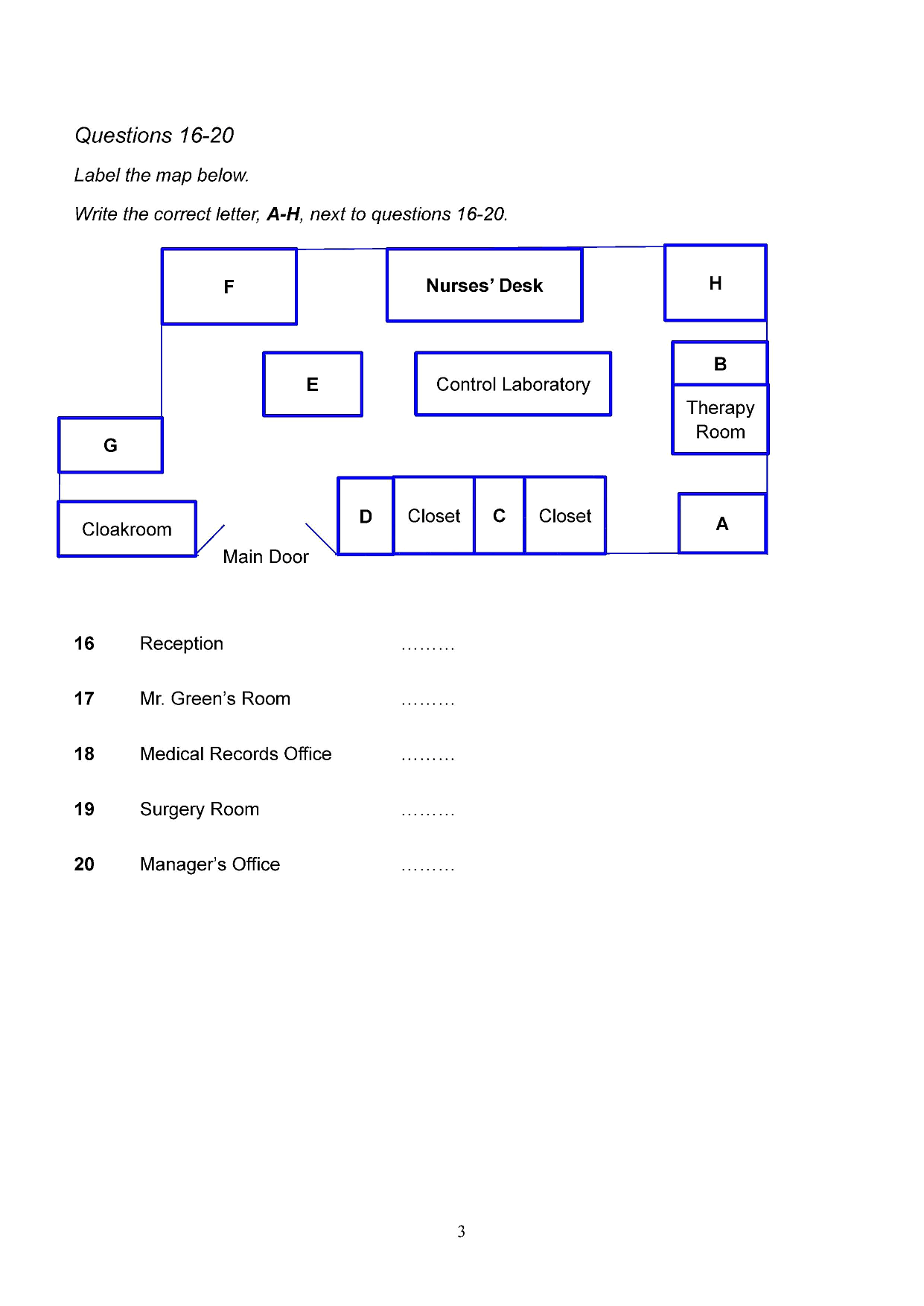
Woman: Now, please look at the map I've given you of the Healthy Hearing Medical Clinic and Surgery.
Woman: For those not familiar with our practice, reception can be found through the main door at the end of the corridor.
Woman: If your consultation is booked with Mr. Green, you need to go through the main door and turn right by the nurses' desk, and his office is at the end of the corridor on your left-hand side.
Woman: If you need to alter any of your personal details, please visit our secretary at the Office for Medical Records, which you will find next to the therapy room.
Woman: If you're awaiting surgery, please first check in with reception, before taking the first door on the right after you enter the clinic.
Woman: Finally, in the event that you feel disappointed with any of the services we have provided, or have any further questions, please locate our Manager's Office, which can be found near the Office for Medical Records and between two closets.
Woman: If you have any more questions about the Healthy Hearing Medical Clinic and Surgery, please do not hesitate to contact us on 01256 111 111.
Narrator: Section 3.
Charlotte: Excuse me, Dr Twain. May I speak with you for a minute?
Dr. Twain: Of course, please come in.
Charlotte: I'm Charlotte York. I'm considering taking your course in Tourism.
Dr. Twain: Right. Well, Charlotte, how can I help you?
Charlotte: I have been considering studying Tourism, however, it is such an important decision that I would like to seek some advice about it first. Would you mind answering some of my questions?
Dr. Twain: Absolutely, fire away!
Charlotte: Well I have been discussing courses with my parents and they are concerned that I will not be able to get a well-paid job with a degree in Tourism. The reason that I want to study the course is that I have a great interest in the subject and I think I would really enjoy it. I believe the only way that I will enjoy my life is if I enjoy my career. Happiness is far more important than money, don't you think?
Dr. Twain: Absolutely. I would much rather be happy and poor rather than rich and miserable. Money cannot buy you happiness.
Charlotte: I'm glad you agree.
Dr. Twain: You needn't worry about money, Charlotte. A large part of the Tourism course is dedicated to teaching students how to manage finances, a skill that you can apply to your everyday life as well. I would also recommend that you take a sideline course in time management, as this can be incredibly useful in efficiently planning your workload. Efficiency is the key to success!
Charlotte: I'll remember that.
Dr. Twain: Now I have found that some students have natural talents that really help them to succeed in the course. Communication skills, for example, can be very beneficial. Do you have any strengths?
Charlotte: Maths was always my favourite subject at school so I really enjoy solving mathematical problems, however I find statistics quite difficult. I have always been very capable and self-sufficient. I have a lot of confidence in my abilities and will take the initiative in situations without needing to depend on anyone else for their help.
Dr. Twain: That's a really great quality to have and will be particularly useful if you choose to study Tourism.
Charlotte: That's great.
Dr. Twain: I would recommend that you spend some of your time researching the course. A lot of people who are uneducated on the subject claim that Tourism is a shrinking industry and that it will become irrelevant in the future. If you study the published research however, you will see that the truth is quite the opposite. The industry has, in fact, grown significantly as people have developed an ever-increasing interest in culture and travel. Have you compared the university course with a polytechnic?
Charlotte: Yes, I have. I was interested in studying the course in modules. However, the university doesn't offer that option. I don't have enough funds to be able to attend an expensive university, so I was relieved to see that the course is quite affordable. I also considered attending a summer school instead of university to save money and so that I could work during the rest of the year, but I really wanted the university experience.
Dr. Twain: I think that university would suit you well.
Dr. Twain: Now, what about the courses? Are you interested in any of the other subjects on offer?
Charlotte: I have looked at a few. I was interested in Travel and Business as it sounds similar to Tourism.
Dr. Twain: That is really worth learning, however, be aware that it is difficult and will demand a lot of your time.
Charlotte: OK, that's good to know.
Dr. Twain: You might find that Japanese is an interesting course and it will teach you valuable skills in speaking the language. Personally, it's not bad and could be of some help, but not that much.
Charlotte: OK, Japanese, got that... What about Medical Care?
Dr. Twain: Well, if you have time, the course will teach you a lot about curing diseases and illnesses, or dealing with injuries outside, although it's not essential.
Charlotte: So, OK, if it's useful, I'll take it.
Dr. Twain: If you enjoy using technology and are worried about fulfilling the entry requirements, computing is very relaxed about the skills that applicants must possess.
Charlotte: I'm terrible with computers so I'm not sure that I would enjoy that course. How about Public Relations?
Dr. Twain: Yes, I would recommend that course. It would be related to entering the Tourism industry as it will educate you on how to approach clients and develop associations with them.
Charlotte: That's great! Thank you so much for your help!
Narrator: Section 4.
Lecturer: Good morning. In the last few lectures I've been talking about the history of technology in the modern world.
Lecturer: But today I want to use Roberts as our case study, which is a company that develops complex camera technology for a range of industries and disciplines.
Lecturer: Since the camera was invented in 1816, it has changed and improved dramatically with cameras now in existence that can fit on the head of a pin.
Lecturer: The company has been founded on a series of principles by which the company operates in its day-to-day business, the most important of these being to enhance the present development of camera technology.
Lecturer: Roberts has a philosophy of pioneering and innovation, having been responsible for the invention of numerous technologies since it was founded by Dwayne Roberts in 1957.
Lecturer: It has achieved many of its aims over the years, but its principal and founding aim persists through time, which is to explore new facts and imagine the unimaginable.
Lecturer: The cameras produced by Roberts have a multitude of potential applications that are currently being explored.
Lecturer: One of these is an anti-gravity camera that they aim to attach to a space satellite from where it will record live, high-definition video and provide fascinating new views of planet earth.
Lecturer: It could also prove useful in exploring other planets by providing researchers with never before seen images of the universe.
Lecturer: Roberts are also experimenting with attaching the cameras to small drones that will fly through the rainforest in search of plants that could be used to develop future medicine.
Lecturer: The camera also has the potential to be used on the roads.
Lecturer: As it is 20% cheaper than the speed cameras that are currently in operation, this means that more of them could be distributed across the road network where they can control traffic by making sure that all cars abide by the speed regulations.
Lecturer: Despite this diverse range of potential applications, the cameras are presently used for very different, more domestic purposes.
Lecturer: Roberts’ cameras are presently used as nanny-cams, which allow parents to watch their nannies to ensure that they are responsibly attending to the children that they have been employed to care for.
Lecturer: These cameras give parents peace of mind and more control over their child's welfare whilst they are at work or otherwise occupied.
Lecturer: The highest sales of the company are in toys that have the cameras hidden within them.
Lecturer: This clever idea means that the cameras are camouflaged from view and do not look out of place in the child's nursery.
Lecturer: The toys are also very robust, so children can play with them without damaging them in the process.
Lecturer: The toys are designed to look like animals and come in a range of shapes, sizes and colors as well as different animal species such as monkeys and bears.
Lecturer: These toys are incredibly popular and can be bought in any toy store for only twenty dollars.
Lecturer: Always eager to be constantly improving their products, Roberts are now working on a product that will change the way people see photography.
Lecturer: This new contraption is a mini camera that is built into eyewear such as glasses and sunglasses where it can capture the world as you see it.
Lecturer: Holiday makers and tourists no longer have to carry a big, heavy camera around with them on their travels.
Lecturer: They can instead purchase a set of eyewear with the built-in camera, which will capture the moment with a simple tap.
Lecturer: Roberts are also developing a model of this tiny camera for use during medical procedures and operations.
Lecturer: The camera will be used during non-invasive keyhole surgeries to enable the surgeon to see what they are doing inside the body without having to make a large incision.
Lecturer: This innovative application for the camera could make surgeries a lot faster and the saved time and energy will also make it far more efficient.
Lecturer: As the patient will no longer have to undergo a large incision for their surgery, it also means that their recovery will be much faster with a greatly reduced chance of post-op infection.
Lecturer: If any of you have an interest in working in this field of technological invention, Roberts is a very diverse and fast-growing company that would be a fantastic internship opportunity.
Lecturer: Every year they organize a series of competitions where entrants stand the chance of winning a place in their internship programme, so I would suggest that all of you enter.
Lecturer: That wraps up the lecture for today. Please remember that attendance is mandatory.