수험생 회상으로 복원된 자료입니다 — 공식 IELTS 자료가 아닙니다. 오디오와 지문은 연습용으로 재구성되었습니다.
스크립트 보기
====================
IELTS Listening Transcript
====================
PART 1
Speaker 0: You will hear a number of different recordings, and you will have to answer questions on what you hear. There will be time for you to read the instructions and questions, and you will have a chance to check your work. All the recordings will be played once only. The test is in four parts. Write all your answers in the listening question booklet. At the end of the test, you will be given ten minutes to transfer your answers to an answer sheet. Now turn to part one on page two of your question booklet. Part one. You will hear a teenager asking about joining a film club. First, you have some time to look at questions one to four. Now listen carefully and answer questions one to four.
Speaker 1: Hi. Can I help you?
Speaker 2: Yeah. I saw on the Internet that you have a film club here at the cinema, but there wasn't a lot about it. Can you tell me a bit more?
Speaker 1: Yes. We're still setting up the web page. Sorry about that. We only started the club a few months ago. It's been very popular right from the beginning. We have regular film showings, and there are lots of other benefits.
Speaker 2: How often does the club meet?
Speaker 1: Every two weeks on Thursday nights.
Speaker 2: Okay. And I'm 16. So could I join?
Speaker 1: Sure. People of any age can join.
Speaker 2: Right. So how much does it cost to join?
Speaker 1: Well, it depends. The basic charge is £24 a season. But for people eligible for concessions, it's £21.50.
Speaker 2: I'm a student.
Speaker 1: You'd get the concession rate then.
Speaker 2: That's good.
Speaker 1: That entitles you to free entry to the club films and also to £2 off tickets for all other films on at the cinema. So you'd pay £4.50 instead of £6.50.
Speaker 2: Great.
Speaker 1: Okay. Now I don't know if this applies to you, but club members are also eligible for three hours complimentary parking when there's a film on.
Speaker 2: Well, I don't drive, but my girlfriend does. So it might be useful.
Speaker 1: Yes.
Speaker 2: Okay. Well, I'd definitely like to join.
Speaker 0: Before you hear the rest of the conversation, you have some time to look at questions five to 10. Now listen and answer questions five to 10.
Speaker 2: Can you give me any information about the next few films you're showing?
Speaker 1: I'm afraid we've run out of leaflets for this season. So I'll tell you about the next few films, and hopefully, we'll have all details on the Internet soon. So the next meeting's this Thursday, October 14, and that's a film called Pablo.
Speaker 2: Ah, read the reviews of that. It's set in Argentina, isn't it?
Speaker 1: Mhmm.
Speaker 2: About a child who's run away from home?
Speaker 1: That's right. It just came out recently. And the kid somehow gets on TV and he wins a dance competition or something.
Speaker 2: A singing competition.
Speaker 1: Yeah. I haven't seen it either, but it tells you on the posters.
Speaker 2: Yes. It sounds really good. Well, I definitely want to see that. What's on after that?
Speaker 1: On October 28, there's an American film called The Soldier. That's an old silent movie. But in this showing, we have someone who'll accompany it on the piano, just like they used to in the old cinemas, though it was sometimes an organ accompaniment in those days.
Speaker 2: Must be a pretty old film then. When did they release the first talkies? 1926 or '27?
Speaker 1: Yes. This was made in 1922, so well before. Though I think they had short feature films with sound by 1923, actually.
Speaker 2: So what sort of film is it?
Speaker 1: Well, it's billed as a comedy. Though you'd think it was a war film from the title. I don't know much about the plot. We don't have much information, though you could always look it up on the Internet.
Speaker 2: Yeah. I'll do that. Then the next film after that?
Speaker 1: So that'll be let's see. The November 11 is a film about animals, and it's just called Tiger. And that's a cartoon film, which makes it sound as if it's for children, but actually, it's aimed at adults, and it's really quite frightening in places. I saw it when it first came out.
Speaker 2: What's it about?
Speaker 1: It's got no humans in it at all. It's just about the effect of environmental changes millions of years ago on the animals who lived then. It's a really strange film. There's a talk afterwards given by the director, so that should be very popular. You'll need to book early for that, I should think.
Speaker 2: Right. Well, thanks for all that. Now if you can give me the application form...
Speaker 1: Sure.
Speaker 0: That is the end of part one. You now have one minute to check your answers to part one.
PART 2
Speaker 3: Part two. You will hear a member of staff called Mary Linden giving some information about their community centre. First, you have some time to look at questions 11 to 14. Now listen carefully and answer questions 11 to 14.
Speaker 3: On behalf of our community centre, I'd like to welcome you all here today. My name is Mary Linden. As you can see here, this multipurpose hall is a great venue for various events, including banquets, seminars or dances. The center provides services for all ages. As the majority of you have already signed up for our dance workshops, I'll introduce relevant information first before we start the tour and get ourselves oriented. Okay. Now when participants check-in for their first dancing session, they will be given a class list printed with available seasonal classes ranging from Zumba to ballet as well as detailed descriptions and schedules. The dance studio will also give you a complimentary shoe bag to store your dance shoes. Every week will be a surprise in cardio movement. Our fitness professional will guide you through an upbeat, heart pumping, lively dance class. Therefore, it is highly advised to bring a face towel and a water bottle with you. As things get mixed up easily, you might also want to attach a name tag to your belongings. It will be sent to you by mail in advance. Now let us get a closer look at our dance workshops and its curriculum. There is a list of activities to participate during and after each session. You'll have the chance to make your own costume, but it won't be held until tomorrow. You can also practice dance with music whenever the studio is available. In the first afternoon and evening of your dance class, there will be an introduction to the development of dance for the past few decades. Then we'll warm up with an informal dance. I know you don't have much experience in dancing, but we'll get there soon. Rest assured, there won't be a dance test until the end of the course.
Speaker 3: Before you hear the rest of the talk, you have some time to look at questions 15 to 20. Now listen and answer questions 15 to 20.
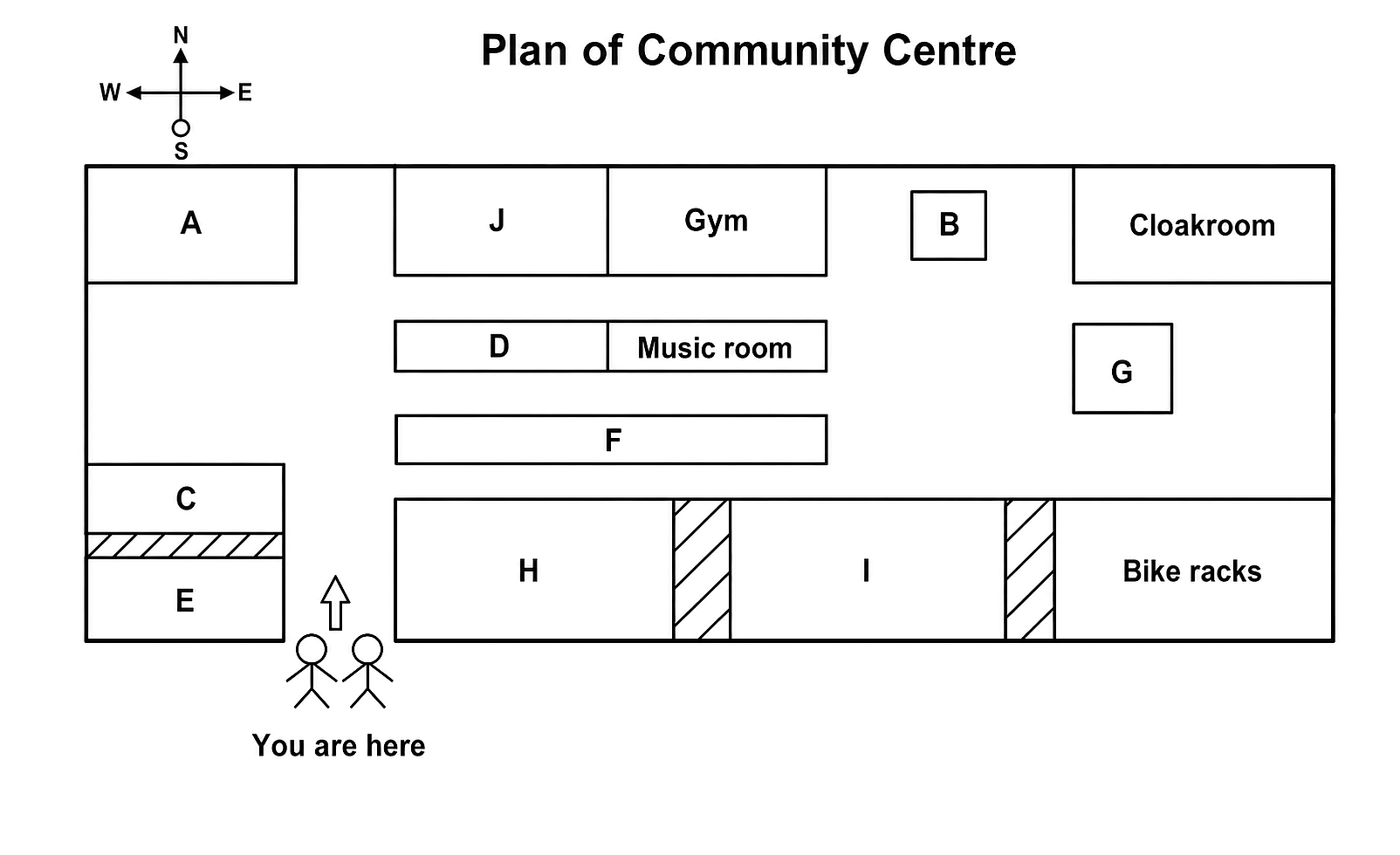
Speaker 3: Okay. Now a word about the layout of the center. Our beautiful facility has 25 rooms altogether, which are both very functional and aesthetically pleasing. We're standing here right at the entrance. To your left, you can see two rooms in a row. After each dance session, you're probably soaking in sweat and in desperate need of a shower. Just go straight ahead, turn left, and the shower room is on your left hand side. If you just want to take a nap, there is a six bed bunk room. It's immediately to the left of where you are standing right before the shower room. We also have a games room with dart boards, table tennis, pool, and card games. It is a good place to have fun with friends. Just take the first right. It is the second area to your right. You can explore it well later during our tour. Further ahead, in the corner, there are the bike racks. You can either park your bike here or hire one if you want a ride. The first hour is free. Part of our dance sessions will take place in the music room. It has a large mirror with various musical instruments and state of the art stereos. If you want to get there, just go straight, take the second right, and it's the second area to your left. Our friendly reception team is an invaluable resource for any visitor to the center. If your mobile phone needs charging, we have several adapters and can easily get your phone back up and running again. We also offer a range of chargeable services, including photocopy, scanning, and faxing. The reception is located in the center to the south of the music room. There is a medical center providing a full spectrum of care and treatment, especially for sports injuries like sprained knee. It's right opposite the reception to the left of the music room. Now I have to tell you about our gym where some of our dance sessions take place. It is also equipped with the latest equipment, including exercise bikes, treadmills, rowing machines, etcetera. If you walk straight ahead before you come to the end and turn right, it's the second room to your left. And speaking of food, if you ever feel hungry, you can either cook in the kitchen or grab a snack at the store. To reach it, keep straight on until you get to the third passageway, turn right, and it's the one after the gym. And the kitchen sits right next to the gym on the same side of the passageway. It has all the utensils you'll need, spatulas, frying pans, ladles, and plates. You name it. Just feel free to use it. By the way, if you have coats, umbrellas, or any large bags with you, the cloakroom is available. It's the room in the top right corner on the far side. Right. Well, if you're ready, we'll start the tour of our lovely community center.
Speaker 3: That is the end of part two. You now have thirty seconds to check your answers to part two.
PART 3
Speaker 4: Section three. You will hear two students called Helen and Paul talking to their tutor about a nursing course. First, you have some time to look at questions 21 to 24. Now listen carefully and answer questions 21 to 24.
Speaker 5: Helen and Paul, congratulations to you both for doing so well the past semester. You two have exhibited an impeccable performance during your first year in the nursing programme. I'd like to get some feedback from the two of you to better improve the programme and to provide guidance for our prospective students. I'd like to start with you, Helen. So, first of all, which aspect of the programme impressed you?
Speaker 3: Well, to be honest, when I was enrolled into the course, I was expecting a group of classmates my age. But as I stepped into the classroom for the first time, I was surprised by the diversity. Most were in their twenties, but there were also those in the thirties or even forties. As it turns out, the intergenerational communication has sparked intense debate and new thinking, and I think that's something special about the program that I appreciate very much.
Speaker 5: What about you, Paul? What do you think of the program?
Speaker 6: For me, the group project we carried out last semester is another key feature of the program. The whole class was divided into eight different groups working on eight prospective cases. Team building sessions were conducted in a collaborative way most of the time. Comprised of five members, our group studied acute pancreatitis. During the process, we broke the task into different parts and assigned them to each member. We were then able to tackle the complex problem by pooling our knowledge and skills. More importantly, stronger links were established between the group members. Because of the project, we've all become good friends.
Speaker 3: That's true.
Speaker 5: According to graduates, group projects prepare them for the work world in which teamwork and collaboration are increasingly the norm. So tell me, Paul, what else do you like about the program?
Speaker 6: I want to be a registered nurse working in a public hospital after graduation, so the internship provided is a valuable opportunity for clinical practice in a supportive learning atmosphere. However, I was amazed by the amount of written assignments since I thought the course should have focused more on practice oriented learning.
Speaker 3: Well, I have to disagree with you, Paul. The essays demonstrate your understanding of the course. For me, writing essays is a process that involves critical thinking, which challenges me to develop my points more thoroughly. I thus manage to gain a diversity of perspectives.
Speaker 5: The programme is designed to deliver basic and advanced theoretical knowledge of core concepts, including health care systems concepts, together with practicum or clinical practice experience to bridge the classroom content to the practice setting. So I'm afraid written work is unavoidable. Also this year, we've added a module of law. How do you feel about that?
Speaker 3: At first, we felt that learning law is kind of redundant and too time consuming. After a few sessions, we realised that it is necessary in dealing with future medical disputes.
Speaker 4: Before you hear the rest of the talk, you have some time to look at questions 25 to 30. Now listen and answer questions 25 to 30.
Speaker 5: Do you have any suggestions for prospective students?
Speaker 6: What bothers me most is handing in essays on time. I almost missed the deadline once because there were three essays due within the same week, so rationalizing your time is critical.
Speaker 3: Well, that's true. The lectures deliver so much useful information. I have poor memory, so I kept making notes and revisiting them on a regular basis. To my surprise, at the end of the semester, I have learned the key concepts by heart.
Speaker 5: How was the research? I heard that it was quite challenging. How did you manage to overcome the difficulties?
Speaker 6: That's true. The majority of us had no clue how to carry out the research at first. Fortunately, when I was digging up reference materials at the library, I sought help from the librarian. She taught me about finding the appropriate resources and choosing the proper research methods.
Speaker 3: Have you checked out the online forum? Yes. It has become a habit for me to visit the forum regularly. In a sense, it extends classroom learning. It is where the students post academic problems that they come across and get support from the faculty members.
Speaker 6: Some of my classmates didn't do so well during the placement tests. I feel that background reading is necessary.
Speaker 5: Lastly, do you have anything to say to the freshman?
Speaker 3: I was really ambitious at first, trying to get straight A's on my transcript. I made tons of notes and worked hard even on the optional assignments to get extra credit. I stress myself out before having an emotional breakdown. After consulting my adviser, I found it important to set realistic goals. Don't push yourself too hard. It is wise to sort out your priorities.
Speaker 5: Thank you for coming here today and providing valuable feedback on the program. Have a great summer break.
Speaker 4: That is the end of section three. You now have half a minute to check your answers.
PART 4
Speaker 7: Part four. You will hear an agriculture student giving part of a presentation about organic farming. First, you have some time to look at questions 31 to 40. Now listen carefully and answer questions 31 to 40.
Speaker 8: Good morning. In today's presentation, I will talk about organic farming. Organic farming is an alternative agricultural system which originated early in the twentieth century in reaction to rapidly changing farming practices. Is a method of crop and livestock production that involves much more than choosing not to use pesticides, fertilisers, genetically modified organisms and antibiotics. Why do we adopt organic farming? There are many advantages of it. To begin with, organic farming is labelled as sustainable because it can protect the environment and maintain biological diversity. It's also rewarding that more and more customers tend to buy organic food nowadays. Product taste, concerns for the environment and the desire to avoid foods from genetically engineered organisms are among the main reasons some consumers prefer to buy organic food products. So this type of farming is expected to contribute to an increase in sales for grocery stores globally. Most studies suggest that organic farming uses significantly less energy than conventional one. This is primarily due to the fact that organic farming eliminates the need for synthetic fertilisers, which require substantial energy for production. In organic farming, soil fertility is maintained through the recycling of organic residues and nutrients produced on the farm. This practice not only reduces energy consumption but also benefits the soil by promoting its health and abundance of organic nutrients. Importantly, organic methods have the potential to effectively control insects that pose threats to crops, unlike artificial fertilizers, which may not have the same level of efficacy. For example, a common practice in organic farming to control aphids, which are pests that can damage crops, is the introduction of ladybugs into the fields. Ladybugs are natural predators of aphids and feed on them, effectively reducing their population. This method is environmentally friendly and avoids the use of synthetic pesticides. There are, of course, some disadvantages of organic farming. This past winter, due to extreme weather conditions, the production of potatoes in the north of our country had gone down by 40%. Lots of farmers had to face the severe loss in the production. The top 10 organic company in this country, Winter Wild Production, just announced that their sales have been really slow because of the natural disasters. In the past, the sales might increase by 30%, but this year it's only gone up by 20%. Despite weather challenges, the production of organic grass has not changed much over the years due to the implementation of various strategies. These include the use of resilient crop varieties that are carefully selected for their ability to withstand varying climatic conditions, the adoption of sustainable farming practices that prioritise soil health and fertility, and the incorporation of innovative irrigation and water management techniques. In the 1950s, organic farming in India experienced several changes. One notable development was the growing production of crops through organic farming practices, especially when compared to the early days when there was a food crisis. This positive outcome encouraged farmers to explore and adopt organic methods. Unlike the common perception that farmers were unwilling to accept organic farming, they actually showed interest in its potential benefits. However, despite their enthusiasm, farmers faced challenges in successfully implementing organic farming techniques. They encountered difficulties in effectively applying the prescribed instructions, which hindered their ability to fully embrace organic farming practices. In the 1990s, the United Nations World Food Programme published an international review on organic farming practices. The review examined the global implications of organic methods, concluding that such practices, invoid synthetic chemicals, provide a sanctuary for wildlife, thereby enhancing biodiversity and ecological health. Following the publication, an increased number of countries began showing interest in these findings. Subsequently, many took steps to improve their agricultural practices, integrating organic farming principles to support both the environment and local economy. As I have mentioned, compared to the conventional farming, organic farming has its advantages and disadvantages. Consumers' knowledge about organic food is increasing. So are their attitudes, preferences and willingness to pay for organic products. The good thing is that the scale of organic farming can be mostly determined by the demands of the market. Governments will respect people's attitudes towards how they want their food to be produced. Of course, environmental protection should never stop however agriculture is developed in the future. What I'm going to share next is...
Speaker 7: That is the end of part four. You now have half a minute to check your answers. That is the end of the listening test.