Listening 2026-01 Test 4

시험 월: 2026-01

수험생 회상으로 복원된 자료입니다 — 공식 IELTS 자료가 아닙니다. 오디오와 지문은 연습용으로 재구성되었습니다.

재구성 오디오

Section 1: Birmingham Exhibition

Complete the notes below. Write NO MORE THAN TWO WORDS AND/OR A NUMBER for each answer.

BIRMINGHAM EXHIBITION • Open in: 1.______________ . • Length of exhibition: 2. ______________ . • A wide range of manufacturers will be showcased. • Some cars are available to observe and others are for 3. ______________ . • The 4. is prohibited to take into the museum. • Every ticket includes one free photo. • Price of the ticket: 5. £______________ (in advance). • Transfer to Mark 6. ______________ (Box Office Manager). • Held in the 7. ______________ Palace this year. • Not far from 8. ______________ . • Website: www. 9. ______________ .com. • Best way to contact: 10. ______________ .
  1. 1

    Open in: 1.______________ .

  2. 2

    Length of exhibition: 2. ______________ .

  3. 3

    Some cars are available to observe and others are for 3. ______________ .

  4. 4

    The 4. is prohibited to take into the museum.

  5. 5

    Price of the ticket: 5. £______________ (in advance).

  6. 6

    Transfer to Mark 6. ______________ (Box Office Manager).

  7. 7

    Held in the 7. ______________ Palace this year.

  8. 8

    Not far from 8. ______________ .

  9. 9

    Website: www. 9. ______________ .com.

  10. 10

    Best way to contact: 10. ______________ .

Section 2: Hospital Consultation

Answer the questions below. Choose the correct letter, A, B, or C.

  1. 11

    How many patients does the hospital consult every year?

    • A. 3,000.
    • B. 5,000.
    • C. 11,000.
  2. 12

    When can patients meet the female doctor?

    • A. On weekday mornings.
    • B. Three days a week.
    • C. Only on Mondays and Fridays.
  3. 13

    Who is the expert on treating hearing loss?

    • A. Mr. Roberts.
    • B. Mr Green.
    • C. Mr. Edwards.
  4. 14

    Where are patients recommended to buy their medicine?

    • A. The supermarket in the town.
    • B. Pharmacies nearby the city centre.
    • C. The health care's pharmacy.
  5. 15

    What will the patients be asked about whether they are willing to do?

    • A. Letting one student attend the consultation.
    • B. Asking postgraduate students to do treatment.
    • C. Meeting students in group discussion.

Section 2: Hospital Map Labelling

Label the map below. Write the correct letter, A-H, next to questions 16-20.
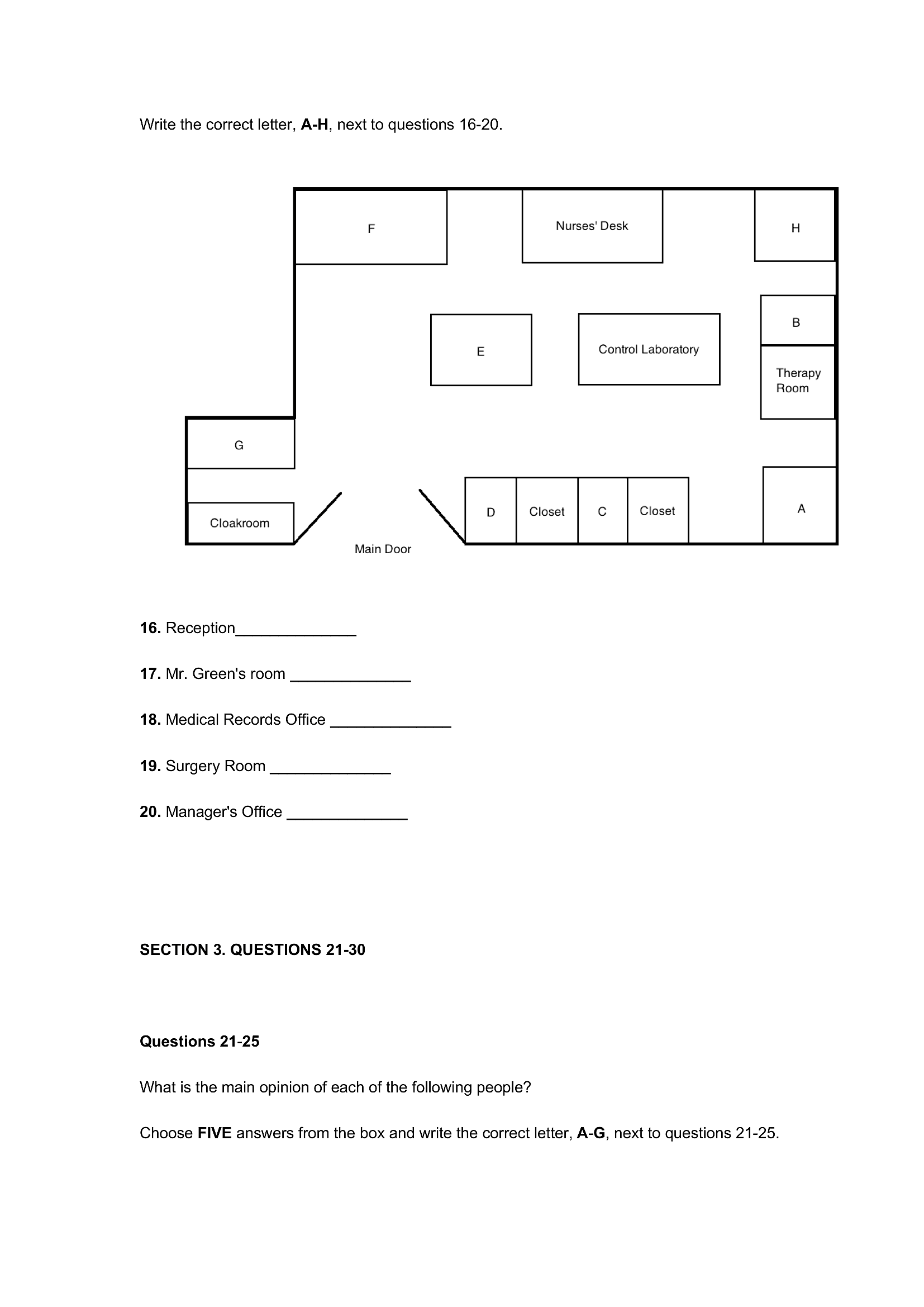
Hospital floor plan
  1. 16

    Reception

  2. 17

    Mr. Green's room

  3. 18

    Medical Records Office

  4. 19

    Surgery Room

  5. 20

    Manager's Office

Section 3: Opinions on Lighting and Animals

What is the main opinion of each of the following people? Choose FIVE answers from the box and write the correct letter, A-G, next to questions 21-25.

Opinions A lightning restrictions B alternative lighting C reduce the number of insects D decline in the number of species E climate changes F impacts on the growth of animals G impacts on water quality
  1. 21

    Ken Simpson

  2. 22

    Dave Kepler

  3. 23

    Sharon Grey

  4. 24

    Maria Jackson

  5. 25

    Barbara Swallow

Section 3: Jim and Jane's Opinions

Choose the correct letter, A, B or C.

  1. 26

    What does Jim think about the difference among species in natural and artificial light?

    • A. It makes no difference.
    • B. Species will die out in natural light.
    • C. Species will die out in artificial light.
  2. 27

    One reason why Jim and Jane felt unsatisfied about the theories discussed in the lecture was that

    • A. governments didn't increase any spending on them.
    • B. most theories had nothing to do with the exam.
    • C. many theories lack solid proof in the field.

Section 3: Future Study Interests

Choose THREE letters, A-G. Which THREE topics are they interested in studying in the future?

A quality of life tourism B wildlife park animals C migration birds D animals living in rural areas E animals living in tropical climate F the impact of different environment on animals G pandas in the zoo
  1. 28

    Which THREE topics are they interested in studying in the future? (First choice)

    • A. quality of life tourism
    • B. wildlife park animals
    • C. migration birds
    • D. animals living in rural areas
    • E. animals living in tropical climate
    • F. the impact of different environment on animals
    • G. pandas in the zoo
  2. 29

    Which THREE topics are they interested in studying in the future? (Second choice)

    • A. quality of life tourism
    • B. wildlife park animals
    • C. migration birds
    • D. animals living in rural areas
    • E. animals living in tropical climate
    • F. the impact of different environment on animals
    • G. pandas in the zoo
  3. 30

    Which THREE topics are they interested in studying in the future? (Third choice)

    • A. quality of life tourism
    • B. wildlife park animals
    • C. migration birds
    • D. animals living in rural areas
    • E. animals living in tropical climate
    • F. the impact of different environment on animals
    • G. pandas in the zoo

Section 4: New Rules in Football

Choose TWO letters, A-E. Which TWO aspects did the new rules at the end of the 19th century focus on?

  1. 31

    Which TWO aspects did the new rules at the end of the 19th century focus on? (First aspect)

    • A. cooperation
    • B. competition
    • C. moral values
    • D. player's physical protection
    • E. business model
  2. 32

    Which TWO aspects did the new rules at the end of the 19th century focus on? (Second aspect)

    • A. cooperation
    • B. competition
    • C. moral values
    • D. player's physical protection
    • E. business model

Section 4: Football in the UK

Complete the sentences below. Write ONLY ONE WORD for each answer.

Football in the UK • At present the main reason why UK schools push football education is the pressure from 33. ______________ . • Prior to the 19th, football players used different 34.______________ of rules. • People attempted to standardise the rules from the whole 35. ______________ , known as the 'Cambridge Rules' in 1848. • Attendances were increasing due to the improvement of infrastructure and the 36. ______________ system. • Football became popular and it is regarded as a 37. ______________ event. • The football clubs were responsible for most of the 38. ______________ and development for the football association. • 39. ______________ against other teams were also organised by the football clubs. • In 1910s, 40. ______________ football players were approved of in the game.
  1. 33

    At present the main reason why UK schools push football education is the pressure from 33. ______________ .

  2. 34

    Prior to the 19th, football players used different 34.______________ of rules.

  3. 35

    People attempted to standardise the rules from the whole 35. ______________ , known as the 'Cambridge Rules' in 1848.

  4. 36

    Attendances were increasing due to the improvement of infrastructure and the 36. ______________ system.

  5. 37

    Football became popular and it is regarded as a 37. ______________ event.

  6. 38

    The football clubs were responsible for most of the 38. ______________ and development for the football association.

  7. 39

    39. ______________ against other teams were also organised by the football clubs.

  8. 40

    In 1910s, 40. ______________ football players were approved of in the game.

답안지

문제를 풀면서 바로 입력하세요 — 즉시 채점되고, 틀린 문제는 오답노트에 저장되어 관련 해설과 함께 복습할 수 있습니다.

  1. 1.
  2. 2.
  3. 3.
  4. 4.
  5. 5.
  6. 6.
  7. 7.
  8. 8.
  9. 9.
  10. 10.
  11. 11.
  12. 12.
  13. 13.
  14. 14.
  15. 15.
  16. 16.
  17. 17.
  18. 18.
  19. 19.
  20. 20.
  21. 21.
  22. 22.
  23. 23.
  24. 24.
  25. 25.
  26. 26.
  27. 27.
  28. 28.
  29. 29.
  30. 30.
  31. 31.
  32. 32.
  33. 33.
  34. 34.
  35. 35.
  36. 36.
  37. 37.
  38. 38.
  39. 39.
  40. 40.
이 기기에 저장됩니다 — 계정 없이 사용 가능. 다른 곳과 연동하려면 진행 페이지에서 로그인하세요.
스크립트 보기
==================== IELTS Listening Transcript ==================== PART 1 Speaker 0: You will hear a number of different recordings, and you will have to answer questions on what you hear. There will be time for you to read the instructions and questions, and you will have a chance to check your work. All the recordings will be played once only. The test is in four sections. At the end of the test, you will be given ten minutes to transfer your answers to an answer sheet. Now turn to section one. Section one. You will hear a woman phoning to inquire about exhibition information. First, you have some time to look at questions one to four. You will see that there is an example that has been done for you. On this occasion only, the conversation relating to this will be played first. Speaker 1: Good morning. You're through to the events coordinator at the Birmingham City Council. Speaker 2: How may I help you? Hello there. My husband and I are interested in purchasing tickets to the automobile exhibition, but I couldn't find many details about it on your website. And I was wondering whether you could provide me with some more information. Does it open in June? Speaker 0: The purpose of calling is to purchase tickets, so purchasing has been written in the space. Now we shall begin. You should answer the questions as you listen because you will not hear the recording a second time. Listen carefully and answer questions one to four. Speaker 1: Good morning. You're through to the events coordinator at the Birmingham City Council. Speaker 2: How may I help you? Hello there. My husband and I are interested in purchasing tickets to the automobile exhibition, but I couldn't find many details about it on your website. And I was wondering whether you could provide me with some more information. Does it open in June? Speaker 1: Yes. Of course, madam. The exhibition will take place during July and will showcase the history of automobiles from the very first commercial car in the late eighteen hundreds all the way through to the present day. Speaker 2: Is the exhibition open for the duration of July? Speaker 1: No, madam. The exhibition will last three days from July 1 to July 3, and then the cars will be taken to another exhibition. Speaker 2: Okay. Does the exhibition focus on a certain manufacturer? Speaker 1: No. It will showcase a wide range of manufacturers. Speaker 2: Wonderful. I'm ever so fed up of going to these shows and only seeing one manufacturer. Are there any opportunities to sit in or even drive the cars? Speaker 1: There will be many opportunities for you to sit in the cars. However, some of the cars will only be available to observe. We are yet to be told whether any of the antique cars will be available to drive. However, there will certainly be an opportunity to test drive some of the more modern cars on a purpose-built track. Speaker 2: That sounds like great fun. I mustn't forget to bring my camera or my husband will never forgive me. Speaker 1: I'm afraid to say that cameras are actually strictly not allowed to bring into the exhibition. There will, however, be a section where a professional photographer will be available to take photos of you sitting in a car in period clothing. Speaker 2: Well, that sounds like it could be fun, but I assume the photos won't be free. Speaker 1: On the contrary, one free photograph is included within every ticket, but each photo after this will cost £5. Speaker 0: Before you hear the rest of the conversation, you have some time to look at questions five to 10. Now listen and answer questions five to 10. Speaker 2: That's a nice surprise. Not many things are free anymore. I've been asking around about the ticket prices, but I haven't yet had a definite answer. Is it correct that the tickets are £100 whether you buy them now or on arrival? Speaker 1: I'm afraid not. If you buy the ticket in advance, the price is £110, but it's £165 on the door. Speaker 2: Oh, goodness. I suppose I best pay for them now then. Is it possible to buy tickets from you now over the phone? Speaker 1: Yes. Of course, madam. I'll transfer you to the box office manager, Mark Edgeworth. That's E D G E W O R T H, and he will probably need to take your credit card details and some personal details. Speaker 2: Yes. That's fine. Before you transfer me, I just need to ask a few more questions. Will the exhibition be held in the Birmingham Exhibition Center? I think that's where I went last time. Speaker 1: No, madam. The Birmingham Exhibition Center is currently undergoing some renovations. So this year, all exhibitions will be held in the Summer Palace. Speaker 2: Summer Palace? I'm not entirely sure where that is. Speaker 1: Well, it's not too far from city center. Once you're in the center, you should be able to find signs for the palace. If not, most people in Birmingham will be able to direct you. Speaker 2: Neither my husband nor I am particularly good with directions. Is there anywhere I can find this information on the Internet? Speaker 1: Our website will give you an address. Perhaps you could visit www.directions.com for more detailed information, and they should be able to provide you with step-by-step instructions. Speaker 2: Okay. And is this the best way to contact you by phone? Speaker 1: I think the most convenient way to contact us is inquiring online, which is much simpler than having to dial various different numbers to reach the right person. Unless you have any more questions, I'll transfer you now. Speaker 2: No. That's great. Thank you for your help. Speaker 0: That is the end of section one. You now have half a minute to check your answers. Now turn to section two. PART 2 Speaker 0: Section two. You will hear part of a talk given by a member of staff at a hospital. First, you have some time to look at questions 11 to 15. Now listen carefully and answer questions 11 to 15. Speaker 3: Hello and welcome to the home page for the Healthy Hearing Medical Clinic and Surgery where we'd like to share a little more information about the services we provide and more. Our hospital is one of the leading specialised hospitals in the United Kingdom, attracting the very best healthcare professionals from around the globe. Not only are we a leading medical practice, but we are also the only hospital in the United Kingdom dedicated entirely to the treatment of, and research into, the curing of hearing loss. Our facilities and staff here are renowned across Europe, attracting thousands of patients a year. Our consultations can number anything up to 11,000 patients a year. However, we aim to treat around 5,000 patients a year so as to maintain and ensure the quality of our services. Our patients are guaranteed the highest standard of care as well as the use of our first-class facilities. All patients requiring overnight treatment are provided with their own private room with ensuite facilities, as well as a state-of-the-art entertainment center which includes a flat-screen LCD television and PlayStation. Appointments with our healthcare professionals can be made at any time during the week with female doctors available between 8 AM and 11 AM. If you need to see a doctor outside of these times, please visit the out-of-hours page of our website for more information. Our doctors are all trained to an exceptionally high standard and practice a vast array of specialities. Mr. Roberts is a fully qualified ear and throat specialist. Mr. Edwards is a paediatric hearing specialist, while Mr. Green specialises in reversing hearing loss. For more details about our people, please visit the staff members page on our website. During a consultation, doctors will sometimes decide medication is required for which patients should receive a prescription. There are several pharmacies within the city, however we recommend that patients use the pharmacy housed within our healthcare facility. Our in-house pharmacy is well stocked at all times. Our products are competitively priced and our pharmacists are on hand to help and advise from 8 AM until 10 PM from Monday to Saturday and from 9 AM until 12 PM on Sundays. If you require any help outside of these hours, please see our out-of-hours page on the website. Since the Healthy Hearing Medical Clinic and Surgery also functions as a teaching hospital, we aim to provide our students with every opportunity to expose themselves to medicine in practice. Therefore, we would like to encourage our patients to give their consent for a medical student to attend their consultations. If our patients are not comfortable with this, there will be a form at reception where patients will be able to opt out. Speaker 0: Before you hear the rest of the talk, you have some time to look at questions 16 to 20. Now listen and answer questions 16 to 20. Speaker 3: Now please look at the map I've given you of the Healthy Hearing Medical Clinic and Surgery. For those not familiar with our practice, reception can be found through the main door at the end of the corridor. If your consultation is booked with Mr. Green, you need to go through the main door and turn right by the nurse's desk and his office is at the end of the corridor on your left-hand side. If you need to alter any of your personal details, please visit our secretary at the Office for Medical Records which you will find next to the Therapy Room. If you're awaiting surgery, please first check-in with reception before taking the first door on the right after you enter the clinic. Finally, in the event that you feel disappointed with any of the services we have provided or have any further questions, please locate our manager's office, which can be found near the Office for Medical Records and between two closets. If you have any more questions about the Healthy Hearing Medical Clinic and Surgery, please do not hesitate to contact us on 1256 111 011. Speaker 0: That is the end of section two. You now have half a minute to check your answers. Now turn to section three. PART 3 Speaker 0: Section three. You will hear Jim and Jane, two students, talking about their professor's lecture. First, you have some time to look at questions 21 to 25. Now listen carefully and answer questions 21 to 25. Speaker 4: Jane, what did you think of Professor Morgan's lecture? I don't know about you, but I find it incredibly difficult to believe that light influences the environment as much as he says. I've never seen any journal articles, websites, or anything that verifies his arguments. It's stupid. Speaker 3: On the contrary, I've seen a great deal of research supporting his argument from a wide range of renowned scientists. Have you looked at the recommended textbook listed on the course outline given to us at the beginning of the semester? All the information is in there. Perhaps you've just been looking in the wrong places. Speaker 4: I never look at the course outlines. I have so many loose sheets of paper I tend to lose anything I'm given by the end of the day. What's the textbook they recommend, and where can I get it from? I should probably go buy it soon. I'm already behind in the course. Speaker 3: Yeah. You definitely should buy it, and our grades are more important this year. It's called "The Influence of Light on the Environment." You should be able to find it in the bookshop on campus. If not, they'll order it within two weeks. In the meantime, you should read up on Ken Simpson's work. He argues that in order to protect natural habitats, governments should endeavor to turn off lights in cities at night. Speaker 4: Well, that's controversial. I doubt any government would be willing to do that anytime soon. I imagine roads would become quite dangerous without street lighting. For this issue, Dave Keppler suggests they could just replace the existing lights with more environmentally friendly bulbs. They could even install solar-powered lights. That way, roads will be more eco-friendly while maintaining safety. Although I guess they wouldn't be particularly effective in colder countries, especially during the winter. Speaker 3: That's quite a good idea, actually. The price of solar power is supposed to be on par with electricity within the next few decades, and it was on the news this morning. I've also heard that according to Sharon Gray, in countries with more sunlight, insect-eating animals tend to be smaller in size since there are fewer insects and the remaining insects produced a smaller number of eggs. Speaker 4: Yeah. I think I read somewhere that sunlight also has a negative effect on the quality of water, but I'm not sure I believe it. In many hot countries, particularly developing countries, there is a lot of water pollution caused by factories rather than sunlight. Nevertheless, Maria Jackson says that in direct sunlight, the surface of the water becomes more translucent. Therefore, it affects the amount of sunlight that aquatic insects can absorb. Not much research has been undertaken to prove Jackson's theory, but it seems to have been widely accepted anyway. Speaker 3: I've never heard of that. I'll have to look it up on Google. The only other theory I've studied is Barbara Swallow's study on how declined insect population adversely affects the frog population. Not that I'm complaining. I hate insects, especially spiders. Speaker 4: You have arachnophobia? I never would have guessed. Didn't your brother have a pet black widow spider? Speaker 3: Yes. He did, and I hated it. It escaped from its cage once, and we never found it. I had nightmares for months. Speaker 0: Before you hear the rest of the conversation, you have some time to look at questions 26 to 30. Now listen and answer questions 26 to 30. Speaker 3: Okay. Now I'm getting goosebumps. Let's change the subject. What's your stance on natural and artificial light? Speaker 4: Honestly, I'm not sure it makes much difference which one you use. Species will die out either way. I think the real argument we should consider is global warming and protection or replacement of finite fuels. Solar power provides us with an incredible opportunity to replace electricity, and governments should definitely increase spending on research in this field. The theories discussed in our lectures, like Simpson's and Gray's, are so vague and lack proof, so I don't understand why we even study them. Speaker 3: I see what you mean. I don't like learning unsupported theories for exams, and I'd rather spend my time learning something else. For example, I'd be much more interested in studying the animals in safari parks than researching migratory birds, particularly the effect of tourists on the quality of life of animals. As we know, every year thousands of visitors will drive in their own vehicles or ride in vehicles provided by the facility to observe freely roaming animals. Speaker 4: Yeah. That would be really interesting. Especially those animals living in more tropical countries like Borneo. Following on from that, I want to study how bringing animals over from foreign countries to put in our zoos affects their life expectancy. For example, do you remember when China sent pandas to Edinburgh Zoo? Apparently, one of the pandas became depressed, but it was never explained why. To me, obviously, you can't take an animal out of its natural habitat and put it in a cage on the other side of the world. It just doesn't work. Speaker 0: That is the end of section three. You now have half a minute to check your answers. Now turn to section four. PART 4 Speaker 0: Section four. You will hear a talk on the history of football in Great Britain in the nineteenth century. First, you have some time to look at questions 31 to 40. Now listen carefully and answer questions 31 to 40. Speaker 1: Great Britain is often hailed as the home of football, with talented players traveling from far and wide to play for teams in the English Premier League, one of the most popular football leagues on the planet. Today, we are going to take a look back to the nineteenth century Great Britain in an attempt to trace the evolution of the beautiful game as it is now known. Prior to the nineteenth century, the game featured a wide variety of local and regional adaptations, which were later smartened up and made more uniform to create our modern-day sports of association football, rugby football, and Ireland's Gaelic football. Even up to the mid-nineteenth century, Shrove Tide football or mob football was still widely practiced. According to the rules of mob football, there were no rules. A player could legally use any means whatsoever to obtain the ball, such as kicking, punching, biting, and gouging, with the only exceptions being murder and manslaughter. These games may be regarded as the ancestors of modern codes of football, and by comparison with later models of football, they were chaotic and had few cooperation. Towards the latter end of the nineteenth century and moving into the early part of the twentieth century, however, there appeared a newfound emphasis on moral values in football. Perhaps a more modern example of this can be seen in John Terry's suspension as England captain following reports of his infidelity to his wife. Furthermore, as mob football died away, there grew a greater concern for players' health and general well-being, with many clubs affording their top players access to frequent medical checkups and treatment. Despite the presence of Great Britain's unique state-funded national health service, football clubs are still seen today providing team members with state-of-the-art healthcare facilities, with the top clubs even housing their own specialist doctors and physicians. Today, football is a key feature of school children's day-to-day education, particularly for boys. With the help of football associations, all schools in the UK are boasting their own football teams. This mainly comes as a result of pressure put on schools and the government by concerned parents who felt that football education taught their children valuable lessons and indeed vital life skills, such as teamwork and a drive to succeed. Nowadays, many of the UK's top football clubs provide training facilities and outreach programs in an attempt to educate the nation's aspiring youths. As I previously mentioned, it was only during the nineteenth century that football in its uniform concept truly began to emerge, with footballers previously playing according to their own versions of the rules. However, it was not until the early twentieth century that different players actually began to play according to these standardized rules. Prior to the nineteenth century, football was played by all the major English public schools, including the likes of Eton College, Winchester College, and Harrow. In 1848, there was a meeting at Cambridge University in an attempt to lay down the laws of football. Present at the meeting were representatives of each of these major public schools, whom each brought a copy of the rules enforced by their own individual school's rules of football. The result of the meeting was what is now known as the Cambridge rules, thereby uniting the rules from across the country into one simple document. However, the Cambridge rules were not liked by all, and a new set of rules, Thring's rules, compounded in the book "The Simplest Game," became commonplace among dissenters. Across the country, improvements in infrastructure and public transport had a knock-on effect of dramatically increasing attendance to football games. Football quickly became a social event where spectators would meet friends, drink tea, and chat about the good old days. As football became more and more popular, it was decided that more money should be invested in maintaining the quality of pitches amongst other things, and there was even talk of installing seating for spectators. However, the question of who was to foot the bill quickly became a divisive issue with many believing that the government should fund football's development as a national sport. But in the end, the onus fell upon Britain's local and regional football clubs for the funding and development of the football association. They became responsible for the upkeep of football grounds, began to pay their best players a small salary, and organized competitions against other local and regional teams. And there began England's Football Association or the FA, as we know it in its current form, the governing body of football in England. As the FA continued to grow and accumulate greater wealth, it was able to attract more and more talented young men from across the country before finally accepting professional talent in the early twentieth century. Today, football is played at a professional level all over the world. Millions of people regularly go to football stadiums to follow their favorite teams, while billions more watch the game on television or on the Internet. Speaker 0: That is the end of section four. You now have half a minute to check your answers. That is the end of the listening test. In the IELTS test, you will now have ten minutes to transfer your answers to the answer sheet.
정답 보기

정답표

  1. 1. July

    The answer is 'July' because the woman asks if the exhibition opens in June, and is told, 'The exhibition will take place during July.'

  2. 2. Three days

    The answer is 'Three days' because it is stated, 'The exhibition will last three days from July 1 to July 3.'

  3. 3. sitting in

    The answer is 'Test driving' because the speaker says, 'there will certainly be an opportunity to test drive some of the more modern cars.'

  4. 4. Camera

    The answer is 'Camera' because it is said, 'cameras are actually strictly not allowed to bring into the exhibition.'

  5. 5. 110

    The answer is '110' because the ticket price is, 'If you buy the ticket in advance, the price is £110.'

  6. 6. Edgeworth

    The answer is 'Edgeworth' because the woman is told, 'I'll transfer you to the box office manager, Mark Edgeworth.'

  7. 7. Summer

    The answer is 'Summer' because the exhibition is held in 'the Summer Palace.'

  8. 8. city centre / city center

    The answer is 'City centre' because the Summer Palace 'is not too far from city center.'

  9. 9. Directions

    The answer is 'Directions' because the website given is 'www.directions.com.'

  10. 10. enquiring online / inquiring online

    The answer is 'Enquiring online' because the speaker says, 'the most convenient way to contact us is inquiring online.'

  11. 11. C

    The answer is 'C' (11,000) because it is said, 'Our consultations can number anything up to 11,000 patients a year.' The tempting wrong answer 'B' (5,000) is the number they aim to treat, not the number they consult.

  12. 12. A

    The answer is 'A' (On weekday mornings) because female doctors are 'available between 8 AM and 11 AM,' which are morning hours during the week. The other options mention specific days, but the passage says 'any time during the week.'

  13. 13. B

    The answer is 'B' (Mr Green) because 'Mr. Green specialises in reversing hearing loss.'

  14. 14. C

    The answer is 'C' (The health care's pharmacy) because 'we recommend that patients use the pharmacy housed within our healthcare facility.'

  15. 15. A

    The answer is 'A' (Letting one student attend the consultation) because patients are encouraged 'to give their consent for a medical student to attend their consultations.'

  16. 16. F

    The answer is 'F' because 'reception can be found through the main door at the end of the corridor.'

  17. 17. H

    The answer is 'H' because Mr. Green's office is 'at the end of the corridor on your left-hand side' after turning right by the nurse's desk.

  18. 18. A

    The answer is 'A' because the Medical Records Office is 'next to the Therapy Room.'

  19. 19. D

    The answer is 'D' because for surgery, 'take the first door on the right after you enter the clinic.'

  20. 20. C

    The answer is 'C' because the manager's office 'can be found near the Office for Medical Records and between two closets.'

  21. 21. A

    The answer is 'A' because Ken Simpson 'argues that in order to protect natural habitats, governments should endeavor to turn off lights in cities at night.'

  22. 22. B

    The answer is 'B' because Dave Kepler 'suggests they could just replace the existing lights with more environmentally friendly bulbs... even install solar-powered lights.'

  23. 23. F

    The answer is 'F' because Sharon Gray says 'in countries with more sunlight, insect-eating animals tend to be smaller in size.'

  24. 24. G

    The answer is 'G' because Maria Jackson says 'in direct sunlight, the surface of the water becomes more translucent... affects the amount of sunlight that aquatic insects can absorb.'

  25. 25. D

    The answer is 'D' because Barbara Swallow's study is about 'how declined insect population adversely affects the frog population.'

  26. 26. A

    The answer is 'A' (It makes no difference) because Jim says, 'I'm not sure it makes much difference which one you use. Species will die out either way.'

  27. 27. C

    The answer is 'C' (many theories lack solid proof in the field) because Jim says, 'The theories discussed in our lectures... are so vague and lack proof.'

  28. 28. B

    The answer is 'B' (wildlife park animals) because Jane says, 'I'd be much more interested in studying the animals in safari parks.'

  29. 29. E

    The answer is 'E' (animals living in tropical climate) because Jim says, 'Especially those animals living in more tropical countries like Borneo.'

  30. 30. F

    The answer is 'F' (the impact of different environment on animals) because Jim wants to study 'how bringing animals over from foreign countries to put in our zoos affects their life expectancy.'

  31. 31. C

    The answer is 'C' (moral values) because the passage says, 'there appeared a newfound emphasis on moral values in football.'

  32. 32. D

    The answer is 'D' (player's physical protection) because there was 'a greater concern for players' health and general well-being.'

  33. 33. Parents

    The answer is 'Parents' because football education in schools comes 'as a result of pressure put on schools and the government by concerned parents.'

  34. 34. Versions

    The answer is 'Versions' because 'footballers previously playing according to their own versions of the rules.'

  35. 35. Country

    The answer is 'Country' because the Cambridge rules 'united the rules from across the country into one simple document.'

  36. 36. Transport

    The answer is 'Transport' because 'improvements in infrastructure and public transport had a knock-on effect of dramatically increasing attendance.'

  37. 37. Social

    The answer is 'Social' because 'Football quickly became a social event where spectators would meet friends, drink tea, and chat.'

  38. 38. Funding

    The answer is 'Funding' because 'the onus fell upon Britain's local and regional football clubs for the funding and development of the football association.'

  39. 39. Competitions

    The answer is 'Competitions' because clubs 'organized competitions against other local and regional teams.'

  40. 40. Professional

    The answer is 'Professional' because the FA 'finally accepting professional talent in the early twentieth century.'