درباره این مجموعه: از محتوای واقعی آزمون که شرکتکنندگان به یاد آوردهاند جمعآوری و کمی ویرایش شده است. IELTS از بانک سوالات جهانی استفاده میکند، بنابراین این مطالب در سراسر جهان استفاده میشوند. برای اینکه یک آزمون کامل و قابل حل داشته باشید، مطالب گزارششده در یک بازه زمانی کنار هم قرار گرفتهاند — بنابراین ممکن است یک مجموعه شامل محتوای چند تاریخ مختلف باشد، نه فقط یک آزمون. هر فایل صوتی بازسازیشده و برای تمرین است. برای راحتی مطالعه سازماندهی شدهاند. بر اساس خاطرات شرکتکنندگان — محتوای رسمی IELTS نیست.
Reading Passage 1: A Brief History of Tea
Reading Passage 1 has eight paragraphs, A-H. Choose the correct heading for each paragraph from the list of headings below. Write the correct number, i-xi, in boxes 1-8 on your answer sheet.Look at the following statements (Question 9-13) and the list of countries below. Match each statement with the correct country, A-G. Write the correct letter, A-G, in boxes 9-13 on your answer sheet.
A The story of tea began in ancient China over 5,000 years ago. According to legend, the Emperor Shen Nung was a skilled ruler, creative scientist and patron of the arts. His far-sighted edicts required, among other things, that all drinking water be boiled as a hygienic precaution. One summer day while visiting a distant region of his realm, he and the court stopped to rest. In accordance with his ruling, the servants began to boil water for the court to drink. Dried leaves from a nearby bush fell into the boiling water, and as the leaves infused the water turned brown. As a scientist, the Emperor was intrigued by the new liquid, drank some, and found it very refreshing. And so, according to legend, tea was created.
B Tea consumption spread throughout Chinese culture, reaching into every aspect of the society. The first definitive book was written on tea – a book clearly reflecting Zen Buddhist philosophy – 1,200 years ago. The first tea seeds were brought to Japan by a returning Buddhist priest who had seen the value of tea in enhancing meditation in China. As a result, he is known as the ‘Father of Tea’ in Japan. Because of this early association, tea in Japan has always been linked with Zen Buddhism. Tea received the Japanese Emperor’s support almost instantly and spread rapidly from the royal court and monasteries to other sections of society.
C Tea was elevated to an art form in the Japanese tea ceremony, in which supreme importance is given to making tea in the most perfect, most polite, most graceful, most charming manner possible. Such a purity of expression prompted the creation of a particular form of architecture for tea houses, duplicating the simplicity of a forest cottage. The cultural/artistic hostesses of Japan, the geishas, began to specialize in the presentation of the tea ceremony. However, as more and more people became involved in the excitement surrounding tea, the purity of the original concept was lost, and for a period the tea ceremony became corrupted, boisterous and highly embellished. Efforts were then made to return to the earlier simplicity, with the result that, in the 15th and 16th centuries, tea was viewed as the ultimate gift. Even warriors paused for tea before battles.
D While tea was at this high level of development in parts of Aisa, information concerning the then unknown beverage began to filter back to Europe. Earlier traders had mentioned it, but were unclear as to whether tea should be eaten or drunk. The first European to personally encounter tea and write about it was Portuguese – Portugal, with her technologically advanced navy, had been successful in gaining the first right of trade with China.
E Tea finally arrived in Europe in the 16th century, brought to Holland by the country’s navy, and becoming very fashionable in the Dutch capital, the Hague. This was due in part to tea being very expensive (over $100 per pound), which immediately made it the domain of the wealthy. Slowly, as the amount of tea imported increased, the price fell, and by 1675 it was available in common food shops throughout Holland.
F As the consumption of tea increased dramatically in Dutch society, doctors and university authorities in Holland argued as to its benefits or drawbacks. The public largely ignored the scholarly debate and continued to enjoy their new beverage, though the controversy lasted from 1635 to roughly 1657. Throughout this period, France and Holland led Europe in the use of tea.
G As the craze for all things oriental swept through Europe, tea became part of the way of life. Adding milk to the drink was first mentioned in 1680. Around that time, Dutch inns provided the first restaurant service of tea. Innkeepers would furnish guests with a portable tea set complete with a heating unit. The Dutchman would then prepare tea for himself and his friends outside in the inn garden. Tea remained popular in France for only about fifty years, being replaced by a preference for wine, chocolate, and exotic coffees. Tea was introduced into England in 1660 by King Charles II and his Portuguese queen, who were both confirmed tea drinkers. Tea mania swept across England as it had earlier spread throughout France and Holland. By 1708 tea importation had risen to thirteen times the 1699 level. Tea was drunk by all levels of society.
H The Russian interest in tea began as early as 1618, when the Chinese embassy in Moscow presented several chests of tea to the Emperor, Czar Alexis. Later in the century, a trade treaty between Russia and China allowed caravans to cross back and forth freely between the two countries. Still, the journey was not easy. The average caravan consisted of 200 to 300 camels, and the 18,000-kilometre trip took over 16 months to complete. Eventually, however, tea became – as it still is – one of the most popular drinks in the country.
- 1
Paragraph A
- i. Not enough tea to meet demand
- ii. Religious objections
- iii. in – and sometimes out of – fashion
- iv. A connection between tea and religion
- v. A luxury item
- vi. News of tea reaches another continent
- vii. Is tea a good or bad thing?
- viii. A chance discovery
- ix. The benefits for health
- x. Tea-making as a ritual
- xi. Difficulties in importing tea
- 2
- 3
- 4
- 5
- 6
- 7
- 8
- 9
Claims that tea might be harmful failed to affect its popularity.
- A. China
- B. Japan
- C. Portugal
- D. Holland
- E. France
- F. England
- G. Russia
- 10
Tea lost favour to other drinks.
- 11
Special buildings were constructed in which to drink tea.
- 12
Animals were involved in importing tea.
- 13
A ruler’s specialist knowledge led to an interest in tea.
Reading Passage 2: Next to Nature, but what is art?
Questions 14-18
Reading Passage 2 has six paragraphs, A-F.
Which paragraph contains the following information?
Write the correct letter, A-F, in boxes 14-18 on your answer sheet.
Questions 19-24
Do the following statements agree with the claims of the writer in Reading Passage 2?
In boxes 19-24 on your answer sheet, write
YES if the statement agrees with the claims of the writer
NO if the statement contradicts the claims of the writer
NOT GIVEN if it is impossible to say what the writer thinks about this
Questions 25 and 26
Choose the correct letter, A, B, C or D.
Write the correct letter in boxes 25 and 26 on your answer sheet.
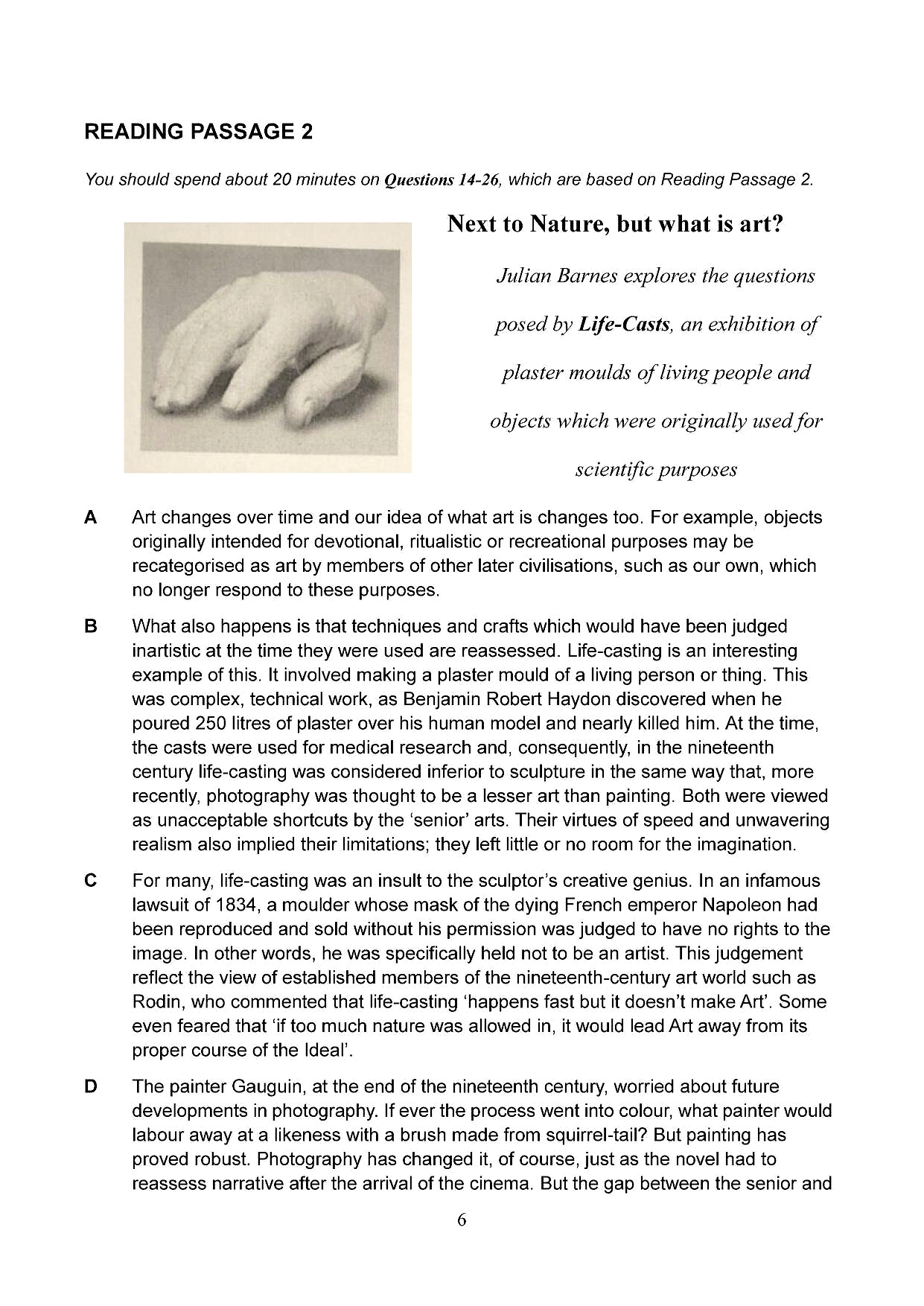
Julian Barnes explores the questions posed by Life-Casts, an exhibition of plaster moulds of living people and objects which were originally used for scientific purposes
A Art changes over time and our idea of what art is changes too. For example, objects originally intended for devotional, ritualistic or recreational purposes may be recategorised as art by members of other later civilisations, such as our own, which no longer respond to these purposes.
B What also happens is that techniques and crafts which would have been judged inartistic at the time they were used are reassessed. Life-casting is an interesting example of this. It involved making a plaster mould of a living person or thing. This was complex, technical work, as Benjamin Robert Haydon discovered when he poured 250 litres of plaster over his human model and nearly killed him. At the time, the casts were used for medical research and, consequently, in the nineteenth century life-casting was considered inferior to sculpture in the same way that, more recently, photography was thought to be a lesser art than painting. Both were viewed as unacceptable shortcuts by the ‘senior’ arts. Their virtues of speed and unwavering realism also implied their limitations; they left little or no room for the imagination.
C For many, life-casting was an insult to the sculptor’s creative genius. In an infamous lawsuit of 1834, a moulder whose mask of the dying French emperor Napoleon had been reproduced and sold without his permission was judged to have no rights to the image. In other words, he was specifically held not to be an artist. This judgement reflected the view of established members of the nineteenth-century art world such as Rodin, who commented that life-casting ‘happens fast but it doesn’t make Art’. Some even feared that ‘if too much nature was allowed in, it would lead Art away from its proper course of the ideal’.
D The painter Gauguin, at the end of the nineteenth century, worried about future developments in photography. If ever the process went into colour, what painter would labour away at a likeness with a brush made from squirrel-tail? But painting has proved robust. Photography has changed it, of course, just as the novel had to reassess narrative after the arrival of the cinema. But the gap between the senior and junior arts was always narrower than the traditionalists implied. Painters have always used technical back-up such as studio assistants to do the boring bits, while apparently lesser crafts involve great skill, thought, preparation and, depending on how we define it, imagination.
E Time changes our view in another way, too. Each new movement implies a reassessment of what has gone before. What is done now alters what was done before. In some cases this is merely self-serving, with the new art using the old to justify itself. It seems to be saying, ‘look at how all of that points to this!’ Aren’t we clever to be the culmination of all that has gone before? But usually it is a matter of re-alerting the sensibility, reminding us not to take things for granted. Take, for example, the cast of the hand of a giant from a circus, made by an anonymous artist around 1889, an item that would now sit happily in any commercial or public gallery. The most significant impact of this piece is on the eye, in the contradiction between unexpected size and verisimilitude. Next, the human element kicks in; you note that the nails are dirt-encrusted, unless this is the caster’s decorative addition, and the fingertips extend far beyond them. Then you take in the element of choice, arrangement, art if you like, in the neat, pleated, buttoned sleeve-end that gives the item balance and variation of texture. This is just a moulded hand, yet the part stands utterly for the whole. It reminds us slyly, poignantly, of the full-size original.
F But is it art? And, if so, why? These are old tediously repeated questions to which artists have often responded, it is art because I am an artist and therefore what I do is art. However, what doesn’t work for literature works much better for art – works of art do float free of their creators’ intentions. Over time the ‘reader’ does become more powerful. Few of us can look at a medieval altarpiece as its painter intended. We believe too little and aesthetically know too much, so we recreate and find new fields of pleasure in the work. Equally, the lack of artistic intention of Paul Richer and other forgotten craftsmen who brushed oil onto flesh, who moulded, cast and decorated in the nineteenth century is now irrelevant. What counts is the surviving object and our response to it. The tests are simple: does it interest the eye, excite the brain, move the mind to reflection and involve the heart? Further, is an apparent level of skill involved? Much currently fashionable art bothers only the eye and briefly the brain but it fails to engage the mind or the heart. It may to use the old dichotomy, be beautiful but it is rarely true to any significant depth. One of the constant pleasures of art is its ability to come at us from an unexpected angle and stop us short in wonder.
- 14
an example of a craftsman’s unsuccessful claim to ownership of his work
- 15
an example of how trends in art can change attitudes to an earlier work
- 16
the original function of a particular type of art
- 17
ways of assessing whether or not an object is art
- 18
how artists deal with the less interesting aspects of their work
- 19
Nineteenth-century sculptors admired the speed and realism of life-casting.
- 20
Rodin believed the quality of the life-casting would improve if a slower process were used.
- 21
The importance of painting has decreased with the development of colour photography.
- 22
Life-casting requires more skill than sculpture does.
- 23
New art encourages us to look at earlier work in a fresh way.
- 24
The intended meaning of a work of art can get lost over time.
- 25
The most noticeable contrast in the cast of the giant’s hand is between the
- A. dirt and decoration
- B. size and realism
- C. choice and arrangement
- D. balance and texture
- 26
According to the writer, the importance of any artistic object lies in
- A. the artist's intentions
- B. the artist's beliefs
- C. the relevance it has to modern life
- D. the way we respond to it
Reading Passage 3: Decisions, decisions!
Questions 27 – 31
Choose the correct letter, A, B, C or D.
Write the correct letter in boxes 27 – 31 on your answer sheet.
Question 32 – 35
Complete the summary using the list of words A – I below.
Write the correct letter, A – I, in boxes 32 – 35 on your answer sheet.
Question 36 – 40
Do the following statements agree with the views of the writer in Reading Passage 3?
In boxes 36 – 40 on your answer sheet, write
YES if the statement agrees with the views of the writer
NO if the statement contradicts the views of the writer
NOT GIVEN if it is impossible to say what the writer thinks about this
Research explores when we can make a vital decision quickly and when we need to proceed more deliberately.
A widely recognised legend tells us that in Gordium (in what is now Turkey) in the fourth century BC an oxcart was roped to a pole with a complex knot. It was said that the first person to untie it would become the king of Asia. Unfortunately, the knot proved impossible to untie. The story continues that when confronted with this problem, rather than deliberating on how to untie the Gordian knot, Alexander, the famous ruler of the Greeks in the ancient world, simply took out his sword and cut it in two – then went on to conquer Asia. Ever since, the notion of a ‘Gordian solution’ has referred to the attractiveness of a simple answer to an otherwise intractable problem.
Among researchers in the psychology of decision making, however, such solutions have traditionally held little appeal. In particular, the ‘conflict model’ of decision making proposed by psychologists Irving Janis and Leon Mann in their 1977 book, Decision Making, argued that a complex decision making process is essential for guarding individuals and groups from the peril of ‘group-think’. Decisions made without thorough canvassing, surveying, weighing, examining and reexamining relevant information and options would be suboptimal and often disastrous. One foreign affairs decision made by a well-known US political leader in the 1960s is typically held up as an example of the perils of inadequate thought, whereas the successful handling of a later crisis is cited as an example of the advantages of careful deliberation. However, examination of these historical events by Peter Suedfield, a psychologist at the University of British Columbia, and Roderick Kramer, a psychologist at the Stanford Graduate School of Business, found little difference in the two decision-making processes; both crises required and received complex consideration by the political administration, but later only the second one was deemed to be the effective.
In general, however, organizational and political science offer little evidence that complex decisions fare better than simpler ones. In fact, a growing body of work suggests that in many situations simple ‘snap’ decisions will be routinely superior to more complex ones – an idea that gained widespread public appeal with Malcolm Gladwell’s best-selling book Blink (2005).
An article by Ap Dijksterhuis of the University of Amsterdam and his colleagues, ‘On Making the Right Choice: the Deliberation-without-attention Effect’, runs very much in the spirit of Gladwell’s influential text. Its core argument is that to be effective, conscious (deliberative) decision making requires cognitive resources. Because increasingly complex decisions place increasing strain on those resources, the quality of our decisions declines as their complexity increases. In short, complex decisions overrun our cognitive powers. On the other hand, unconscious decision making (what the author refer to as ‘deliberation without attention’) requires no cognitive resources, so task complexity does not degrade effectiveness. The seemingly counterintuitive conclusion is that although conscious thought enhances simple decisions, the opposite holds true for more complex decisions.
Dijksterhuis reports four simple but elegant studies supporting this argument. In one, participants assessed the quality of four hypothetical cars by considering either four attributes (a simple task) or 12 attributes (a complex task). Among participants who considered four attributes, those who were allowed to engage in undistracted deliberative thought did better at discriminating between the best and worst cars. Those who were distracted and thus unable to deliberate had to rely on their unconscious thinking and did less well. The opposite pattern emerged when people considered 12 criteria. In this case, conscious deliberation led to inferior discrimination and poor decisions.
In other study, Dijksterhuis surveyed people shopping for clothes (‘simple’ products) and furniture (‘complex’ products). Compared with those who said they had deliberated long and hard, shoppers who bought with little conscious deliberation felt less happy with their simple clothing purchase but happier with the complex furniture purchases. Deliberation without attention actually produced better results as the decisions became more complex.
From there, however, the researchers take a big leap. They write:
There is no reason to assume that the deliberation-without-attention effect does not generalize to other types of choices – political, managerial or otherwise. In such cases, it should benefit the individual to think consciously about simple matters and to delegate thinking about more complicated matters to the unconscious.
This radical inference contradicts standard political and managerial theory but doubtless comforts those in politics and management who always find the simple solution to the complex problem an attractive proposition. Indeed, one suspects many of our political leaders already embrace this wisdom.
Still it is there, in the realms of society and its governance, that the more problematic implications of deliberation without attention begin to surface. Variables that can be neatly circumscribed in decisions about shopping lose clarity in a world of group dynamics, social interaction, history and politics. Two pertinent questions arise. First, what counts as a complex decision? And second, what counts as a good outcome?
As social psychologist Kurt Lewin (1890 – 1947) noted, a ‘good’ decision that nobody respects is actually bad. His classic studies of decision making showed that participating in deliberative processes makes people more likely to abide by the results. The issue here is that when political decision makers make mistakes, it is their politics, or the relation between their politics and our own, rather than psychology which is at fault.
Gladwell’s book and Dijksterhuis’s paper are invaluable in pointing out the limitations of the conventional wisdom that decision quality rises with decision-making complexity. But this work still tempts us to believe that decision making is simply a matter of psychology, rather than also a question of politics, ideology and group membership. Avoiding social considerations in a search for general appeal can take us away from enlightenment rather than toward it.
- 27
The legend of the Gordian knot is used to illustrate the idea that
- A. anyone can solve a difficult problem
- B. difficult problems can have easy solutions
- C. the solution to any problem requires a lot of thought
- D. people who can solve complex problems make good leaders
- 28
The ‘conflict model’ of decision making proposed by Janis and Mann requires that
- A. opposing political parties be involved
- B. all important facts be considered
- C. people be encouraged to have different ideas
- D. previous similar situations be thoroughly examined
- 29
According to recent thinking reinforced by Malcolm Gladwell, the best decisions
- A. involve consultation
- B. involve complex thought
- C. are made very quickly
- D. are the most attractive option
- 30
Dijksterhuis and his colleagues claim in their article that
- A. our cognitive resources improve as tasks become more complex
- B. conscious decision making is negative affected by task complexity
- C. unconscious decision making is a popular approach
- D. deliberation without attention defines the way we make decisions
- 31
Dijksterhuis’s car study found that, in simple tasks, participants
- A. were involved in lengthy discussions
- B. found it impossible to make decisions quickly
- C. were unable to differentiate between the options
- D. could make a better choice when allowed to concentrate
- 32
People who spent 32 ......... time buying simple clothing items were more satisfied than those who had not.
- A. more
- B. counterintuitive
- C. simple
- D. better
- E. conscious
- F. obvious
- G. complex
- H. less
- I. worse
- 33
However, when buying furniture, shoppers made 33 ......... purchasing decisions if they didn’t think too hard.
- A. more
- B. counterintuitive
- C. simple
- D. better
- E. conscious
- F. obvious
- G. complex
- H. less
- I. worse
- 34
From this, the researchers concluded that in other choices, perhaps more important than shopping, 34 ......... decisions are best made by the unconscious.
- A. more
- B. counterintuitive
- C. simple
- D. better
- E. conscious
- F. obvious
- G. complex
- H. less
- I. worse
- 35
The writer comments that Dijksterhuis’s finding is apparently 35 ......... but nonetheless true.
- A. more
- B. counterintuitive
- C. simple
- D. better
- E. conscious
- F. obvious
- G. complex
- H. less
- I. worse
- 36
Dijksterhuis’s findings agree with existing political and management theories.
- 37
Some political leaders seem to use deliberation without attention when making complex decisions.
- 38
All political decisions are complex ones.
- 39
We judge political errors according to our own political beliefs.
- 40
Social considerations must be taken into account for any examination of decision making to prove useful.
نمایش پاسخنامه