Listening 2026-06 Test 2

Exam month: 2026-06

Rebuilt from test-taker recalls — not official IELTS material. Audio and passages are recreations for practice.

Recreated audio

Section 1: Questions 1-5

Complete the notes below. Write NO MORE THAN THREE WORDS AND/OR A NUMBER for each answer.

KT Furniture customer order form Customer details Caller's name: Sue Brown Company name: 1 _________ Address: 2 _________ Trading estate, 210 new hampton road south down Contact number: 3 _________ (mobile) Delivery option: 1 or 2 (no 4 _________) Method of payment: credit card, Type: 5 _________
  1. 1

    Company name: 1 _________

  2. 2

    Address: 2 _________ Trading estate, 210 new hampton road south down

  3. 3

    Contact number: 3 _________ (mobile)

  4. 4

    Delivery option: 1 or 2 (no 4 _________)

  5. 5

    Method of payment: credit card, Type: 5 _________

Section 1: Questions 6-10

Complete the table below. Write NO MORE THAN TWO WORDS AND/OR A NUMBER for each answer.

Item Code Color Quantity Office chairs ASP 23 6 _________ 5 7 _________ 8 _________ Leather sofa DFD 33 9 _________ 1 10 _________ TX 22 silver 1
  1. 6

    Office chairs ASP 23 6 _________ 5

  2. 7

    7 _________

  3. 8

    8 _________

  4. 9

    Leather sofa DFD 33 9 _________ 1

  5. 10

    10 _________ TX 22 silver 1

Section 2: Questions 11-17

Label the map below. Choose SEVEN answers from the box and write the correct letter, A-H, next to questions 11-17.
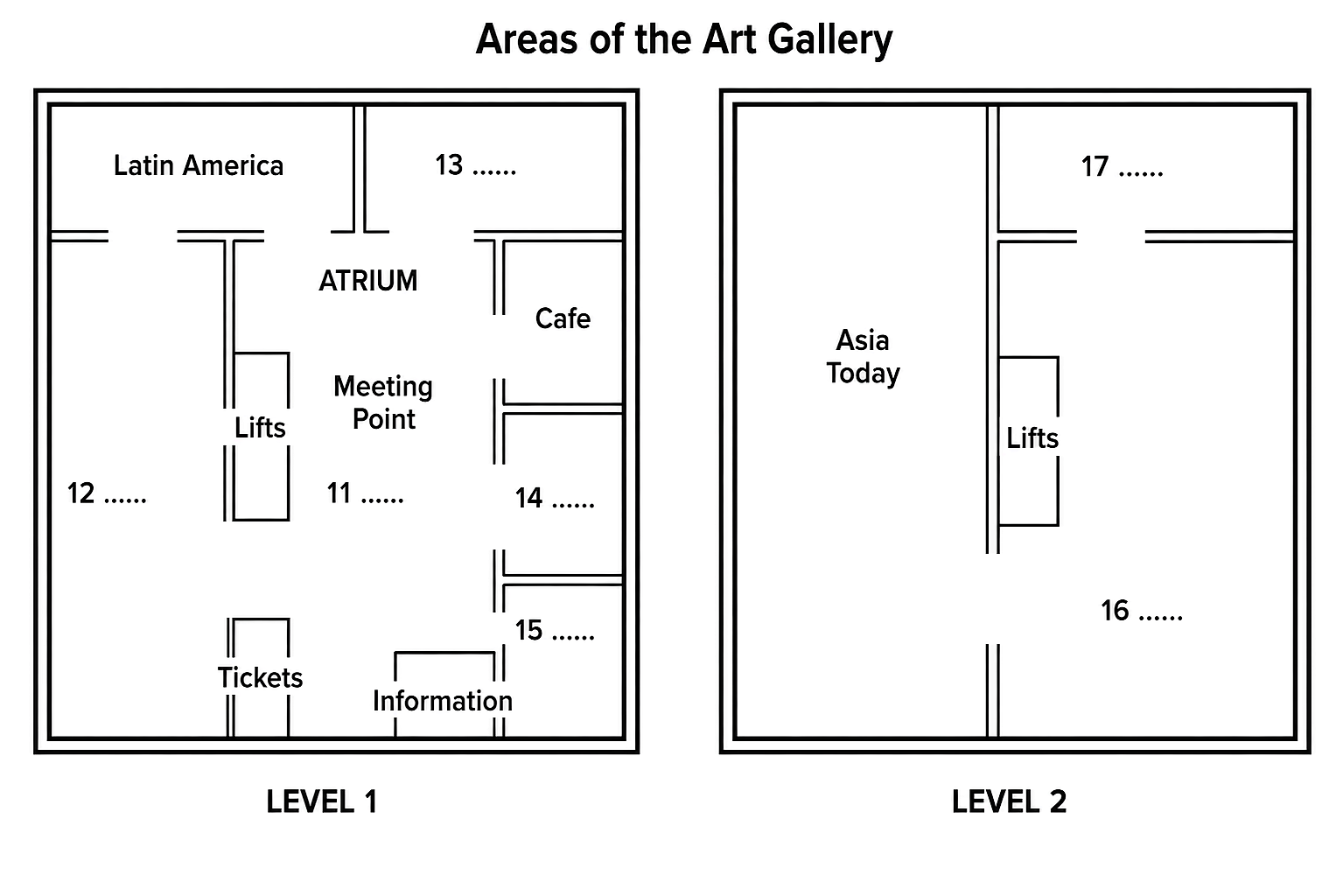
A Cinema Zone B European Paintings C Gallery Shop D History in Photographs E Learning Zone F Local Heroes G Members' Restaurant H Recent Award Winners
Recreated diagram for questions 11, 12, 13, 14, 15, 16, 17
  1. 11

    11 _________

  2. 12

    12 _________

  3. 13

    13 _________

  4. 14

    14 _________

  5. 15

    15 _________

  6. 16

    16 _________

  7. 17

    17 _________

Section 2: Questions 18-20

Choose the correct letter, A, B or C.

  1. 18

    For families, the tour guide recommends

    • A. the Science Centre
    • B. the Natural History Museum
    • C. the Maritime Museum
  2. 19

    You can buy a family ticket for a minimum of

    • A. two adults and one child
    • B. one adult and two children
    • C. two adults and two children
  3. 20

    The Culture Pass is valid for

    • A. two days
    • B. three days
    • C. one week

Section 3: Questions 21-24

Choose the correct letter, A, B or C.

  1. 21

    Laura chose Burdock Engineering for her research because

    • A. she was contacted by the managing director.
    • B. she knew several people who worked there.
    • C. she had already done a work placement there.
  2. 22

    What does Laura agree to do regarding the central theme of her research?

    • A. check it is relevant
    • B. broaden the focus
    • C. be more specific in her aims
  3. 23

    What does Laura expect to find from her research?

    • A. Absence rates are related to the type of work done.
    • B. A lot of worker absence is actually unnecessary.
    • C. Employee absence rates are increasing.
  4. 24

    What employee information does the tutor think Laura will be able to obtain from company records?

    • A. dates of birth
    • B. details of employment
    • C. individual records of absence

Section 3: Questions 25 and 26

Choose TWO letters, A-E. Which TWO recommendations does the tutor make about Laura's questionnaire?

  1. 25

    Which TWO recommendations does the tutor make about Laura's questionnaire?

    • A. Leave a space for contact details.
    • B. Specify a completion date.
    • C. Provide a mixture of question types.
    • D. Keep the length to a minimum.
    • E. Trial it on someone before finalising it.
  2. 26

    Which TWO recommendations does the tutor make about Laura's questionnaire?

    • A. Leave a space for contact details.
    • B. Specify a completion date.
    • C. Provide a mixture of question types.
    • D. Keep the length to a minimum.
    • E. Trial it on someone before finalising it.

Section 3: Questions 27 and 28

Choose TWO letters, A-E. Which TWO things will Laura explain in her covering letter to participants?

  1. 27

    Which TWO things will Laura explain in her covering letter to participants?

    • A. when the questionnaire should be completed
    • B. the fact that participation in the survey is voluntary
    • C. how long the questionnaire is likely to take
    • D. the purpose of the survey
    • E. the benefits of participation in the survey
  2. 28

    Which TWO things will Laura explain in her covering letter to participants?

    • A. when the questionnaire should be completed
    • B. the fact that participation in the survey is voluntary
    • C. how long the questionnaire is likely to take
    • D. the purpose of the survey
    • E. the benefits of participation in the survey

Section 3: Questions 29 and 30

Choose TWO letters, A-E. Which TWO activities does Laura already have definite dates for?

  1. 29

    Which TWO activities does Laura already have definite dates for?

    • A. completion of her finished assignment
    • B. questionnaire distribution
    • C. collection of completed questionnaires
    • D. the next meeting with her tutor
    • E. analysis of figures from the company's database
  2. 30

    Which TWO activities does Laura already have definite dates for?

    • A. completion of her finished assignment
    • B. questionnaire distribution
    • C. collection of completed questionnaires
    • D. the next meeting with her tutor
    • E. analysis of figures from the company's database

Section 4: Questions 31-38

Complete the notes below. Write ONE WORD AND/OR A NUMBER for each answer.

Chimpanzee Behaviours Species l We can find Pan or Pan Troglodytes in West and Central Africa. l The Bonobo or PanPaniscus are found in Democratic Republic of Congo. Current research l rule out 31 _________ and biological factors l learn through 32 _________ of other chimps' behaviour Discoveries l The book The Third - Chimpanzee by James Diamond discusses some physical features of chimpanzees. l The discovery - reported by Jane Goodall suggests that chimpanzees know how to use 33 _________ Chimpanzees in Senegal l use spears sharpened with their teeth l can 34 _________ the shell of a coconut l use a 35 _________ hammer to crash nuts l are capable of learning 36 _________ and understanding human language Sub-species l Bonobos live on the other side of a 37 _________ l Both of them are reducing alarmingly in population 38 _________
  1. 31

    rule out 31 _________ and biological factors

  2. 32

    learn through 32 _________ of other chimps' behaviour

  3. 33

    chimpanzees know how to use 33 _________

  4. 34

    can 34 _________ the shell of a coconut

  5. 35

    use a 35 _________ hammer to crash nuts

  6. 36

    are capable of learning 36 _________ and understanding human language

  7. 37

    Bonobos live on the other side of a 37 _________

  8. 38

    Both of them are reducing alarmingly in population 38 _________

Section 4: Questions 39-40

Choose TWO letters, A-E. Which TWO topic about chimpanzees will the students discuss next week?

  1. 39

    Which TWO topic about chimpanzees will the students discuss next week?

    • A. They are slower than human in different ways.
    • B. They learn things by copying human's behaviour.
    • C. They develop behaviours generation by generation.
    • D. They have very strong ability of logical thinking.
    • E. They could be modified to adapt to the environment.
  2. 40

    Which TWO topic about chimpanzees will the students discuss next week?

    • A. They are slower than human in different ways.
    • B. They learn things by copying human's behaviour.
    • C. They develop behaviours generation by generation.
    • D. They have very strong ability of logical thinking.
    • E. They could be modified to adapt to the environment.
Show transcript
==================== IELTS Listening Transcript ==================== PART 1 Speaker 0: Hear a woman talking on the phone to a furniture company. Speaker 0: First, you have some time to look at questions one to five. Speaker 0: Now we shall begin. Speaker 0: You should answer the questions as you listen because you will not hear the recording a second time. Speaker 0: Listen carefully and answer questions one to five. Speaker 1: Good afternoon. Katie Furniture. Can I help you? Speaker 2: Oh, hello. Yes. I'm setting up a new office, and I don't have Internet access yet, but I'd like to place an order for some furniture. Speaker 1: That's fine. You can do it over the phone, and I can fill in the form for you this end. Speaker 2: Oh, great. Thanks. Speaker 1: I just need to take a few customer details first, if that's okay. Speaker 2: Yes. Fine. Speaker 1: What name is it? Speaker 2: My name? Yes. Oh, it's Sue Brown. Speaker 1: Sue Brown. Thanks. And what's the name of your company, Miss Brown? Speaker 2: It's a clothing company. It's called Dress Your Best. Speaker 1: Okay. I'll just note that down. Dress for best. Speaker 2: No. Your best. Speaker 1: Oh, right. Got it. So you make smart clothes? Speaker 2: Yes. Formal dress for weddings and special occasions. We also repair and alter clothes. Speaker 1: I see. And where are you located? What's your postal address? Speaker 2: Right. Well, we're on Kirby Trading Estate. Speaker 1: Kirby. How do you spell that? Speaker 2: It's K-I-R-B-Y. Speaker 1: Oh, I know that area. It's New Hampton Road, isn't it? Speaker 2: Yes. That's right. Number 210 in South Down. Speaker 1: Okay. And can I have a contact number for our delivery man? Speaker 2: Sure. It's probably best if I give you my mobile number. Speaker 1: Okay. Speaker 2: The number's 09356788545. Speaker 1: Okay. 778. Speaker 2: No. 788545. Speaker 1: Okay. That's great. Now just a couple more questions before I take your order. Speaker 2: Fine. Speaker 1: We have two delivery dates this month, and you should be able to have either. When are they? Well, there's one on the sixteenth of the month, but there's a charge of $40 for that one. Speaker 2: Oh, that's a lot. Speaker 1: Or there's option two, which is the end of the month. I'll have to confirm the date later, and that's a free delivery. Speaker 2: I'll take option two. Thanks. I don't want to pay a charge. Speaker 1: Okay. I'll note down no charge. Speaker 2: We haven't organised the office yet, so there should be plenty of time. Speaker 1: Mhmm. And lastly, you don't have an account with us, so how would you like to pay? Speaker 2: I'll pay by credit card. Speaker 1: Okay. Will that be Visa? Speaker 2: Is American Express okay? Speaker 1: Absolutely fine. Speaker 0: Before you hear the rest of the conversation, you have some time to look at questions six to 10. Speaker 0: Now listen and answer questions six to 10. Speaker 1: So what would you like to order? Speaker 2: Well, I've been looking in your catalogue, and you have some office chairs that look very comfortable for our type of work. Is there an item code? Speaker 1: Yes. It's ASP 23. Speaker 2: Okay. Speaker 1: Those chairs come in pink, white, and black. Speaker 2: Yes. The pink looks nice, but I think the darker color is better for us. You can see light materials on it more easily. Speaker 1: That's true. Speaker 2: We'll have five of those, I think. Speaker 1: Okay. I've got that. Anything else? Speaker 2: Do you have any striped mats? Speaker 1: I'm sorry. Not at the moment. They're out of stock. We should have some in next month. Speaker 2: Never mind. Well, I'd also like two of your glass desks. They're lovely, aren't they? Speaker 1: Yes. Speaker 2: You seem to have two sizes. Speaker 1: Basically, large or small. I think the code for the small ones is... Speaker 2: I think we'll have the large ones. The code here is TG586. Speaker 1: Okay. So that's two glass desks. Any lamps for those? Speaker 2: No. We have to get special lamps for our work. Speaker 1: Oh, I see. Do you have another supplier for those? Speaker 2: Yes. We do need some furniture for our customers, though. Speaker 1: Okay. For a waiting area or something? Speaker 2: Well, we have to discuss the work with them, so we need a nice sofa. Something soft and I thought leather. Speaker 1: Ah, yes. A good choice. Speaker 2: There's a three seater here, DFD 44. That seems to be in red, cream, or chocolate brown. Speaker 1: Yes. It does come in yellow as well. Speaker 2: Yellow. I'd thought of red, but that sounds lively. Yes. I'll have that color. I think brown's a bit too dull and cream shows the dirt too much. Speaker 1: Yeah. You're right. Anything else? A coffee table perhaps? Speaker 2: Yes. I think so. Maybe TX 22, the silver one. Speaker 1: A very good choice. Speaker 2: Well, that's it, I think. Speaker 1: Okay. I'll just add that up for you and then take your credit card details. Speaker 0: That is the end of section one. You now have half a minute to check your answers. PART 2 Speaker 3: Now listen carefully and answer questions 11 to 17. Speaker 4: Welcome to the Modern Art Gallery. It is my pleasure to introduce you to the various sections of the gallery. The gallery consists of two levels. As you can see from the map, we are in the large atrium on Level 1 at the meeting point. First of all, I'll tell you about the exhibits on this level. In this room, you will find an exhibition of our very own heroes. Told in photographs, paintings and memorabilia, this is a great starting point if you want to find out more about the people who have played an important role in our city. Between the ticket booth and lifts, you'll find the entrance to the other major display on this level. All the works featured here are by modern artists who have won awards in the last few years. Recent winners such as Martelli and Kashiwagi are on display, and I suggest you take advantage of it while it's here. If you like sculpture, then please visit our section called Latin America in the far corner. There's an excellent collection of two of Colombia's finest. Sculptures by Morales and Alvares are rarely not to be missed. One of my favourite areas on the first level is for our younger visitors. The resident art teacher is here throughout the school holidays to help your children create a piece of art in the learning zone. You'll find it between the Latin American exhibition and the cafe. On the right here, you'll find the Gallery Cafe, which serves drinks and light meals throughout the day. If you have membership at any of the galleries or museums in the city, you can make use of the section reserved for members just next door, which has views of the lake and an excellent menu. Before you make your way to the second Level, you might like to take a look at the books and prints on sale in the shop located next to the information desk. Gift certificates and membership packages can be bought there. Now let me introduce the second level of the gallery. As you step out of the lifts, you come into the largest exhibition in the gallery. From World War one to the present day, this exhibition shows how photographers have responded to some of the most important local and global events in history. On the other side of the lifts is another permanent exhibition called Asia Today. Divided by region, you will experience work from the best Asian artists. And last but not least is one of the most innovative areas of the gallery, our permanent movie theatres. This cinema has two theatres showing films every two hours throughout the day. This month, we feature European filmmakers in the genre of animation from the millennium year to present day. Speaker 3: Before you hear the rest of the talk, you have some time to look at questions 18 to 20. Speaker 3: Now listen and answer questions 18 to 20. Speaker 4: If you have a full day to spend, there are several excellent museums in the city. In the same complex as this gallery, you'll find the Natural History Museum, which has an excellent collection of gemstones. For those of you with children, though, the best option is the recently upgraded Science Centre, just next door to the Maritime Museum on the Quayside. If you are here with the family, and you do intend to visit more than one museum, I definitely recommend purchasing the Family Pass, as this will work out much cheaper and is a really good deal. You can visit two museums in one day, providing there is an adult in the group with between two and four children 16. If you were here for a week or so, and you would like to visit several museums or galleries, you might consider the Culture Pass. This allows unlimited entry for two adults to all galleries for three days. You will save a lot by doing this, and you could revisit any of the galleries if you like. It's also really good value, as it covers travel on the routes between the museums on weekdays, as well as the entry fee, so you save on transport too. We hope you enjoy your visit today, and continue to support us if you have any questions. Speaker 3: That is the end of part two. PART 3 Speaker 5: Part three. You will hear a business student called Laura talking to her tutor about some research she is planning to do on employee absence. First, you have some time to look at questions 21 to 24. Listen carefully and answer questions 21 to 24. Speaker 6: Hello, Laura. Have a seat. Speaker 7: So I understand you're planning to investigate absence from work for your research project. Speaker 6: That's alright. Speaker 7: I'm going to base it on a local company called Burkock Engineering. Speaker 6: Is there any particular reason why you've chosen Burkock? Speaker 7: Well, I'd originally thought of asking another company, FG Engineering, because I did my placement there and I knew the staff there, but the CEO wasn't very keen. But she knows the managing director at Burcock, and she spoke to him, and then he got in touch with me. Apparently, absence is a major problem there, so he's quite interested in having it investigated. Speaker 6: Okay. Speaker 7: So my central theme is absence, but I'm thinking of concentrating on long term absence. I thought that might allow me to give more helpful feedback to the company. Speaker 6: If I were you, I wouldn't be that specific. I'd look at absence as a whole. You might get more interesting results. Speaker 7: Oh, okay. Speaker 6: So what's the main thing you expect to find? Rises in absence rates over time? Speaker 7: Not really. Initially, I wondered if workers often take time off without real justification, but I think that'll be hard to determine. So, well, I think I may find that it's something to do with what sort of job the employee is doing. Speaker 6: Okay. Now have you thought how you'll get your information? Speaker 7: Well, first of all, I need access to the company records. Speaker 6: Yes. Obviously, you'll need overall absence figures, though it's unlikely they'll let you have them for individual workers. And you probably won't have access to personal information like when they were born, but you should be able to use anonymous details like the type of work they do or how long they've been with the company. Speaker 7: Okay. Speaker 5: Before you hear the rest of the discussion, you have some time to look at questions 25 to 30. Speaker 5: Now listen and answer questions 25 to 30. Speaker 6: So let's think a bit more about your questionnaire. Speaker 7: I know that it shouldn't be too long or people get bored. Speaker 6: No. But if it's too short, you don't get enough information. Speaker 7: The trick is to get the balance right. I think the questions should be closed questions too. I mean, where people choose an answer from a list. Speaker 6: But then you miss the chance of getting unexpected information, so I'd include one or two open ended questions too. Speaker 7: Okay. And I won't ask for names or addresses or anything. Speaker 6: No. It needs to be anonymous. And after you've drafted it, you need to give it to at least one person to check there aren't any problems. So you need to leave enough time for that and any revisions necessary. Speaker 7: What about the covering letter that I'll send out with the questionnaire? I'll need to introduce myself and explain what the questionnaire is for, but what else should I include? Speaker 6: I'd reassure people that the survey isn't going to be used to assess them personally. Otherwise they might choose not to take part. Speaker 7: Yes. I'll make that clear. And what about when they do it? Will they be allowed to use work time? Speaker 6: That's really up to their manager, but you should say roughly how much time it'll take. Speaker 7: Okay. Speaker 6: So now you need to produce a schedule with dates, for example, when you'll send out the questionnaire. Speaker 7: Yes. Okay. Once I can arrange that date with the manager, I'll be able to fix the deadline for getting the completed questionnaires back. And I want to use the time in between to analyse the figures that HR is going to give me from their database, though they haven't said exactly when I'll get them. Speaker 6: And you have to submit your assignment by the end of June? Speaker 7: Actually, I have to get it finished by the second because I've arranged a work placement after that. Speaker 6: Okay. Speaker 7: So our next meeting is two weeks today. Is that still okay? Speaker 6: Yes. And in the meantime, I'll send you an... Speaker 5: That is the end of part three. You now have thirty seconds to check your answers to part three. PART 4 Speaker 8: Section four. You will hear a talk on the research of the behavior of chimpanzees. First, you have time to look at questions 31 to 40. Now listen carefully and answer questions 31 to 40. Speaker 9: Welcome back to my series of short lectures on apes. Today, we will examine recent and historical breakthroughs on the behavior of chimpanzees, otherwise known as chimps. The word chimpanzee is an umbrella term for two different species of apes in the genus Pan, which are the common chimpanzee or pan troglodytes found in West and Central Africa, and the bonobo or pan paniscus, which are found in the forests of the Democratic Republic of the Congo. Chimpanzees belong to the Hominidae family together with gorillas, orangutans, and indeed humans. Current research tells us that the chimps broke away from the human branch of the Hominidae family approximately six million years ago and remain the closest living relative to humans to this day. More modern researchers into chimpanzees have centered on their behavioral characteristics once all biological and genetic factors have been ruled out. In this way, scientists have unearthed an unfathomable amount of similarities between human and chimpanzee behavior. Although much of this research has taken place through observation of captive chimps, the results are widely seen as an authoritative reflection of chimps living in the wild. Chimps live in large so-called communities comprised of many male and female members, with the social hierarchy determined by an individual chimp's position and influence. Through such research, scientists have found that chimps learn and adapt through observation of others' behavior. Once in power, the alpha male is often seen to alter its body language in order to retain power. For example, he might puff himself up in order to intimidate others, while lower ranking chimps are noted to behave more submissively and holding out their hands while grunting. Female chimpanzees also have a distinct social hierarchy with high social standing inherited by children. It is not unheard of for dominant females within a community to unite and overthrow the alpha male, backing another in his place. James Diamond, in his book, The Third Chimpanzee, suggests that chimps should now be reclassified in the genus Homo instead of Pan, and there are many arguments still in favor of this. Male common chimpanzees are on average 1.7 meters in height, weighing 70 kilograms, with their female counterparts being somewhat smaller. By comparison, the bonobo is slightly shorter and lighter, but with longer arms and legs. However, both species walk on all fours and climb trees with great ease. Jane Goodall made a groundbreaking discovery in 1960 when she observed the use of tools among chimpanzees, including digging for termites with large sticks. A recent study claimed to reveal that common chimpanzees in Senegal have been using spears sharpened with their teeth to hunt. However, these reports remain unsubstantiated. Researchers have witnessed such tools, namely rocks, being used by chimps to open coconut shells and indeed crushing nuts with stone hammers. As scientific technology has developed, so too has our knowledge of the sheer extent of the chimps' intelligence. Research has now shown that chimps have the capability to learn and use symbols and understand aspects of the human language, including syntax as well as numerical sequences. As I mentioned earlier, the umbrella term chimpanzee is comprised of the common chimpanzee and the bonobo. These two subspecies are divided along the Congo River, with the common chimps living on one side and the bonobos living on the opposite side of the river. Over the past few decades, both of these subspecies have witnessed an alarming decrease in population density, with animal activists now working harder than ever to protect those remaining and encourage procreation. In addition, next week's episode will focus more closely on how chimpanzees in captivity are able to learn things through imitating the behavior of humans, as well as how chimpanzees' behaviors have developed over many generations. Thank you very much for attending this evening's lecture. I hope you found it intellectually stimulating, and I look forward to seeing you again next week. Good night. Speaker 8: That is the end of section four. You now have half a minute to check your answers. That is the end of the listening test. In the IELTS test, you will now have ten minutes to transfer your answers to the answer sheet. ==================== Chinese Translation ==================== 第一部分 Speaker 0: 请听一位女士与家具公司的电话对话。 Speaker 0: 首先,你有时间看一下第一至第五题。 Speaker 0: 现在开始。 Speaker 0: 你应该边听边答题,因为录音不会重复播放。 Speaker 0: 请仔细听,并回答第一至第五题。 Speaker 1: 下午好。凯蒂家具。有什么可以帮您的吗? Speaker 2: 哦,你好。是的。我正在布置一间新办公室,但还没有网络,所以我想电话订购一些家具。 Speaker 1: 没问题。您可以通过电话下单,我这边帮您填写表格。 Speaker 2: 哦,太好了。谢谢。 Speaker 1: 我先需要记录一些客户信息,可以吗? Speaker 2: 好的,没问题。 Speaker 1: 请问您的名字是? Speaker 2: 我的名字吗?是的。哦,我叫苏·布朗。 Speaker 1: 苏·布朗。谢谢。布朗小姐,请问您的公司名称是什么? Speaker 2: 是一家服装公司,叫“穿出最佳”。 Speaker 1: 好的,我记一下。“穿出最佳”。 Speaker 2: 不,是“穿出最佳”。 Speaker 1: 哦,明白了。所以你们是做正装的? Speaker 2: 是的。为婚礼和特殊场合提供正式服装。我们还提供服装修补和修改服务。 Speaker 1: 明白了。请问您的地址在哪里?邮寄地址是什么? Speaker 2: 好的。我们在柯比贸易区。 Speaker 1: 柯比。怎么拼写? Speaker 2: K-I-R-B-Y。 Speaker 1: 哦,我知道那个地方。是在新汉普顿路,对吗? Speaker 2: 是的,没错。南唐区210号。 Speaker 1: 好的。能给我一个送货员的联系电话吗? Speaker 2: 当然。最好给你我的手机号码。 Speaker 1: 好的。 Speaker 2: 号码是09356788545。 Speaker 1: 好的。778。 Speaker 2: 不,是788545。 Speaker 1: 好的,没问题。在下单之前,我还有几个问题。 Speaker 2: 好的。 Speaker 1: 我们这个月有两个送货日期,您都可以选择。是哪两天?嗯,一个是本月16号,但需要收取40美元的费用。 Speaker 2: 哦,那挺贵的。 Speaker 1: 或者第二个选择是月底,具体日期我稍后确认,并且是免费送货。 Speaker 2: 我选第二个。谢谢。我不想付运费。 Speaker 1: 好的,我记下免费。 Speaker 2: 我们办公室还没布置好,所以时间上很充裕。 Speaker 1: 嗯。最后,您没有我们的账户,请问您想如何付款? Speaker 2: 我用信用卡支付。 Speaker 1: 好的。是维萨卡吗? Speaker 2: 美国运通卡可以吗? Speaker 1: 完全可以。 Speaker 0: 在听对话剩余部分之前,你有时间看一下第六至第十题。 Speaker 0: 现在请听并回答第六至第十题。 Speaker 1: 那么您想订购什么? Speaker 2: 嗯,我看了你们的目录,有些办公椅看起来非常适合我们的工作。有商品代码吗? Speaker 1: 有的,是ASP 23。 Speaker 2: 好的。 Speaker 1: 那些椅子有粉色、白色和黑色。 Speaker 2: 是的。粉色看起来不错,但我觉得深色更适合我们。浅色材料更容易显脏。 Speaker 1: 确实。 Speaker 2: 我们要五把吧。 Speaker 1: 好的,记下了。还需要别的吗? Speaker 2: 你们有条纹地垫吗? Speaker 1: 抱歉,目前没有。缺货了。下个月应该会有。 Speaker 2: 没关系。嗯,我还想要两张玻璃桌。它们很漂亮,不是吗? Speaker 1: 是的。 Speaker 2: 你们好像有两种尺寸。 Speaker 1: 基本上是大号和小号。小号的代码是…… Speaker 2: 我们要大号的。这里的代码是TG586。 Speaker 1: 好的。那就是两张玻璃桌。需要配灯吗? Speaker 2: 不用。我们需要为工作配专门的灯。 Speaker 1: 哦,明白了。你们有其他供应商吗? Speaker 2: 是的。不过我们确实需要一些给客户用的家具。 Speaker 1: 好的。是等候区之类的吗? Speaker 2: 嗯,我们需要和他们讨论工作,所以需要一张漂亮的沙发。要柔软的那种,我想用皮质的。 Speaker 1: 啊,是的。好选择。 Speaker 2: 这里有一款三人座,DFD 44。有红色、奶油色和巧克力棕色。 Speaker 1: 是的。还有黄色的。 Speaker 2: 黄色。我本来想选红色,但黄色听起来很活泼。是的,我要那个颜色。我觉得棕色太沉闷,奶油色又太容易显脏。 Speaker 1: 是的,你说得对。还需要别的吗?也许要一张咖啡桌? Speaker 2: 是的,我想是的。可能是TX 22,银色的那款。 Speaker 1: 非常好的选择。 Speaker 2: 嗯,就这些了。 Speaker 1: 好的。我帮你算一下总价,然后记录你的信用卡信息。 Speaker 0: 第一部分到此结束。你现在有半分钟时间检查答案。 第二部分 Speaker 3: 现在请仔细听,并回答第11至第17题。 Speaker 4: 欢迎来到现代艺术画廊。很高兴向大家介绍画廊的各个展区。画廊分为两层。从地图上可以看到,我们现在位于一楼的中央大厅集合点。首先,我向大家介绍这一层的展品。在这个房间里,您将看到我们本地英雄的展览。通过照片、绘画和纪念品的形式呈现,如果您想了解更多关于在我们城市扮演重要角色的人物,这是一个很好的起点。在售票处和电梯之间,您会找到这一层另一个主要展览的入口。这里展出的所有作品都是近年来获奖的现代艺术家创作的。像马泰利和柏木这样的近期获奖者的作品正在展出,我建议您趁此机会参观。如果您喜欢雕塑,请前往角落的“拉丁美洲”展区。那里有两位哥伦比亚最杰出艺术家的精彩收藏。莫拉莱斯和阿尔瓦雷斯的雕塑作品不容错过。一楼我最喜欢的区域之一是为年轻游客准备的。常驻艺术老师在假期期间都在这里,帮助您的孩子在“学习区”创作艺术作品。您可以在拉丁美洲展览和咖啡馆之间找到它。在您的右边,是画廊咖啡馆,全天供应饮品和简餐。如果您拥有本市任何画廊或博物馆的会员资格,您可以使用隔壁的会员专区,那里可以欣赏湖景,并提供优质菜单。在您前往二楼之前,您可能想看看信息台旁边商店里出售的书籍和版画。那里可以购买礼品券和会员套餐。现在让我介绍画廊的二楼。走出电梯,您就进入了画廊最大的展览。从第一次世界大战至今,这个展览展示了摄影师如何回应历史上一些最重要的本地和全球事件。在电梯的另一侧是另一个常设展览,名为“今日亚洲”。按地区划分,您将体验亚洲最优秀艺术家的作品。最后但同样重要的是画廊最具创新性的区域之一,我们的常设电影院。这个电影院有两个影厅,全天每两小时放映一场电影。本月,我们放映欧洲电影制作人的动画作品,时间跨度从千禧年至今。 Speaker 3: 在听演讲剩余部分之前,你有时间看一下第18至第20题。 Speaker 3: 现在请听并回答第18至第20题。 Speaker 4: 如果您有一整天的时间,市里有几家很棒的博物馆。在这个画廊的同一建筑群内,您可以找到自然历史博物馆,那里有极好的宝石收藏。不过,对于带孩子的游客来说,最好的选择是最近升级的科学中心,就在码头区的海事博物馆旁边。如果您和家人一起来,并且打算参观多个博物馆,我强烈建议购买家庭通票,这样会便宜很多,非常划算。您可以在一天内参观两个博物馆,前提是团队中有一名成人和两到四名16岁以下的儿童。如果您在这里待一周左右,并且想参观多个博物馆或画廊,您可以考虑文化通票。这允许两名成人在三天内无限次进入所有画廊。这样能省很多钱,而且如果您喜欢,还可以重访任何画廊。它的性价比也很高,因为它涵盖了工作日博物馆之间的交通费用以及门票,所以交通费也省了。希望您今天参观愉快,如果有任何问题,请继续支持我们。 Speaker 3: 第二部分到此结束。 第三部分 Speaker 5: 第三部分。您将听到一名叫劳拉的商科学生与导师讨论她计划进行的一项关于员工缺勤的研究。首先,你有时间看一下第21至第24题。请仔细听并回答第21至第24题。 Speaker 6: 你好,劳拉。请坐。 Speaker 7: 所以我了解到你计划为研究项目调查员工缺勤问题。 Speaker 6: 好的。 Speaker 7: 我打算以一家名为伯科克工程的本土公司为基础进行研究。 Speaker 6: 你选择伯科克有什么特别的原因吗? Speaker 7: 嗯,我最初想过问另一家公司,FG工程公司,因为我在那里实习过,认识那里的员工,但CEO不太感兴趣。但她认识伯科克的总经理,她和他谈过,然后他联系了我。显然,缺勤在那里是个大问题,所以他很希望有人来调查。 Speaker 6: 好的。 Speaker 7: 所以我的核心主题是缺勤,但我考虑专注于长期缺勤。我觉得这样可能能给公司提供更有帮助的反馈。 Speaker 6: 如果我是你,我不会那么具体。我会把缺勤作为一个整体来研究。你可能会得到更有趣的结果。 Speaker 7: 哦,好的。 Speaker 6: 那么你主要期望发现什么?缺勤率随时间上升? Speaker 7: 不完全是。最初,我想知道员工是否经常无故请假,但我觉得这很难确定。所以,嗯,我想我可能会发现这与员工从事的工作类型有关。 Speaker 6: 好的。那你考虑过如何获取信息吗? Speaker 7: 嗯,首先,我需要查阅公司记录。 Speaker 6: 是的。显然,你需要整体的缺勤数据,尽管他们不太可能让你查看个别员工的数据。而且你可能无法获取个人信息,比如他们的出生日期,但你应该可以使用匿名信息,比如他们从事的工作类型或他们在公司工作了多久。 Speaker 7: 好的。 Speaker 5: 在听讨论剩余部分之前,你有时间看一下第25至第30题。 Speaker 5: 现在请听并回答第25至第30题。 Speaker 6: 那么我们来多想想你的问卷。 Speaker 7: 我知道问卷不能太长,否则人们会厌烦。 Speaker 6: 是的。但如果太短,你又得不到足够的信息。 Speaker 7: 诀窍在于取得平衡。我觉得问题也应该是封闭式的。我的意思是,让人们从列表中选择答案。 Speaker 6: 但那样你就会错过获得意外信息的机会,所以我建议也加入一两个开放式问题。 Speaker 7: 好的。我也不会询问姓名或地址之类的信息。 Speaker 6: 是的。需要匿名。而且在你起草之后,你需要至少找一个人检查一下是否有问题。所以你需要留出足够的时间来做这件事以及进行必要的修改。 Speaker 7: 那随问卷一起寄出的附信呢?我需要介绍自己并说明问卷的用途,但还应该包括什么? Speaker 6: 我会向人们保证,这项调查不会用于评估他们个人。否则他们可能会选择不参与。 Speaker 7: 是的。我会说清楚这一点。那他们什么时候填写呢?他们可以用工作时间吗? Speaker 6: 这真的取决于他们的经理,但你应该大致说明需要多长时间。 Speaker 7: 好的。 Speaker 6: 所以现在你需要制定一个包含日期的时间表,比如你什么时候寄出问卷。 Speaker 7: 是的。好的。一旦我能和经理确定那个日期,我就能确定收回已填写问卷的截止日期。我想利用中间的时间来分析人力资源部将从他们的数据库中给我的数据,尽管他们还没说具体什么时候能给我。 Speaker 6: 你必须在六月底前提交作业吗? Speaker 7: 实际上,我必须在二号之前完成,因为之后我安排了一个工作实习。 Speaker 6: 好的。 Speaker 7: 那我们下次见面是两周后的今天。还是可以吗? Speaker 6: 好的。与此同时,我会给你发…… Speaker 5: 第三部分到此结束。你现在有三十秒时间检查第三部分的答案。 第四部分 Speaker 8: 第四部分。您将听到一个关于黑猩猩行为研究的讲座。首先,你有时间看一下第31至第40题。现在请仔细听并回答第31至第40题。 Speaker 9: 欢迎回到我关于类人猿的系列短讲座。今天,我们将探讨关于黑猩猩行为的最新和历史性突破。黑猩猩这个词是黑猩猩属两种类人猿的总称,即常见于西非和中非的普通黑猩猩,以及生活在刚果民主共和国森林中的倭黑猩猩。黑猩猩与大猩猩、猩猩以及人类同属人科。当前的研究告诉我们,黑猩猩大约在六百万年前从人科的人类分支中分离出来,并且至今仍是人类现存最近的亲属。对黑猩猩的现代研究主要集中在排除所有生物学和遗传因素后的行为特征上。通过这种方式,科学家们发现了人类与黑猩猩行为之间难以计数的相似之处。尽管这些研究大多是通过观察圈养黑猩猩进行的,但结果被广泛视为对野生黑猩猩行为的权威反映。黑猩猩生活在大型的所谓社群中,由许多雄性和雌性成员组成,社会等级由个体黑猩猩的地位和影响力决定。通过这类研究,科学家们发现黑猩猩通过观察其他个体的行为来学习和适应。一旦掌权,阿尔法雄性通常会被观察到改变其肢体语言以维持权力。例如,它可能会膨胀自己的身体以威慑其他个体,而地位较低的黑猩猩则表现出更顺从的行为,并伸出手发出咕噜声。雌性黑猩猩也有独特的社会等级,较高的社会地位由后代继承。社群中占主导地位的雌性联合起来推翻阿尔法雄性并支持另一只取而代之的情况并不罕见。詹姆斯·戴蒙德在他的《第三种黑猩猩》一书中建议,黑猩猩现在应被重新归类为人属而非黑猩猩属,并且仍有许多支持这一观点的论据。雄性普通黑猩猩平均身高1.7米,体重70公斤,而雌性则稍小。相比之下,倭黑猩猩稍矮稍轻,但手臂和腿更长。然而,这两个物种都能轻松地用四肢行走和爬树。珍·古道尔在1960年取得了突破性发现,她观察到黑猩猩使用工具,包括用大树枝挖白蚁。最近的一项研究声称揭示了塞内加尔的普通黑猩猩使用牙齿磨尖的矛来狩猎。然而,这些报告仍未得到证实。研究人员目睹了黑猩猩使用此类工具,即岩石,来打开椰子壳,以及用石锤砸碎坚果。随着科学技术的发展,我们对黑猩猩智力广度的认识也在加深。研究现已表明,黑猩猩有能力学习和使用符号,并理解人类语言的某些方面,包括句法以及数字序列。正如我之前提到的,黑猩猩这个总称包括普通黑猩猩和倭黑猩猩。这两个亚种以刚果河为界,普通黑猩猩生活在河的一侧,倭黑猩猩生活在河的另一侧。在过去的几十年里,这两个亚种的种群密度都出现了令人担忧的下降,动物保护人士现在比以往任何时候都更加努力地保护剩余的黑猩猩并鼓励繁殖。此外,下周的节目将更深入地关注圈养黑猩猩如何通过模仿人类行为来学习,以及黑猩猩的行为如何经过多代发展。非常感谢大家参加今晚的讲座。希望你们觉得它富有启发性,并期待下周再次见到大家。晚安。 Speaker 8: 第四部分到此结束。你现在有半分钟时间检查答案。听力测试到此结束。在雅思考试中,你现在将有十分钟时间将答案誊写到答题纸上。
Show answer key

Answer key

  1. 1. dress your best

    The woman says her company is called 'Dress Your Best', and she corrects the staff member who mishears it.

  2. 2. Kirby

    She spells out 'Kirby' as the trading estate location: 'It's K-I-R-B-Y.'

  3. 3. 09356788545

    She gives her mobile number as '09356788545' for the delivery contact.

  4. 4. (extra) charge

    She chooses the second delivery option because it has 'no charge', saying 'I don't want to pay a charge.'

  5. 5. american express

    She says she will pay by credit card and asks, 'Is American Express okay?'

  6. 6. black / dark

    She chooses the office chairs in black, saying, 'the darker color is better for us... You can see light materials on it more easily.'

  7. 7. glass desk

    She orders 'two of your glass desks', saying 'I'd also like two of your glass desks.'

  8. 8. TG586

    She confirms the code for the large glass desk as 'TG586': 'The code here is TG586.'

  9. 9. yellow

    She chooses the leather sofa in yellow: 'Yellow. I'd thought of red, but that sounds lively. Yes. I'll have that color.'

  10. 10. coffee table

    She agrees to add a coffee table: 'Yes. I think so. Maybe TX 22, the silver one.'

  11. 11. F

    F is correct because the passage says the meeting point is in the large atrium on Level 1.

  12. 12. H

    H is correct as the 'learning zone' for children is between the Latin American exhibition and the cafe.

  13. 13. E

    E is correct because the shop is located next to the information desk.

  14. 14. G

    G is correct as the 'Asia Today' exhibition is on the other side of the lifts on Level 2.

  15. 15. C

    C is correct because the Gallery Cafe is on the right and serves drinks and light meals.

  16. 16. D

    D is correct as the permanent movie theatres are described as one of the most innovative areas.

  17. 17. A

    A is correct because the exhibition on Level 2 is the largest in the gallery, covering photography from World War One to present.

  18. 18. A

    A is correct because the guide says, 'the best option is the recently upgraded Science Centre, just next door to the Maritime Museum on the Quayside.' B is tempting but the Science Centre is recommended for families.

  19. 19. B

    B is correct as the guide says, 'providing there is an adult in the group with between two and four children.'

  20. 20. B

    B is correct because the Culture Pass allows unlimited entry for two adults to all galleries for three days.

  21. 21. A

    A is correct because Laura says the managing director at Burcock contacted her after speaking with the CEO of another company.

  22. 22. B

    B is correct as Laura agrees to look at absence as a whole, not just long-term absence, after her tutor's advice.

  23. 23. A

    A is correct because Laura expects to find that absence is related to 'what sort of job the employee is doing.'

  24. 24. B

    B is correct as the tutor says Laura should be able to use 'anonymous details like the type of work they do or how long they've been with the company.'

  25. 25. C / E

    C is correct because the tutor suggests including both closed and open-ended questions; E is correct as the tutor says to give the draft to at least one person to check for problems.

  26. 26. C / E

    C is correct for including a mixture of question types; E is correct for trialing the questionnaire before finalising.

  27. 27. C / D

    C is correct because the tutor says to mention how much time it will take; D is correct as Laura will explain the purpose of the survey.

  28. 28. C / D

    C is correct for explaining the time needed; D is correct for explaining the purpose of the survey.

  29. 29. A / D

    A is correct as Laura says she must finish by the second; D is correct as the next meeting with her tutor is set for two weeks later.

  30. 30. A / D

    A is correct for the assignment completion date; D is correct for the next meeting with her tutor.

  31. 31. genetic

    The lecturer says researchers focus on behavior 'once all biological and genetic factors have been ruled out.'

  32. 32. observation

    Chimps 'learn and adapt through observation of others' behavior.'

  33. 33. tools

    Jane Goodall observed chimps using 'tools', such as sticks to dig for termites.

  34. 34. open

    Chimps use rocks 'to open coconut shells.'

  35. 35. stone

    They use a 'stone hammer' to crush nuts.

  36. 36. symbols

    Chimps can learn and use 'symbols' and understand aspects of human language.

  37. 37. river

    Bonobos and common chimps are divided along the Congo 'River.'

  38. 38. density

    Both subspecies have seen an 'alarming decrease in population density.'

  39. 39. B / C

    B is correct as next week's episode will focus on how chimps in captivity learn by 'imitating the behavior of humans'; C is correct as it will also discuss how behaviors have developed 'over many generations.'

  40. 40. B / C

    B is correct for learning by copying humans; C is correct for developing behaviors generation by generation.

Listening 2026-06 Test 2 — IELTS Listening Actual Test with Answers | IELTS Actual Tests