Listening 2026-05 Test 8

ماه آزمون: 2026-05

بر اساس خاطرات شرکت‌کنندگان بازسازی شده — محتوای رسمی IELTS نیست. فایل صوتی و متن‌ها برای تمرین بازسازی شده‌اند.

فایل صوتی بازسازی‌شده

Section 1

Complete the notes below. Write ONE WORD AND/OR A NUMBER for each answer.

Poppy Reserve The poppies will be at their best at the end of the 1 _________ The poppies on the hills are 2 _________ in color The reserve is located to the 3 _________ of the garden The best time for photography is 4 _________ Wear 5 _________ because of rattlesnakes Activity Time Duration 6 _________ tour 1.5 hours viewpoint of 7 _________ 8 _________ Wildlife 9 _________ am to 1:00 pm To bring the tripods and 10 _________ lens of camera
  1. 1

    The poppies will be at their best at the end of the 1 _________

  2. 2

    The poppies on the hills are 2 _________ in color

  3. 3

    The reserve is located to the 3 _________ of the garden

  4. 4

    The best time for photography is 4 _________

  5. 5

    Wear 5 _________ because of rattlesnakes

  6. 6

    6 _________ tour 1.5 hours viewpoint of 7 _________

  7. 7

    6 general tour 1.5 hours viewpoint of 7 _________

  8. 8

    8 _________

  9. 9

    Wildlife 9 _________ am to 1:00 pm

  10. 10

    To bring the tripods and 10 _________ lens of camera

Section 2

Choose TWO letters, A-E. Which TWO things will employees need to do during their first week in their new office space?

  1. 11

    Which TWO things will employees need to do during their first week in their new office space?

    • A. find out about safety procedures
    • B. collect a new form of identification
    • C. move boxes containing documents
    • D. make a note of any problem that occurs
    • E. learn about new company technology
  2. 12

    Which TWO things will employees need to do during their first week in their new office space?

    • A. find out about safety procedures
    • B. collect a new form of identification
    • C. move boxes containing documents
    • D. make a note of any problem that occurs
    • E. learn about new company technology

Section 2

Choose TWO letters, A-E. Which TWO steps have the company taken to improve the physical environment of employees' offices?

  1. 13

    Which TWO steps have the company taken to improve the physical environment of employees' offices?

    • A. provided comfortable seating
    • B. installed a new heating system
    • C. used attractive materials
    • D. enlarged people's working space
    • E. replaced the old type of lights
  2. 14

    Which TWO steps have the company taken to improve the physical environment of employees' offices?

    • A. provided comfortable seating
    • B. installed a new heating system
    • C. used attractive materials
    • D. enlarged people's working space
    • E. replaced the old type of lights

Section 2

Label the map below. Write the correct letter, A-l, next to Questions 15-20.
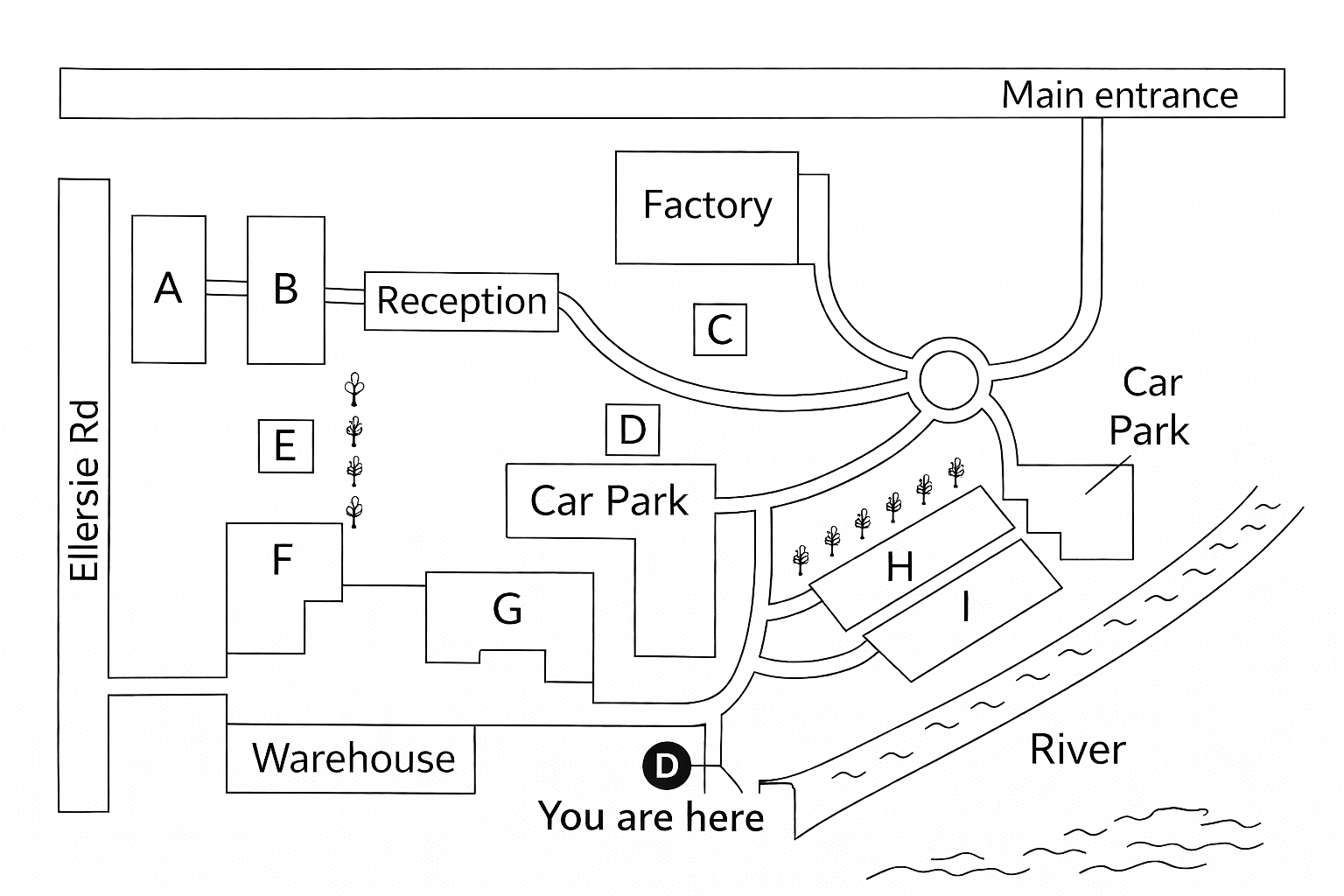
Willford Living Museum 15. Conference Centre 16. New Office Space 17. Stores 18. Finance 19. Café 20. IT Department
Recreated diagram for questions 15, 16, 17, 18, 19, 20
  1. 15

    Conference Centre

  2. 16

    New Office Space

  3. 17

    Stores

  4. 18

    Finance

  5. 19

    Café

  6. 20

    IT Department

Section 3

Choose the correct letter, A, B or C.

  1. 21

    Why did buildings made of plastic fail to please the public in the 1960s?

    • A. People didn't think they were good for the environment.
    • B. People didn't want to live in them.
    • C. People didn't find them visually appealing.
  2. 22

    In the 1960s and 1970s, engineers were unable to overcome the problem of

    • A. damage caused in the production process.
    • B. the effects of light and water.
    • C. the potential danger of wind.
  3. 23

    Luke and Millie agree to try to get more information about present-day plastics from

    • A. journals.
    • B. a PhD student.
    • C. websites.
  4. 24

    What do Luke and Millie agree about the article by Peterson?

    • A. It provided useful examples.
    • B. It was easy to understand.
    • C. It was a good introduction to the topic.

Section 3

What description applies to each of the following structures? Choose SIX answers from the box and write the correct letter, A-G, next to questions 25-30.

Descriptions A. easy to transport B. not much room inside C. made from recycled materials D. designed to promote technology E. never actually built F. easy to keep clean G. very strong construction Structures 25. the 'house of the future' (1957) 26. the 'wonderhouse' (1964) 27. spaceship houses (1968-78) 28. foam houses (1979-83) 29. plastic exhibition hall 30. New Zealand house
  1. 25

    the 'house of the future' (1957)

  2. 26

    the 'wonderhouse' (1964)

  3. 27

    spaceship houses (1968-78)

  4. 28

    foam houses (1979-83)

  5. 29

    plastic exhibition hall

  6. 30

    New Zealand house

Section 4

Complete the notes below. Write ONE WORD ONLY for each answer.

Plastics exhibition History • first plastic developed to replace ivory in sports equipment • semi-synthetics, e.g. commercial celluloid used 31 _________ • experiments making plastics from 32 _________ products were unsuccessful • earliest fabric to be produced was artificial 33 _________ • first plastic produced in a 34 _________ • invented by a 35 _________ called Hendrik Baekeland • unusual because it becomes 36 _________ when heated Exhibition Problems with display: • older plastic objects may release acidic 37 _________ • plastic objects degrade in 38 _________ Popular exhibits: • chandelier made using recycled 39 _________ • 40 a________ made in Japan from semi-synthetic materials based on substances found in plantations
  1. 31

    semi-synthetics, e.g. commercial celluloid used 31 _________

  2. 32

    experiments making plastics from 32 _________ products were unsuccessful

  3. 33

    earliest fabric to be produced was artificial 33 _________

  4. 34

    first plastic produced in a 34 _________

  5. 35

    invented by a 35 _________ called Hendrik Baekeland

  6. 36

    unusual because it becomes 36 _________ when heated

  7. 37

    older plastic objects may release acidic 37 _________

  8. 38

    plastic objects degrade in 38 _________

  9. 39

    chandelier made using recycled 39 _________

  10. 40

    40 a________ made in Japan from semi-synthetic materials based on substances found in plantations

برگه پاسخ

در حین حل کردن پر کنید — بررسی پاسخ‌ها فوری و فقط روی همین دستگاه انجام می‌شود و هر اشتباه در لیست اشتباهات شما با درس مربوطه ذخیره می‌شود.

  1. 1.
  2. 2.
  3. 3.
  4. 4.
  5. 5.
  6. 6.
  7. 7.
  8. 8.
  9. 9.
  10. 10.
  11. 11.
  12. 12.
  13. 13.
  14. 14.
  15. 15.
  16. 16.
  17. 17.
  18. 18.
  19. 19.
  20. 20.
  21. 21.
  22. 22.
  23. 23.
  24. 24.
  25. 25.
  26. 26.
  27. 27.
  28. 28.
  29. 29.
  30. 30.
  31. 31.
  32. 32.
  33. 33.
  34. 34.
  35. 35.
  36. 36.
  37. 37.
  38. 38.
  39. 39.
  40. 40.
روی همین دستگاه ذخیره می‌شود — نیازی به حساب کاربری نیست. اگر می‌خواهید پیشرفتتان را در دستگاه‌های دیگر داشته باشید، وارد صفحه پیشرفت خود شوید.
نمایش متن صوتی
==================== IELTS Listening Transcript ==================== PART 1 Speaker 0: Part one. Speaker 0: You will hear a telephone conversation between a woman and a park ranger. Speaker 0: First, you have some time to look at questions one to five. Speaker 0: Listen carefully and answer questions one to five. Speaker 1: Almond Valley Poppy Reserve. May I help you? Speaker 2: Is the nature reserve open now? Speaker 1: Yes. We are actually open all year, although this is the best time of year to see the wildflowers. Speaker 2: Are the poppies blooming yet? Speaker 1: Absolutely. They started to bloom last week and are already beautiful, but they should peak and be in full bloom at the end of the month. Speaker 2: Oh, I was planning on coming at the end of this week. Is that too early? Speaker 1: No. Not at all. The hills are already covered with orange poppies. Speaker 2: I thought poppies were red. Speaker 1: Not in California. I've never seen a red poppy here. Speaker 2: The Poppy Reserve is in Ocean County. Right? Speaker 1: Right. From Lakeside, you'll need to drive about an hour east. Speaker 2: What time does the reserve open? Speaker 1: The reserve is open from sunrise to sunset. It's best to come early in the morning to beat the crowds, but for the best photography, you might want to consider a mid-afternoon visit on a weekday. Speaker 2: I heard that there are a lot of rattlesnakes in the desert. Is it dangerous to walk about? Speaker 1: Most wildlife is quite safe. There are very few people bitten by rattlesnakes, so we do recommend wearing trousers just to be on the safe side. Speaker 2: Alright. I was hoping that I might have the chance to see some wildlife too. Oh, how much is the admission to the reserve? Speaker 1: It's $5. Speaker 2: Can I use my National Park Pass to enter the reserve? Speaker 1: Unfortunately not, since it is a state park, not a national park. Speaker 2: Alright. I heard from a friend that there is a nature tour available. Can you tell me about it? Speaker 1: Certainly. But can you excuse me just a sec? I'll be right back. Speaker 2: Okay. Speaker 0: Before you hear the rest of the conversation, you have some time to look at questions six to ten. Speaker 0: Now listen and answer questions six to ten. Speaker 1: Hello? Speaker 2: Yes. I'm still here. Speaker 1: Now, you are interested in the nature tours. Right? Speaker 2: Oh, there's more than one? Speaker 1: Yes. We have the general tour, which is the one your friend may have taken, but we also have two more specialized tours. Starting at 7:30 AM is our general tour. That's early for some people, I know. It's offered every hour too. But it's a great time, and it only lasts thirty minutes. Speaker 2: Is that the tour that takes you to the Vista Points? Speaker 1: Yes. That is one of the highlights, along with a film introducing the park and the museum. You're welcome to tour the museum at your leisure. It's a great tour for those who just want to take panoramic pictures with automatic cameras. Speaker 2: Well, if I come all that way, I'd like to have a more detailed tour. Speaker 1: Then you are in luck, because we have a wonderful wildflower tour every two hours from 8 AM. It lasts one hour, and the volunteer will give you information about many of the flowers on the reserve. Speaker 2: Besides the poppies, will cream cups be in bloom? Speaker 1: Yes. And you will see lots of sage too. We have a volunteer who is really good at giving tips on close-up photography. Speaker 2: You mentioned another tour. Speaker 1: Yes. The last one is the wildlife tour, but it is offered at very limited times. Speaker 2: Is that because most of the wildlife is nocturnal? Speaker 1: Yes. So we offer this tour only two times: 5:30 AM or 7 PM. Speaker 2: Wow. That early? But don't the snakes and lizards like the sun? Speaker 1: Right. First, let me say it takes about an hour and a half, but you will have the opportunity to see other animals like coyotes, quail, and roadrunners. You have to get here before the crowds arrive or after most of them leave. Speaker 2: Well, that makes sense. Does it require a lot of walking? Speaker 1: More like a lot of standing. But most of the time, you will be at one or two locations, so we recommend bringing a tripod and zoom lens if you want to take pictures. Speaker 2: Well, thank you very much. You've been extremely helpful and informative. Speaker 1: You're welcome. Glad I could be of service. Goodbye. Speaker 2: Goodbye. PART 2 Speaker 3: You will hear the manager of a factory talking to office staff about renovation work at the factory complex. Speaker 3: First, you have some time to look at questions 11 to 14. Speaker 3: Now listen carefully and answer questions 11 to 14. Speaker 4: Good afternoon. First of all, I want to say thank you for your patience for the last six months. As you know, all the office staff had to move to temporary offices while the renovation work at the factory complex was taking place. But finally, that work is finished, and everyone can return to the factory complex and their new office space. We're hoping everything will go smoothly, but there are a couple of things we'll need you to do during your first week back. You'll be pleased to know that your files and folders have been placed at your desk, so there's no need for you to go hunting around for any records. A couple of people have asked whether their old pass will still work at the security gate, or will they need to get their photo done and update their personal details. I can assure you that the old pass will still get you through the gate, no problem. Once you've had a chance to settle into the new offices, please take the time to view a training video for the operating system we're now using. We think it's going to manage all our programmes far more efficiently. Obviously, the sooner you can get this done, the better. Also, for next week, because the renovations have meant a complete redesign of some of the company's buildings, you'll need to attend a session on things like what to do if you hear the fire alarm go off, and where to meet if you have to evacuate the buildings. We'll let you know as soon as we have a definite time for that. It's going to be a busy week for everyone, but hopefully the kind of challenge that can help bring the team together. We'll make a time for you to report back to me on Friday. Alright. We've also taken some steps to improve the physical environment in your offices. Bigger windows mean that the offices are a lot brighter, and that's better for your eyes. We've also invested in some adjustable chairs. You can lower or raise them to whatever height feels right for you. What else? We've now got some quality insulation in the ceilings and walls that'll make everything a lot warmer. Also, another thing, we've set aside several rooms for project work. That will allow a team to get together around the same table. We feel that more opportunities for face-to-face discussion will benefit the whole company. So when you have had time... Speaker 3: Before you hear the rest of the talk, you have some time to look at questions 15 to 20. Speaker 3: Now listen and answer questions 15 to 20. Speaker 4: Okay. So let's look at a plan of the factory complex and see how it's changed. You can see that the main entrance is at the top of the map. Ellersley Road is on the left-hand side, and the warehouse is at the bottom. Okay. Let's start with one of the new buildings. The conference centre perhaps. If you look at the lower half of your plan, on the right, there are two long buildings that are parallel to each other. The conference centre is the one with a view of the river. Hopefully, that's something visitors to the factory complex will appreciate, especially on a sunny day when it's clear outside. Now, what about the new office space? As you know, the offices used to be in that large building right alongside Ellersley Road, and that could get a bit noisy at times. So what we've done is move the office space further away from the road, into the building that directly joins on to reception. This should mean employees can benefit from a quieter working environment, as well as the other improvements I mentioned earlier. We also decided to move the stores building, so it could be a lot closer to the warehouse. So now, if you were going to enter the factory complex from the Ellersley Road entrance, stores would be the building immediately on your left. The warehouse staff have already commented that having the stores here is much more convenient. Yes, I'm sure it's going to save a lot of time. Finance was another building that had to be relocated. They just didn't have enough space before. So you can see the main entrance on the plan, right? And below that is the roundabout. Then there's the road that goes from the roundabout directly to reception. Well, the finance building is about halfway along that road. On the plan, the factory is just above it. The cafe, just so you know, is in the same place as before. It's not ideally located for the factory workers, that's true, but it's not too far if you're heading down from reception or up from the warehouse. But what we've done is try to make the environment a bit more pleasant. So whereas before you looked straight from the cafe onto the large car park, now there's a line of trees separating them. I think you'll agree that this was a good decision. Putting in the trees, I mean. It was also necessary to relocate the IT department. Of course, for some of their work, they can do it remotely. But from time to time, the IT people do need to visit the different buildings around the factory complex. For that reason, we've given the IT department a more central location. It's that square building you see right in the centre of the plan, one of the closest buildings to the larger car park. Something I'd like to say about the car park actually. Speaker 3: That is the end of part two. You now have half a minute to check your answers. PART 3 Speaker 5: Part three. Speaker 5: You will hear two architecture students called Luke and Millie discussing their assignment about the use of plastic as a building material. Speaker 5: First, you have some time to look at questions 21 to 24. Speaker 5: Now listen carefully and answer questions 21 to 24. Speaker 7: Hi, Millie. Speaker 6: Hi, Luke. Speaker 7: So we're here to talk over our first assignment on alternative building materials. Speaker 6: Yeah. I think it will be really interesting to learn more about how plastic has been used. I found lots of information from the 1960s. Speaker 7: So did you find out why the idea of plastic buildings wasn't popular with the public at that time? Speaker 6: It wasn't the materials' environmental credentials. Speaker 7: The concept of plastic houses was just too futuristic. Speaker 6: So you mean it was their appearance? Speaker 7: No. People liked their modern design, but the idea of that sort of building as a home just didn't appeal. Speaker 6: Right. I did some research on the kind of problems engineers had with the old plastics in the 1960s and 1970s. Speaker 7: What did you learn? Speaker 6: Well, firstly, because plastic doesn't weigh very much, the buildings weren't very good in windy weather. They managed to fix that by amending the shape of the buildings, but the real disadvantage was that when the plastic was exposed to the light, it developed fine cracks, and when rain got into these cracks, the plastic would deform and lose its strength. Speaker 7: Right. I wonder where we can find some more information about the situation nowadays. Speaker 6: Maybe we could ask one of the PhD students. Speaker 7: I expect they'll be too busy. Speaker 6: Yeah, that's true. Speaker 7: Well, we could always use the Internet. Speaker 6: Maybe we should research more academic sources like the journals we have in the library. Speaker 7: Okay. That way we can reference everything properly at the end of the assignment. Have you read Peterson's article about plastic houses? Speaker 6: Yeah. It was really good. Speaker 7: But it didn't have enough illustrations of the houses. That was a shame. They'd have been useful for us as examples in our presentation. I like the way it was organized, though. That was really clear. Speaker 6: Yeah. And it wasn't too technical, but you did need to know a bit about plastic houses before you read it to get the most out of it. Speaker 7: That's true. Speaker 5: Before you hear the rest of the discussion, you have some time to look at questions 25 to 30. Speaker 5: Now listen and answer questions 25 to 30. Speaker 7: Okay. Well, shall we start comparing our findings then? Speaker 6: Sure. I'll make some notes. Speaker 7: Well, the earliest one I read about was a plastic house called the House Of The Future that was built in 1957, though no one actually lived in it. It was on show at a theme park in America for ten years. After that, they demolished it. But they had a hard time. It was really built to last. They couldn't break the plastic up. Speaker 6: Was that the one that had an ultrasonic dishwashing machine? Speaker 7: Yes. That would still be pretty revolutionary today. Speaker 6: Did you read about the Wonder House? It was designed in 1964 by an industrial designer called Alfred Noyes. Speaker 7: Oh, the one with the roof like a sort of tent or an umbrella. Speaker 6: That's right. The roof was made of fibreglass, and it curved down to the ground at each corner, enclosing a big central space. Then the sides were filled with glass or plastic. It was a really innovative idea for the time, but Noyes only made a small model, and the design wasn't implemented. Speaker 7: Pity. Speaker 6: What about those spaceship houses they built between 1968 and 1978? Like flying saucers. Speaker 7: They built over 100 of them. I don't know if I'd want to live in one. The living area was quite limited, and they had really low ceilings. But they do look really futuristic, don't they? Speaker 6: With their white walls and circular shape, yes. But the plastic houses I like are the foam houses they built between 1979 and 1983. They've got really curvy shapes. They built them by spraying foam over a great big balloon. Speaker 7: They were partly built to show what computers could do in the home, things like controlling heat and lights and so on. Quite new ideas at the time. And they were very well insulated as well, so they saved energy. Speaker 6: People were just beginning to get into that. I read about a plastic exhibition hall that can all be packed away in a relatively small container. You just put it on a truck and take it to wherever you want it, then inflate it. You know, fill it up with air, and there's room for hundreds of people. And when the exhibition or whatever's over, you just take it down again, and you can reuse it again and again. And there's a house in New Zealand that's built from household and industrial waste, like plastic boxes. Speaker 7: They say it's a much better construction material than bricks from the point of view of insulation. Speaker 6: Yes. They're using that idea to build houses in other parts of the world too. Speaker 7: Okay. Well, it looks as if we've got plenty of stuff. Speaker 5: That is the end of part three. You now have thirty seconds to check your answers to part three. PART 4 Speaker 8: Good morning. My name's Susan Mossman, and as well as being a part-time lecturer on the university's Museum Science degree, I'm also curator of a new exhibition opening at the Bidmouth Museum called Plasticity. This traces the history of plastics and ways they are being developed and used today. The first type of plastic was originally developed in response to a call from the makers of sports equipment. Animal-derived materials were becoming extremely expensive, so manufacturers launched a competition to find an alternative to ivory for making pool and billiard balls. Although various forms of plastic were developed, none of them were good enough to win the competition. But the inventors knew they were on to a good thing, and started researching a variety of different substances, partly based on organic material, what we call semisynthetics. One of the early semisynthetic materials produced was the first commercially produced celluloid, or plastic film, which was made by dissolving cotton in a strong acid, such as nitric acid. Unfortunately, this had a tendency to explode, so technicians had to be very careful with it. They also experimented with making plastics out of products derived from milk, but this didn't really work, and efforts were therefore concentrated on other organic material. One of the first uses of plastic was in the production of artificial fabric, and the earliest successful one was a substitute for silk. This was obviously a very expensive fibre, so artificial alternatives were thought to be worth investing in. The next significant breakthrough came in 1907 with the invention of Bakelite. This was the first entirely synthetic plastic made in a laboratory. It was invented by Hendrik Beikeland, a chemist who had made a fortune from producing paper used in photographic processes. Bakelite is a pretty unusual type of plastic because it actually gets hard when it's heated, whereas most other plastic becomes more malleable when hot. That is, they become more plastic, which is of course where the name for the category of materials comes from. So strictly speaking, Bakelite isn't a plastic at all. But now let's look at the exhibition itself. In it we show a variety of semisynthetic and totally synthetic plastics, some of them dating back 100 years. Some of the older plastics on display are unstable. This means that when they are in the process of degrading, they may produce gases which are acidic, and which can cause neighbouring objects in the display to disintegrate. We had to be very careful with these displays because there is one thing which causes plastic objects to degrade or break down, and that is light. So we've had to think of ways to get around this problem when setting up the objects on display. We have about 850 objects in the exhibition. One of our most interesting is a magnificent chandelier, a lamp designed to hang in the centre of the ceiling of a big hall. It's only when you look carefully that you can see this is a wonderful example of recycling. It's made entirely of pens, ones which we use and throw away every day. A second exhibit which is drawing a lot of attention is a car made entirely from plastic, which is now in small-scale production in Japan.
نمایش پاسخ‌نامه

پاسخ‌نامه

  1. 1. month

    The answer is 'month' because the speaker says the poppies 'should peak and be in full bloom at the end of the month.'

  2. 2. orange

    The answer is 'orange' because the speaker says 'the hills are already covered with orange poppies.'

  3. 3. east

    The answer is 'east' because the speaker says, 'From Lakeside, you'll need to drive about an hour east.'

  4. 4. mid-afternoon

    The answer is 'mid-afternoon' because the speaker says, 'for the best photography, you might want to consider a mid-afternoon visit on a weekday.'

  5. 5. trousers

    The answer is 'trousers' because the speaker recommends 'wearing trousers just to be on the safe side' because of rattlesnakes.

  6. 6. general

    The answer is 'general' because the general tour is described as the one that lasts 1.5 hours and includes a viewpoint.

  7. 7. Vista Points

    The answer is 'center' because the general tour takes you to the Vista Points, which are highlights, and includes a film introducing the park and the museum (center).

  8. 8. 1 hour

    The answer is '1 hour' because the wildflower tour 'lasts one hour.'

  9. 9. 5:30

    The answer is '5:30' because the wildlife tour is offered 'only two times: 5:30 AM or 7 PM.'

  10. 10. zoom

    The answer is 'zoom' because the speaker says, 'we recommend bringing a tripod and zoom lens if you want to take pictures.'

  11. 11. A

    The answer is A (find out about safety procedures) because employees 'need to attend a session on things like what to do if you hear the fire alarm go off, and where to meet if you have to evacuate the buildings.'

  12. 12. E

    The answer is E (learn about new company technology) because employees are told to 'view a training video for the operating system we're now using.'

  13. 13. A

    The answer is A (provided comfortable seating) because the company 'invested in some adjustable chairs. You can lower or raise them to whatever height feels right for you.'

  14. 14. C

    The answer is C (used attractive materials) because the company 'now got some quality insulation in the ceilings and walls that'll make everything a lot warmer.' The most tempting wrong option is B (installed a new heating system), but the passage only mentions insulation, not a new heating system.

  15. 15. I

    The answer is 'I' because the conference centre is described as 'the one with a view of the river' in the lower right of the plan.

  16. 16. B

    The answer is 'B' because the new office space is 'in the building that directly joins on to reception,' which matches B on the plan.

  17. 17. F

    The answer is 'F' because the stores building is now 'immediately on your left' when entering from Ellersley Road, which is F on the plan.

  18. 18. C

    The answer is 'C' because the finance building is 'about halfway along that road' from the roundabout to reception, which is C on the plan.

  19. 19. E

    The answer is 'E' because the café is 'in the same place as before,' and E matches its location on the plan.

  20. 20. D

    The answer is 'D' because the IT department is 'that square building you see right in the centre of the plan,' which is D.

  21. 21. B

    The answer is B (People didn't want to live in them) because the speaker says, 'the idea of that sort of building as a home just didn't appeal.' Option C is tempting, but the passage says people liked the modern design.

  22. 22. B

    The answer is B (the effects of light and water) because the speaker says, 'when the plastic was exposed to the light, it developed fine cracks, and when rain got into these cracks, the plastic would deform and lose its strength.'

  23. 23. A

    The answer is A (journals) because Millie says, 'Maybe we should research more academic sources like the journals we have in the library,' and Luke agrees.

  24. 24. B

    The answer is B (It was easy to understand) because Millie says the article 'wasn't too technical,' but you needed some background knowledge. Option A is wrong because Luke says it 'didn't have enough illustrations.'

  25. 25. G

    The answer is 'G' because the 'House Of The Future' was built in 1957 and was on show at a theme park in America for ten years.

  26. 26. E

    The answer is 'E' because the 'Wonder House' was designed in 1964 by Alfred Noyes and had a roof like a tent or umbrella.

  27. 27. B

    The answer is 'B' because the spaceship houses were built between 1968 and 1978 and looked like flying saucers.

  28. 28. D

    The answer is 'D' because the foam houses were built between 1979 and 1983 and had curvy shapes made by spraying foam over a balloon.

  29. 29. A

    The answer is 'A' because the plastic exhibition hall can be packed away, transported, and inflated for use.

  30. 30. C

    The answer is 'C' because the New Zealand house is built from household and industrial waste, like plastic boxes.

  31. 31. cotton

    The answer is 'cotton' because celluloid was made by 'dissolving cotton in a strong acid.'

  32. 32. milk

    The answer is 'milk' because 'they also experimented with making plastics out of products derived from milk, but this didn't really work.'

  33. 33. silk

    The answer is 'silk' because 'the earliest successful one was a substitute for silk.'

  34. 34. laboratory

    The answer is 'laboratory' because Bakelite was 'the first entirely synthetic plastic made in a laboratory.'

  35. 35. chemist

    The answer is 'chemist' because Bakelite 'was invented by Hendrik Beikeland, a chemist.'

  36. 36. hard

    The answer is 'hard' because Bakelite 'actually gets hard when it's heated.'

  37. 37. gases

    The answer is 'gases' because 'when they are in the process of degrading, they may produce gases which are acidic.'

  38. 38. light

    The answer is 'light' because 'there is one thing which causes plastic objects to degrade or break down, and that is light.'

  39. 39. pens

    The answer is 'pens' because the chandelier is 'made entirely of pens, ones which we use and throw away every day.'

  40. 40. car

    The answer is 'car' because 'a car made entirely from plastic, which is now in small-scale production in Japan.'

Listening 2026-05 Test 8 — IELTS Listening Actual Test with Answers | IELTS Actual Tests