Listening 2026-04 Test 5

ماه آزمون: 2026-04

بازسازی‌شده از خاطرات داوطلبان — محتوای رسمی IELTS نیست. فایل صوتی و متون برای تمرین بازسازی شده‌اند.

فایل صوتی بازسازی‌شده

Section 1: Renfrew Activity Centre

Complete the table below. Write NO MORE THAN TWO WORDS for each answer.

Renfrew Activity Centre Activity Basic skill Location learned Price per person Price includes Example Rock climbing £60 (for a group using the 1Centre grounds ............... of twelve) 2 ............... Mountain biking doing 3 ............ in the mountains checks services of a 4£70 ............... Wild camping in the 5 ............... finding out about plants Accommodation £50 in tents in the National Hill walking Park 6 ............ skills 7£90 ...............
  1. 1

    Rock climbing £60 (for a group using the 1Centre grounds ............... of twelve)

  2. 2

    Rock climbing £60 (for a group using the 1Centre grounds ............... of twelve) 2 ...............

  3. 3

    Mountain biking doing 3 ............ in the mountains checks services of a 4£70 ...............

  4. 4

    Mountain biking doing 3 ............ in the mountains checks services of a 4£70 ...............

  5. 5

    Wild camping in the 5 ............... finding out about plants Accommodation £50 in tents

  6. 6

    in the National Hill walking Park 6 ............ skills 7£90 ...............

  7. 7

    in the National Hill walking Park 6 ............ skills 7£90 ...............

Section 1: Group Booking Notes

Complete the notes below. Write NO MORE THAN TWO WORDS AND/OR A NUMBER for each answer.

• Deposit for group booking: 8 ......................... of full amount • Must bring suitable 9 ......................... • Name of contact: Gordon 10 .................................
  1. 8

    Deposit for group booking: 8 ......................... of full amount

  2. 9

    Must bring suitable 9 .........................

  3. 10

    Name of contact: Gordon 10 .................................

Section 2: Museum Collections

What does the speaker say about each of the following collections? Choose SIX answers from the box and write the correct letter, A-G, next to Questions 11-16.

Comments A. was given by one person B. was recently publicised in the media C. includes some items given by members of the public D. includes some items given by the artists E. includes the most popular exhibits in the museum F. is the largest of its kind in the country G. has had some of its contents relocated Collections 11. 20th- and 21st-century paintings 12. 19th-century paintings 13. Sculptures 14. 'Around the world' exhibition 15. Coins 16. Porcelain and glass
  1. 11

    20th- and 21st-century paintings

    • A. was given by one person
    • B. was recently publicised in the media
    • C. includes some items given by members of the public
    • D. includes some items given by the artists
    • E. includes the most popular exhibits in the museum
    • F. is the largest of its kind in the country
    • G. has had some of its contents relocated
  2. 12

    19th-century paintings

    • A. was given by one person
    • B. was recently publicised in the media
    • C. includes some items given by members of the public
    • D. includes some items given by the artists
    • E. includes the most popular exhibits in the museum
    • F. is the largest of its kind in the country
    • G. has had some of its contents relocated
  3. 13

    Sculptures

    • A. was given by one person
    • B. was recently publicised in the media
    • C. includes some items given by members of the public
    • D. includes some items given by the artists
    • E. includes the most popular exhibits in the museum
    • F. is the largest of its kind in the country
    • G. has had some of its contents relocated
  4. 14

    'Around the world' exhibition

    • A. was given by one person
    • B. was recently publicised in the media
    • C. includes some items given by members of the public
    • D. includes some items given by the artists
    • E. includes the most popular exhibits in the museum
    • F. is the largest of its kind in the country
    • G. has had some of its contents relocated
  5. 15

    Coins

    • A. was given by one person
    • B. was recently publicised in the media
    • C. includes some items given by members of the public
    • D. includes some items given by the artists
    • E. includes the most popular exhibits in the museum
    • F. is the largest of its kind in the country
    • G. has had some of its contents relocated
  6. 16

    Porcelain and glass

    • A. was given by one person
    • B. was recently publicised in the media
    • C. includes some items given by members of the public
    • D. includes some items given by the artists
    • E. includes the most popular exhibits in the museum
    • F. is the largest of its kind in the country
    • G. has had some of its contents relocated

Section 2: Basement of Museum Plan

Label the plan below. Write the correct letter, A-H, next to Questions 17-20.
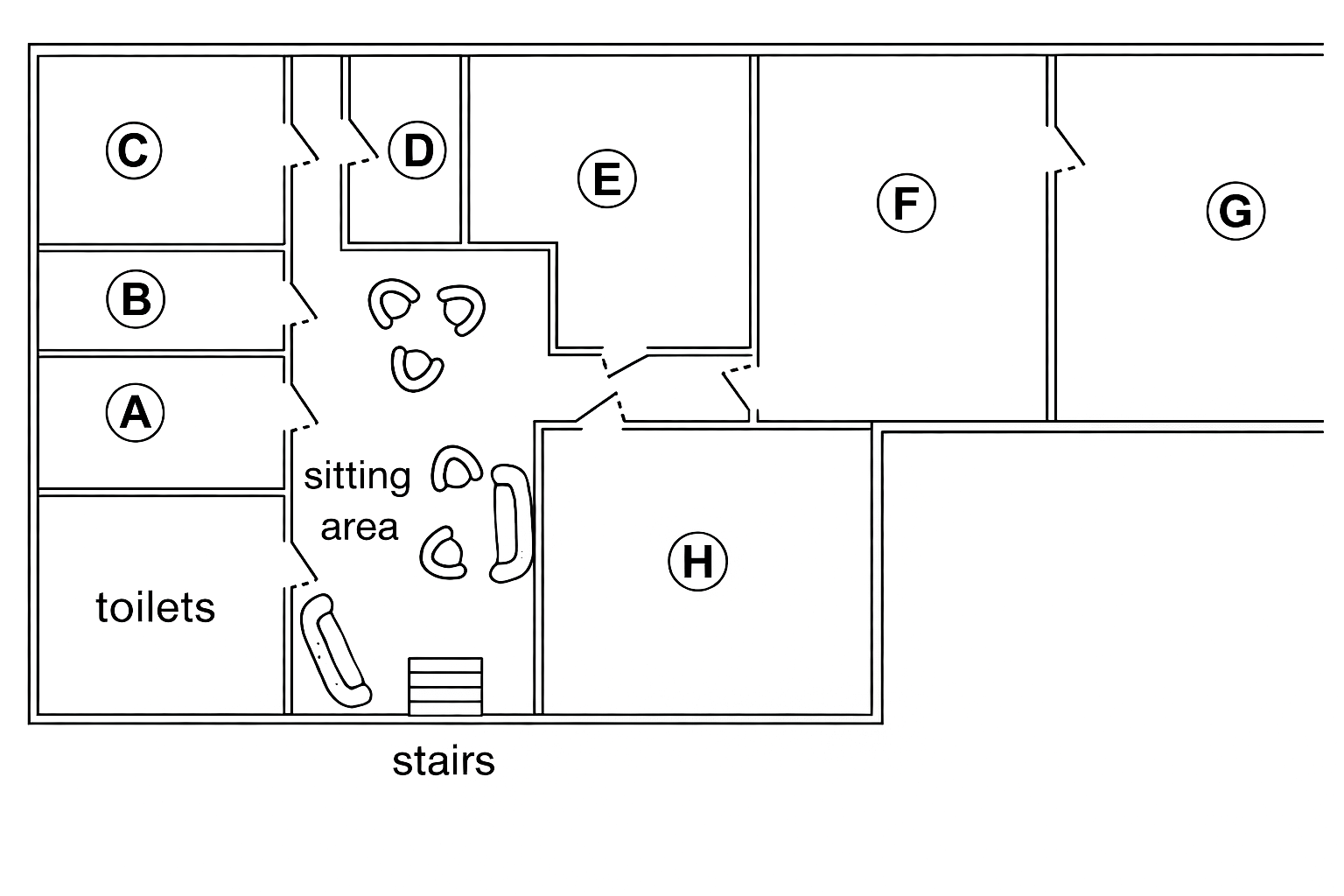
Basement of museum 17. restaurant 18. café 19. baby-changing facilities 20. cloakroom
Recreated diagram for questions 17, 18, 19, 20
  1. 17

    restaurant

  2. 18

    café

  3. 19

    baby-changing facilities

  4. 20

    cloakroom

Section 3: Pacific Tapa Cloth

Choose the correct letter, A, B or C.

  1. 21

    Pacific tapa cloth is different from other types of tapa cloth because it is

    • A. the only tapa made today
    • B. better quality than others
    • C. put to a wider range of uses
  2. 22

    What does Helen say about the paper mulberry tree?

    • A. It is also a source of food
    • B. It is not native to the Pacific
    • C. It can grow in any environment
  3. 23

    Why did the Maori people of New Zealand stop making tapa?

    • A. They could not find the right trees in New Zealand
    • B. They were introduced to other fabrics by the Europeans
    • C. They found a better material for making fabric
  4. 24

    Large pieces of tapa are made from smaller pieces which are

    • A. stuck together
    • B. woven together
    • C. sewn together

Section 3: Tapa Cloth Functions by Country

According to the speakers, what function has tapa cloth played in the following countries? Write the correct letter, A, B, C or D, next to questions 25 - 30.

Functions A. recreational B. practical C. spiritual D. commercial Countries 25. Samoa 26. Tonga 27. Cook Islands 28. Fiji 29. Tahiti 30. Tikopia
  1. 25

    Samoa

    • A. recreational
    • B. practical
    • C. spiritual
    • D. commercial
  2. 26

    Tonga

    • A. recreational
    • B. practical
    • C. spiritual
    • D. commercial
  3. 27

    Cook Islands

    • A. recreational
    • B. practical
    • C. spiritual
    • D. commercial
  4. 28

    Fiji

    • A. recreational
    • B. practical
    • C. spiritual
    • D. commercial
  5. 29

    Tahiti

    • A. recreational
    • B. practical
    • C. spiritual
    • D. commercial
  6. 30

    Tikopia

    • A. recreational
    • B. practical
    • C. spiritual
    • D. commercial

Section 4: Plant Behavior

Complete the notes below. Write ONE WORD ONLY for each answer.

Plant Behavior Changing ideas Scientists once thought of plants as being 31. _______ organisms Now there is evidence that this is not true Recent studies Great Lakes Sea rocket Found on 32. _______ When near other plants, it normally produces extra 33. _______ to compete for nutrients. However, it behaves differently if it is related to the other plants Sagebrush and Thom apple Recognize surrounding plants by the type of34. _______ that they reflect Identification is possible because all plants have a particular 35. _______ Dodder plant Is unable to produce 36. _______ Needs to feed off another plant to survive Affects farmers' crops e.g. alfalfa, 37. _______ and citrus Identifies suitable 'hosts' by detecting the 38. _______ they give off Moves in a 39. _______ most suitable host to check the environment, then grows towards the most suitable host Plant science Use of modern 40. _______ provides evidence of plant behavior
  1. 31

    Scientists once thought of plants as being 31. _______ organisms

  2. 32

    Great Lakes Sea rocket Found on 32. _______

  3. 33

    When near other plants, it normally produces extra 33. _______ to compete for nutrients.

  4. 34

    Sagebrush and Thom apple Recognize surrounding plants by the type of34. _______ that they reflect

  5. 35

    Identification is possible because all plants have a particular 35. _______

  6. 36

    Dodder plant Is unable to produce 36. _______

  7. 37

    Affects farmers' crops e.g. alfalfa, 37. _______ and citrus

  8. 38

    Identifies suitable 'hosts' by detecting the 38. _______ they give off

  9. 39

    Moves in a 39. _______ most suitable host to check the environment, then grows towards the most suitable host

  10. 40

    Use of modern 40. _______ provides evidence of plant behavior

نمایش متن صوتی
==================== IELTS Listening Transcript ==================== PART 1 Speaker 0: You will hear a number of different recordings, and you will have to answer questions on what you hear. There will be time for you to read the instructions and questions, and you will have a chance to check your work. All the recordings will be played once only. The test is in four sections. Write all your answers in the listening question booklet. At the end of the test, you will be given ten minutes to transfer your answers to an answer sheet. Now turn to section one on page two of your question booklet. Section one. You will hear a woman phoning an activity center for information about weekend courses. First, you have some time to look at questions one to four on page two. You will see that there is an example that has been done for you. On this occasion only, the conversation relating to this will be played first. Speaker 1: Good morning. Renfrew Activity Center. How can I help you? Hello. Speaker 2: I'm calling about your activity weekends. Some colleagues and I would like to learn some new skills. We're fed up with the boring things like playing tennis or going to the gym. We thought something like rock climbing might be quite fun. Speaker 1: That's one of the activities you do, don't you? That's right. The rock climbing takes place here in the center grounds. Speaker 0: The woman is interested in going rock climbing, so rock climbing has been written in the space. Now we shall begin. You should answer the questions as you listen because you will not hear the recording a second time. Listen carefully and answer questions one to four. Speaker 1: Good morning. Renfrew Activity Center. How can I help you? Hello. Speaker 2: I'm calling about your activity weekends. Some colleagues and I would like to learn some new skills. We're fed up with the boring things like playing tennis or going to the gym. We thought something like rock climbing might be quite fun. Speaker 1: That's one of the activities you do, don't you? That's right. The rock climbing takes place here in the center grounds. Speaker 2: Fine. From your website, I see that the main technique I would learn would be rope work. What is that exactly? Speaker 1: Well, you need to know how to use ropes if you're going to climb. So we spend the first morning learning about that, and then we practice on the indoor climb. On the second day, we take you on two supervised climbs outside. Speaker 2: And what's the cost of the weekend? Speaker 1: Well, it depends how many of you there are. Up to nine people is £65 per person. Speaker 2: There'll be about 12 of us. Right. That's £60 each. That's very reasonable. Does that include our accommodation and food? Speaker 1: No. But it does include the equipment. Speaker 2: Right. Now I was wondering about the mountain biking weekends. Speaker 1: Oh, yes. They're very popular. Do you have to be an experienced rider? Not at all. We do take you out in the mountains, but our routes are relatively easy. Speaker 2: The website said that we learn to do safety checks on our bikes. Yes. You learn all about that. That'll be very useful. And how much is that? Speaker 1: It's £70 Speaker 3: and includes all the help you need from our guide. He knows all the best places. Speaker 0: Before you hear the rest of the conversation, you have some time to look at questions five to 10 on pages two and three. Now listen and answer questions five to 10. Speaker 2: Some of my colleagues might prefer something a little less energetic, maybe camping or walking. There was something on the website called wild camping. It's in the forest, the website said. That's right. I read a bit about it in the paper last week. They said that the forest has the most amazing plants. Do we get a chance to learn something about that? Yes. You do. And the cost? £50. Speaker 1: That includes your tented accommodation. Speaker 2: Right. I've got that. I think the other activity which we may be interested in is the hill walking one. That's in the national park, isn't it? Yes. It's very popular, Speaker 1: and it gives people a chance to get to know each other. And so you won't get lost when you go walking on your own, we teach you some navigation skills. Speaker 2: And the cost of that? Speaker 1: £90. Speaker 2: Does that include accommodation? Speaker 1: It doesn't, but there are some very inexpensive B and Bs nearby. Or you can stay at the local youth hostel, but lunch is included. Speaker 2: Thanks. Oh, and just a couple of other things. Yes? Will you need a deposit with the booking? Yes. Speaker 1: When you book, we usually ask for a deposit of £25 per person. But if you're booking for a group, then it'll be 20% of the total cost. Speaker 2: Okay. And is there any equipment we must bring with us, or is it all provided? Speaker 1: The most important thing is to have the right shoes, so you'll need to bring those. Other things like maps and wet weather gear can be borrowed from here. Speaker 2: Right. That's good to know. I'll get back to my colleagues and call you when we've decided what to do. Or you could book it online. Speaker 1: But don't hesitate to call me if you still have questions. My name's Gordon, Gordon Arkwright. That's A R K W R I G H T. Speaker 2: Thanks for your help. Speaker 0: That is the end of section one. You now have half a minute to check your answers. PART 2 Speaker 3: Section two. You will hear a guide at an art museum talking to a group of visitors. First, you have some time to look at questions 11 to 16. Now listen carefully and answer questions 11 to 16. Speaker 4: Good morning and welcome to the museum, one with a remarkable range of exhibits which I'm sure you'll enjoy. My name's Greg, and I'll tell you about the various collections as we go around. But before we go, let me just give you a taste of what we have here. Well, for one thing, we have a fine collection of twentieth and twenty first century paintings, many by very well known artists. I'm sure you'll recognize several of the paintings. This is the gallery that attracts the largest number of visitors, so it's best to go in early in the day before the crowds arrive. Then there are the nineteenth century paintings. The museum was opened in the middle of that century, and several of the artists each donated one work to get the museum started as it were. So they're of special interest to us. We feel closer to them than to other works. The Sculpture Gallery has a number of fine exhibits, but I'm afraid it's currently closed for refurbishment. You'll need to come back next year to see it properly, but a number of the sculptures have been moved to other parts of the museum. Around the World is a temporary exhibition. You've probably seen something about it on TV or in the newspapers. It's created a great deal of interest because it presents objects from every continent and many countries, and provides information about their social context, why they were made, who for, and so on. Then there's the collection of coins. This is what you might call a focused specialist collection because all the coins come from this country and were produced between 2000 and a thousand years ago, and many of them were discovered by ordinary people digging their gardens and donated to the museum. All our porcelain and glass was left to the museum by its founder when he died in 1878, and in the terms of his will, we're not allowed to add anything to that collection. He believed it was perfect in itself, and we don't see any reason to disagree. Speaker 3: Before you hear the rest of the talk, you have some time to look at questions 17 to 20. Now listen and answer questions 17 to 20. Speaker 4: Okay. That was something about the collections, and now here's some more practical information in case you need it. Most of the museum facilities are downstairs in the basement, so you go down the stairs here. When you reach the bottom of the stairs, you'll find yourself in a sitting area with comfortable chairs and sofas where you can have a rest before continuing your exploration of the museum. We have a very good restaurant which serves excellent food all day in a relaxing atmosphere. To reach it, when you get to the bottom of the stairs, go straight ahead to the far side of the sitting area, then turn right into the corridor. You'll see the door of the restaurant facing you. If you just want a snack or if you'd like to eat somewhere with facilities for children, we also have a cafe. When you reach the bottom of the stairs, you'll need to go straight ahead, turn right into the corridor, and the cafe is immediately on the right. And talking about children, there are baby changing facilities downstairs. Cross the sitting area, continue straight ahead along the corridor on the left, and you and your baby will find the facilities on the left hand side. The cloakroom, where you should leave coats, umbrellas and any large bags, is on the left hand side of the sitting area. It's through the last door before you come to the corridor. There are toilets on every floor, but in the basement they're the first rooms on the left when you get down there. Okay. Now if you've got anything to leave in the cloakroom, please do that now and then we'll start our tour. Speaker 3: That is the end of section two. You now have half a minute to check your answers. PART 3 Speaker 5: Now Speaker 0: Now turn to section three on page five. Section three. You will hear a discussion between a student called Helen and her tutor about an assignment that Helen is working on. First, you have some time to look at questions 21 to 24 on page five. Now listen carefully and answer questions 21 to 24. Speaker 6: Come in, Helen. How can I help you? Speaker 7: Well, I'm doing research for the anthropology assignment, and I was hoping to check a few details. Speaker 6: Sure. You chose the topic of Pacific Island Tapa Cloth, didn't you? What have you found out so far? Speaker 7: Well, I was going to introduce my assignment by saying that the tapa cloth is a fabric made from bark, just the outer layer of the trees. It's particularly common in the Pacific Islands, but not exclusive to them. In fact, many other peoples around the world have made high quality cloth from bark. But what sets Pacific tapa apart is the incredible variety of roles it's played in this region. Yes. Speaker 6: Nice introduction, though I think you could be more specific regarding dates. Okay. So what about the raw materials used? Speaker 7: Well, tapa cloth is made from several species of tree. In the Pacific, the paper mulberry tree is most common, but it doesn't thrive in all conditions. In fact, it wasn't originally found in the islands, but was carried in their canoes by the first migrants. Tapa is also made from the breadfruit tree, which is convenient because its fruit is a staple food. The paper mulberry tree is only grown for tapa making, though. Yes. Speaker 6: That's good. Now what about the Maori people here in New Zealand? But the Maori don't make tapa now. That's right, and you need to account for it. We know that when Maori migrated here from the other Pacific Islands, they were prepared to make tapa because they brought the paper mulberry tree with them. The thing was, after they'd been in New Zealand a bit, they found the flax plant, which is superior to tapa because it makes a stronger fabric. By the time Europeans arrived in the eighteenth century, Maori were making all their fabric from flax and had been for some time. Okay. Speaker 7: So with the production process itself, first that the inner bark is beaten with wooden hammers to soften the fibres. Then the different pieces are glued together using an adhesive paste made from the arrowroot tuber. This is the only way to fabricate large pieces of cloth because bark strands are too fine to be woven together and stitching isn't strong enough. Speaker 0: Before you hear the rest of the discussion, you have some time to look at questions 25 to 30 on page six. Now listen and answer questions 25 to 30. Speaker 6: So now you need details about different countries. Speaker 7: Where would you start? Speaker 6: I think Samoa is the obvious place. It's famous for its very fine cloth called siapo, which is hand painted with representations of the ancestors. Still today, at the most profound events in life such as births, funerals, weddings, and the investiture of chiefs, Samoans wear siapo robes to add significance and meaning to the ceremony. Speaker 7: Okay. Then I could talk about Tonga. It seems to me that the great innovation in Tonga has been developing a simple, coarse cloth, which is quick and easy to make. This is suitable for all sorts of everyday functions around the house, like bed covers, mosquito nets, and curtains. Speaker 6: Good point. Now what about Cook Islands, tapa? Speaker 7: Well, the soil there is poor quality, so the breadfruit tree is often used. One type of thick cloth called tikoru was wrapped around the poles and used to mark the entrances to places of worship, so it was highly regarded in local culture. Speaker 6: You might mention Fiji as well, which is interesting because tapa was actually used as a currency there. Fijians used to sail between the islands and exchange tapa for other commodities like canoes or pigs. Speaker 7: I know that in Tahiti the tapa cloth is different because the patterns are in colour, which is considered more valuable than the usual brown patterns? Speaker 6: You're right about the Tahitians using coloured pigments, but they aren't more valuable. The colours are only a decoration. People enjoy wearing bright robes, especially for dancing and competitive games, Speaker 7: and do it just for fun. Oh, I'll make a note of it. Well, the last place I was going to mention was Tikopia. Even today, it's commonplace to see people wearing clothes made of tapa cloth. In many of the other islands, the tapa only comes out on special occasions. But here, you see people working in the gardens wearing tapa. Speaker 6: Sounds promising, Helen. I'll look forward to reading your assignment. Speaker 0: That is the end of section three. You now have half a minute to check your answers. PART 4 Speaker 0: Part four. You will hear a lecturer talking to a group of biology students about recent plant studies. First, you have some time to look at questions 31 to 40. Now listen carefully and answer questions 31 to 40. Speaker 5: Good morning, everyone. In the last few weeks, we looked at ways in which different types of animals use their senses. And today, I'm going to introduce the topic of plant behavior, and we'll look at the reasons why ideas about plants have been changing in the last few years. So up until fairly recently, plants' lack of eyes or ears or noses or mouths made them less interesting to many members of the public compared to animal species. And even by scientists, they were generally regarded as organisms which were essentially passive. However, in the last twenty years or so, evidence has started to emerge that plants can sense their surroundings in quite sophisticated ways. But because scientific attitudes towards plants and their capabilities had been fixed for such a long time, this evidence has been met with some disbelief. So let's look at some of these recent findings that are starting to change the way some scientists view plant life. It all began with a Canadian study that looked at a species of plant known as the Great Lakes Sea Rocket. This is a wild plant which grows on beaches. In appearance, it's perfectly ordinary, with little purple flowers and a long stalk. But actually, the plant is far from ordinary. Normally, when the sea rocket detects other plants growing nearby, it quickly grows additional roots. This is so it can compete with these other plants for the available nutrients in the soil, by soaking up as many of them as possible. But scientists found that the sea rocket doesn't do that when the surrounding plants are related to it. And as even animals sometimes find this type of recognition difficult, such a finding was very unexpected. It was an ability that was previously unheard of in any other plant. Since then, it's been suggested that two other plants may have a similar ability. These are sagebrush and thorn apple. It's been claimed that these plants can recognize the characteristics of their neighbors by sensing properties of the light that is reflected from them. The reason they are able to do this is that all plant species are slightly different to each other in this respect. So each plant species has what you could call its own signature. Sagebrush and thorn apple are able to recognize these. But scientists point out that this behavior is very different to the way that animals sense things. Another type of plant which can sense things in its surroundings is the dodder plant. This plant is different to most other species because it doesn't have the ability to make sugar by converting nutrients from the soil. This means that as soon as the dodder has sprouted from a seed, it needs to find another plant in order to survive. In other words, it's a parasite. Dodders infest a variety of food crops around the world as they wrap themselves like string around their target plants, and the effect can be devastating for farmers. It's particularly damaging to alfalfa, as well as to potatoes and different varieties of citrus. At first, scientists were puzzled as to how the dodder knows which plants to prey on. But now they've found that the plant can identify a suitable host by sensing the chemicals that other plants release into the soil and air. What really surprised researchers was how extremely quickly and accurately the dodder identifies a possible host. They used time lapse videos to study the mechanism and saw from these that when the dodder is trying to check out its environment, it rotates in a circle, and then, without touching any other plants, it heads directly towards its selected host. It could sense reliably which type of plant it would grow best on. Scientists who were working on the project reported that the dodder sprout resembled a worm as it moved towards the other plant. Well, those are some examples of the new discoveries about plant characteristics. So which direction is plant science likely to go in next? Many of the phenomena related to plant behavior that I've just described are now quite easy to observe, using up to date equipment. So gradually, scientists are accepting the fact that plants are more capable than we used to believe. But although such plant behavior is often obvious to some scientists Speaker 0: That is the end of part four. You now have one minute to check your answers to part four. ==================== Chinese Translation ==================== 第一部分 Speaker 0: 你将听到几段不同的录音,并需要根据听到的内容回答问题。你会有时间阅读说明和问题,并且有机会检查你的答案。所有录音只播放一次。考试分为四个部分。请将所有答案写在听力问题册中。考试结束时,你将有十分钟时间将答案誊写到答题纸上。现在翻到问题册第二页的第一部分。第一部分。你将听到一位女士打电话给一个活动中心,咨询周末课程的信息。首先,你有时间看一下第二页的第一到第四题。你会看到一个已经为你完成的示例。仅此一次,相关的对话会先播放。 Speaker 1: 早上好。伦弗鲁活动中心。有什么可以帮您的吗?您好。 Speaker 2: 我打电话来是想咨询你们的周末活动。我和一些同事想学一些新技能。我们厌倦了打网球或去健身房这类无聊的事情。我们觉得像攀岩这样的活动可能挺有趣的。 Speaker 1: 这是你们的活动之一,对吧?没错。攀岩就在我们中心场地内进行。 Speaker 0: 这位女士对攀岩感兴趣,所以空格里填入了“攀岩”。现在我们要开始了。你应该边听边回答问题,因为你不会再次听到录音。请仔细听,并回答第一到第四题。 Speaker 1: 早上好。伦弗鲁活动中心。有什么可以帮您的吗?您好。 Speaker 2: 我打电话来是想咨询你们的周末活动。我和一些同事想学一些新技能。我们厌倦了打网球或去健身房这类无聊的事情。我们觉得像攀岩这样的活动可能挺有趣的。 Speaker 1: 这是你们的活动之一,对吧?没错。攀岩就在我们中心场地内进行。 Speaker 2: 好的。从你们的网站上,我看到我要学的主要技巧是绳索操作。那具体是什么? Speaker 1: 嗯,如果你想攀岩,你需要知道如何使用绳索。所以我们第一天上午会学习这个,然后在室内攀岩墙上练习。第二天,我们会带你在户外进行两次有指导的攀爬。 Speaker 2: 这个周末的费用是多少? Speaker 1: 这取决于你们有多少人。九人以下是每人65英镑。 Speaker 2: 我们大概有12个人。好的。那就是每人60英镑。非常合理。这个费用包括住宿和食物吗? Speaker 1: 不包括。但包括装备。 Speaker 2: 好的。我还想问一下山地自行车周末活动。 Speaker 1: 哦,是的。那个很受欢迎。需要有骑行经验吗?完全不需要。我们会带你们去山里,但路线相对容易。 Speaker 2: 网站上提到我们会学习对自行车进行安全检查。是的。你们会学到所有这些。那会很有用。那个多少钱? Speaker 1: 70英镑, Speaker 3: 并且包括我们向导提供的所有帮助。他知道所有最好的地方。 Speaker 0: 在你听到对话的其余部分之前,你有时间看一下第二页和第三页的第五到第十题。现在请听并回答第五到第十题。 Speaker 2: 我的一些同事可能更喜欢不那么剧烈的活动,比如露营或徒步。网站上有一个叫“野外露营”的活动。网站上说是在森林里。没错。我上周在报纸上读到过一些。他们说那片森林有最神奇的植物。我们有机会了解一些吗?是的,可以。费用呢?50英镑。 Speaker 1: 这包括帐篷住宿。 Speaker 2: 好的。我记下了。我想我们可能感兴趣的另一个活动是山地徒步。那是在国家公园里,对吧?是的,非常受欢迎, Speaker 1: 而且它给了人们一个相互了解的机会。为了确保你们自己徒步时不会迷路,我们会教你们一些导航技巧。 Speaker 2: 那个费用呢? Speaker 1: 90英镑。 Speaker 2: 包括住宿吗? Speaker 1: 不包括,但附近有一些非常便宜的民宿。或者你们可以住在当地的青年旅舍,但午餐是包含在内的。 Speaker 2: 谢谢。哦,还有几件事。请说?预订时需要付押金吗?是的。 Speaker 1: 预订时,我们通常要求每人支付25英镑的押金。但如果是团体预订,那就是总费用的20%。 Speaker 2: 好的。我们需要自带装备吗,还是全部提供? Speaker 1: 最重要的是要有合适的鞋子,所以你们需要自带。其他东西,比如地图和防雨装备,可以从这里借用。 Speaker 2: 好的。很高兴知道这些。我会回去和同事们商量,等我们决定好做什么再给你打电话。或者你也可以在线预订。 Speaker 1: 但如果还有问题,请随时给我打电话。我叫戈登,戈登·阿克莱特。拼写是 A-R-K-W-R-I-G-H-T。 Speaker 2: 谢谢你的帮助。 Speaker 0: 第一部分到此结束。你现在有半分钟时间检查答案。 第二部分 Speaker 3: 第二部分。你将听到一位导游在艺术博物馆向一群游客介绍。首先,你有时间看一下第11到16题。现在请仔细听,并回答第11到16题。 Speaker 4: 早上好,欢迎来到博物馆,这里展品种类繁多,相信你们会喜欢。我叫格雷格,我会在参观过程中向大家介绍各个收藏。但在开始之前,我先简单介绍一下这里有什么。首先,我们有一个精美的20世纪和21世纪绘画收藏,许多出自非常著名的艺术家之手。我相信你们会认出其中一些画作。这个画廊吸引的游客最多,所以最好在一天中早些时候、人群到来之前进去。然后是19世纪的绘画。博物馆是在19世纪中期开放的,当时几位艺术家各自捐赠了一件作品,可以说是为了启动博物馆。所以它们对我们有特殊的意义。我们感觉与它们比其他作品更亲近。雕塑馆有一些精美的展品,但恐怕目前正在翻修关闭中。你们需要明年再来才能好好参观,不过一些雕塑已经被移到了博物馆的其他地方。“环游世界”是一个临时展览。你们可能在电视或报纸上看到过相关报道。它引起了极大的兴趣,因为它展出了来自各大洲和许多国家的物品,并提供了关于它们的社会背景、制作目的、为谁制作等信息。然后是硬币收藏。这可以说是专题收藏,因为所有硬币都来自本国,铸造于2000年前到1000年前之间,其中许多是由普通人在自家花园挖掘时发现并捐赠给博物馆的。我们所有的瓷器和玻璃制品都是博物馆创始人于1878年去世时遗赠给博物馆的,根据他的遗嘱条款,我们不得向该收藏添加任何物品。他认为它本身已经完美,我们也没有理由不同意。 Speaker 3: 在你听到谈话的其余部分之前,你有时间看一下第17到20题。现在请听并回答第17到20题。 Speaker 4: 好了。刚才介绍了收藏品,现在再讲一些你可能需要的实用信息。博物馆的大部分设施都在楼下地下室,所以请从这里下楼。当你走到楼梯底部时,你会发现自己身处一个休息区,那里有舒适的椅子和沙发,你可以在继续探索博物馆之前休息一下。我们有一个非常好的餐厅,全天在轻松的氛围中提供美味的食物。要去那里,当你走到楼梯底部时,径直走到休息区的远端,然后右转进入走廊。你会看到餐厅的门正对着你。如果你只想吃点小吃,或者想在适合儿童的场所用餐,我们还有一个咖啡馆。当你走到楼梯底部时,你需要径直往前走,右转进入走廊,咖啡馆就在你的右手边。说到儿童,楼下有婴儿换尿布设施。穿过休息区,沿着左边的走廊继续直走,你和你的宝宝会在左手边找到这些设施。衣帽间,你应该把外套、雨伞和大包留在那里,位于休息区的左侧。它就在你进入走廊之前的最后一个门。每层楼都有卫生间,但在底层,当你下去时,它们是左手边的第一个房间。好了。如果你们有东西要存放在衣帽间,请现在去办,然后我们将开始参观。 Speaker 3: 第二部分到此结束。你现在有半分钟时间检查答案。 第三部分 Speaker 5: 现在 Speaker 0: 现在翻到第五页的第三部分。第三部分。你将听到学生海伦和她的导师之间的讨论,内容是关于海伦正在做的一项作业。首先,你有时间看一下第五页的第21到24题。现在请仔细听,并回答第21到24题。 Speaker 6: 请进,海伦。有什么可以帮你的吗? Speaker 7: 嗯,我正在为人类学作业做研究,想确认一些细节。 Speaker 6: 当然。你选择了太平洋岛屿树皮布这个主题,对吧?你目前发现了什么? Speaker 7: 嗯,我打算这样开始我的作业:树皮布是一种用树皮制成的织物,只用树木的外层。它在太平洋岛屿特别常见,但并非该地区独有。事实上,世界上许多其他民族也用树皮制作过高质量的布料。但太平洋树皮布的独特之处在于它在该地区扮演了极其多样的角色。是的。 Speaker 6: 不错的引言,不过我认为你可以在日期方面更具体一些。好的。那么使用的原材料呢? Speaker 7: 嗯,树皮布由几种树木制成。在太平洋地区,构树最为常见,但它并非在所有条件下都能茁壮成长。事实上,它最初并非原产于这些岛屿,而是由第一批移民用独木舟带来的。树皮布也可以用面包树制作,这很方便,因为它的果实是主食。不过,构树只用于制作树皮布。是的。 Speaker 6: 很好。那么新西兰这里的毛利人呢?但毛利人现在不制作树皮布了。没错,你需要解释这一点。我们知道,当毛利人从其他太平洋岛屿迁移到这里时,他们是有意制作树皮布的,因为他们带来了构树。问题是,他们在新西兰待了一段时间后,发现了亚麻植物,它比树皮布更优越,因为它能制成更结实的织物。到18世纪欧洲人到来时,毛利人已经全部用亚麻制作织物,并且已经持续了一段时间。好的。 Speaker 7: 至于生产过程本身,首先,内层树皮用木槌敲打以软化纤维。然后,不同的碎片用一种由竹芋块茎制成的粘合糊粘合在一起。这是制作大块布料的唯一方法,因为树皮纤维太细,无法编织在一起,而缝合又不够牢固。 Speaker 0: 在你听到讨论的其余部分之前,你有时间看一下第六页的第25到30题。现在请听并回答第25到30题。 Speaker 6: 那么现在你需要不同国家的细节。 Speaker 7: 从哪里开始呢? Speaker 6: 我认为萨摩亚是显而易见的选择。它以非常精细的布料“siapo”而闻名,这种布料上手工绘制着祖先的形象。即使在今天,在生命中最重大的事件中,如出生、葬礼、婚礼和酋长就职仪式,萨摩亚人都会穿着siapo长袍,以增加仪式的庄重感和意义。 Speaker 7: 好的。那么我可以谈谈汤加。在我看来,汤加的重大创新是开发了一种简单粗糙的布料,制作起来又快又容易。这适用于各种日常家居功能,如床罩、蚊帐和窗帘。 Speaker 6: 好观点。那么库克群岛的树皮布呢? Speaker 7: 嗯,那里的土壤质量差,所以经常使用面包树。一种叫做“tikoru”的厚布料被缠绕在柱子上,用来标记礼拜场所的入口,因此在当地文化中备受推崇。 Speaker 6: 你也可以提一下斐济,这很有趣,因为树皮布在那里实际上被用作货币。斐济人过去常常在岛屿间航行,用树皮布交换其他商品,如独木舟或猪。 Speaker 7: 我知道在塔希提岛,树皮布不同,因为图案是彩色的,这被认为比通常的棕色图案更有价值? Speaker 6: 你说得对,塔希提人使用彩色颜料,但它们并非更有价值。颜色只是一种装饰。人们喜欢穿鲜艳的长袍,尤其是在跳舞和竞技比赛时, Speaker 7: 只是为了好玩。哦,我会记下来的。嗯,我要提到的最后一个地方是蒂科皮亚。即使在今天,看到人们穿着树皮布做的衣服也很常见。在许多其他岛屿,树皮布只在特殊场合才拿出来。但在这里,你会看到人们在花园里干活时也穿着树皮布。 Speaker 6: 听起来不错,海伦。我期待阅读你的作业。 Speaker 0: 第三部分到此结束。你现在有半分钟时间检查答案。 第四部分 Speaker 0: 第四部分。你将听到一位讲师向一群生物系学生讲述最近的植物研究。首先,你有时间看一下第31到40题。现在请仔细听,并回答第31到40题。 Speaker 5: 大家早上好。在过去的几周里,我们研究了不同类型动物如何使用它们的感官。今天,我将介绍植物行为这个主题,并探讨为什么关于植物的观念在过去几年中发生了变化。直到最近,与动物物种相比,植物没有眼睛、耳朵、鼻子或嘴巴,这使得它们对许多公众来说不那么有趣。甚至科学家也普遍认为它们本质上是被动的有机体。然而,在过去二十年左右的时间里,有证据开始表明,植物能够以相当复杂的方式感知周围环境。但由于科学界对植物及其能力的看法已经固定了很长时间,这些证据遭到了一些怀疑。那么,让我们来看看这些最近的研究发现,它们正开始改变一些科学家看待植物生命的方式。这一切始于一项加拿大研究,该研究关注一种被称为“大湖海火箭”的植物。这是一种生长在海滩上的野生植物。从外观上看,它非常普通,开着紫色的小花,有一个长长的茎。但实际上,这种植物远非普通。通常,当海火箭检测到附近有其他植物生长时,它会迅速长出额外的根。这是为了通过尽可能多地吸收土壤中的可用养分,来与其他植物竞争。但科学家发现,当周围的植物与它有关联时,海火箭不会这样做。由于即使是动物有时也觉得这种识别很困难,这样的发现非常出人意料。这是一种以前在任何其他植物中都闻所未闻的能力。此后,有迹象表明另外两种植物可能具有类似的能力。它们是蒿子和曼陀罗。据称,这些植物可以通过感知从邻居身上反射的光的特性来识别邻居的特征。它们之所以能够做到这一点,是因为所有植物物种在这方面都略有不同。因此,每个植物物种都有所谓的自己的“签名”。蒿子和曼陀罗能够识别这些。但科学家指出,这种行为与动物感知事物的方式非常不同。另一种能够感知周围事物的植物是菟丝子。这种植物与大多数其他物种不同,因为它没有通过转化土壤养分来制造糖分的能力。这意味着菟丝子一旦从种子中发芽,就需要找到另一种植物才能生存。换句话说,它是一种寄生植物。菟丝子在世界各地侵染各种粮食作物,它们像绳子一样缠绕在目标植物上,对农民的影响可能是毁灭性的。它对苜蓿、马铃薯以及不同品种的柑橘类植物尤其有害。起初,科学家们对菟丝子如何知道要捕食哪些植物感到困惑。但现在他们发现,这种植物可以通过感知其他植物释放到土壤和空气中的化学物质来识别合适的宿主。真正让研究人员惊讶的是菟丝子识别潜在宿主的速度之快和准确性之高。他们使用延时摄影来研究其机制,并从中看到,当菟丝子试图探查环境时,它会旋转一圈,然后,在不接触任何其他植物的情况下,径直朝它选定的宿主前进。它能可靠地感知哪种植物最适合它生长。从事该项目的科学家报告说,菟丝子幼苗在向另一株植物移动时,看起来像一条蠕虫。好了,这些就是关于植物特性的新发现的一些例子。那么,植物科学接下来可能会朝哪个方向发展呢?我刚才描述的许多与植物行为相关的现象,现在使用最新设备已经很容易观察到。因此,科学家们逐渐接受了这样一个事实:植物比我们过去认为的更有能力。尽管这种植物行为对某些科学家来说常常是显而易见的, Speaker 0: 第四部分到此结束。你现在有一分钟时间检查第四部分的答案。
نمایش پاسخ‌نامه

پاسخ‌نامه

  1. 1. Ropes

    The main technique taught for rock climbing is 'rope work', as the speaker says, 'the main technique I would learn would be rope work.'

  2. 2. equipment

    The cost includes the equipment, as the speaker says, 'it does include the equipment.'

  3. 3. safety

    Participants learn to do 'safety checks' on their bikes, as the speaker confirms, 'you learn to do safety checks on our bikes.'

  4. 4. guide

    The £70 fee includes help from a 'guide', as the speaker says, 'includes all the help you need from our guide.'

  5. 5. forest

    Wild camping takes place 'in the forest', as the woman says, 'It's in the forest, the website said.'

  6. 6. navigation

    Hill walking includes learning 'navigation' skills, as the speaker says, 'we teach you some navigation skills.'

  7. 7. lunch

    Lunch is included in the hill walking activity, as the speaker says, 'but lunch is included.'

  8. 8. 20 percent

    The deposit for group booking is '20 percent' of the full amount, as the speaker says, 'for a group, then it'll be 20% of the total cost.'

  9. 9. shoes

    You must bring suitable 'shoes', as the speaker says, 'The most important thing is to have the right shoes, so you'll need to bring those.'

  10. 10. Arkwright

    The contact name is 'Arkwright', as the speaker spells out, 'My name's Gordon, Gordon Arkwright. That's A R K W R I G H T.'

  11. 11. E

    The 20th- and 21st-century paintings 'include the most popular exhibits', as the speaker says, 'This is the gallery that attracts the largest number of visitors.' Option D is tempting but fails because it refers to the 19th-century paintings.

  12. 12. D

    The 19th-century paintings 'include some items given by the artists', as the speaker says, 'several of the artists each donated one work to get the museum started.'

  13. 13. G

    Some sculptures have 'had some of its contents relocated', as the speaker says, 'a number of the sculptures have been moved to other parts of the museum.'

  14. 14. B

    The 'Around the World' exhibition 'was recently publicised in the media', as the speaker says, 'You've probably seen something about it on TV or in the newspapers.'

  15. 15. C

    The coin collection 'includes some items given by members of the public', as the speaker says, 'many of them were discovered by ordinary people... and donated to the museum.'

  16. 16. A

    The porcelain and glass collection 'was given by one person', as the speaker says, 'was left to the museum by its founder when he died in 1878.'

  17. 17. F

    The restaurant is reached by going straight ahead, then right into the corridor, and it's facing you, matching option F.

  18. 18. H

    The café is immediately on the right after turning into the corridor, matching option H.

  19. 19. C

    The baby-changing facilities are along the corridor on the left, and on the left-hand side, matching option C.

  20. 20. B

    The cloakroom is on the left side of the sitting area, through the last door before the corridor, matching option B.

  21. 21. C

    Pacific tapa cloth is different because of 'the incredible variety of roles it's played in this region', so it is put to a wider range of uses.

  22. 22. B

    Helen says the paper mulberry tree 'wasn't originally found in the islands, but was carried in their canoes by the first migrants', so it is not native to the Pacific.

  23. 23. C

    The Maori stopped making tapa because they found flax, 'which is superior to tapa because it makes a stronger fabric', so they found a better material.

  24. 24. A

    Large pieces of tapa are 'glued together using an adhesive paste', so they are stuck together.

  25. 25. C

    In Samoa, siapo robes are worn at 'the most profound events in life such as births, funerals, weddings, and the investiture of chiefs', showing a spiritual use.

  26. 26. B

    In Tonga, tapa is 'suitable for all sorts of everyday functions around the house', so it is practical.

  27. 27. C

    In the Cook Islands, thick cloth was 'used to mark the entrances to places of worship', showing a spiritual use.

  28. 28. D

    In Fiji, tapa was 'used as a currency', so it had a commercial use.

  29. 29. A

    In Tahiti, people enjoy wearing bright robes 'especially for dancing and competitive games, and do it just for fun', so it is recreational.

  30. 30. B

    In Tikopia, 'it's commonplace to see people wearing clothes made of tapa cloth', even when working, so it is practical.

  31. 31. passive

    Scientists once thought of plants as 'essentially passive' organisms.

  32. 32. beaches

    The Great Lakes Sea rocket is 'a wild plant which grows on beaches.'

  33. 33. roots

    When near other plants, it 'quickly grows additional roots' to compete for nutrients.

  34. 34. light

    Sagebrush and thorn apple recognize surrounding plants by 'sensing properties of the light that is reflected from them.'

  35. 35. signature

    Each plant species has 'its own signature' in the way it reflects light.

  36. 36. sugar

    The dodder plant 'doesn't have the ability to make sugar by converting nutrients from the soil.'

  37. 37. potatoes

    Dodder is particularly damaging to 'alfalfa, as well as to potatoes and different varieties of citrus.'

  38. 38. chemicals

    Dodder identifies suitable hosts by 'sensing the chemicals that other plants release into the soil and air.'

  39. 39. circle

    Dodder rotates in a 'circle' to check the environment before growing towards the host.

  40. 40. equipment

    Use of modern 'equipment' provides evidence of plant behavior, as the lecturer says, 'using up to date equipment.'

Listening 2026-04 Test 5 — IELTS Listening Actual Test with Answers | IELTS Actual Tests